The Case For Modesty In Afghanistan, Ctd

Andrew Exum calls Joshua Foust's criticism of the Afghanistan Study Group report "the most clinical and devastating take-down of a policy paper I have ever read." Josh:

[T]he best way to ensure Afghanistan does not fall into chaos is to leave the country as stable as possible. Reducing it to a Special Forces and Drone targetting range, which the group recommends, is just as unsustainable in the long run as the current counterinsurgency effort. Maintaining an active drone program to preemptively bomb any new al Qaeda camps that might spring up will be difficult if not impossible without a massive human intelligence network to support it—and that HUMINT network cannot be maintained without a significant U.S. military and intelligence presence in the country (which is difficult to do if 80% of the force is withdrawn over the next 18 months, as ASG suggest).

D’Souza’s Duct Tape

As noted earlier, Newt Gingrich is touting Dinesh D’Souza's latest nonsense. Weigel retorts:

D'Souza uses a lot of duct tape to put this together — his argument that one quote from the NASA administrator means that Obama has invented a "curious mandate to convert a space agency into a Muslim and international outreach (sic)," for example. It's the kind of analysis that puts greater import on quotes from speeches and interviews then from the theory and research that inform the thousands of staffers who actually import policy, which is fun, but a little wispy. It's not — not — a wink at any conspiracy theories. But it is a knowing attempt by Gingrich to shift the Overton Window and make sure a heretofore crazy-sounding idea — that the president's view of the world comes from 1960s anti-colonialism and Marxism — gets discussed by serious people. And it will!

The Year 1919 Or 1920

Nine years after 9/11, George Packer looks at the path we've taken since:

Crazy, murderous violence hasn’t spread across the land. But unreason, cheered on by cable news, has won the day. We have undeniably gone sour on interfaith tolerance. We have turned inward in sullen exhaustion. The staggering chain of consequences and characters that followed 9/11—Kabul, Tora Bora, Daniel Pearl, John Yoo, Bagram, Guantánamo, Baghdad, Sergio Vieira de Mello, Madrid, Falluja, Abu Ghraib, Nick Berg, London, Zarqawi, military commissions, Samarra, eavesdropping, Sean Hannity, the Taliban’s return, Benazir Bhutto, Mumbai, Hakimullah Mehsud—seems like a fever dream of can-you-top-this atrocities from which we can’t wake up. The bill is finally coming due at home. It turned out that the Bush rhetoric of religious understanding and freedom was a lot less potent and durable than the Bush policies.

Our Wilsonian phase just took too much effort, required too much suspension of deeper, stronger feelings. And we are out of it now. In Wilsonian terms, we are around the year 1919 or 1920. The noble mission to make the world safe for democracy ended inconclusively, and its aftermath has curdled into an atmosphere more like that of the Palmer raids and the second coming of the Klan. This is why Obama seems less and less able to speak to and for our times. He’s the voice of reason incarnate, and maybe he’s too sane to be heard in either Jalalabad or Georgia. An epigraph for our times appears in Jonathan Franzen’s new novel “Freedom”: “The personality susceptible to the dream of limitless freedom is a personality also prone, should the dream ever sour, to misanthropy and rage.”

Freeing You From The Burden Of Pressing Enter

Alexis Madigral weighs the pros and cons of Google Instant, which displays search results as you type. Here are "two pretty glaring downsides":

First, it is a visually intense experience, possibly even an overwhelming one. Tech journalist John Pavlus described it as "like having a websearch seizure. [The] screen explodes with noise as you type." Second — and this is more subtle — I worry that Google is driving more traffic to the most statistically probable searches. The most-trafficked ways of searching for something will get more trafficked. I wouldn't be surprised to see the number of unique searches drop because people see something in the list that makes sense, even if it's not exactly how they'd have put it.

The feature is spreading to Twitter, YouTube, and iTunes. Alexis in earlier post addresses Google's "Odd Vision for the Future of Search." Jason Newman "present[s] to you the full power of Google Instant via the most obvious song: Billy Joel's 'We Didn't Start the Fire.'"

Conservative Degeneracy Watch

Yuval Levin is one of the right's brightest intellectual stars. He has written intelligently on many subjects and although I don't know him, he seems the kind of person conservatism will need if it is to recover. So imagine how one feels reading a paragraph like the following:

Democrats, as the president’s chief of staff Rahm Emanuel explained in 2008, have sought to use the ongoing economic crisis to achieve all kinds of unrelated goals: health care policy they have craved for decades, environmental policy that has little to do with the economy, more protections for unions, a greater role for government in the financial and automotive sectors, and on and on.

The health-care plan to provide access to insurance for the tens of millions was a clear part of Obama's election campaign. It eschewed the left's dream – single-payer – and eliminated a public option. It was supported by the drug and insurance companies. It needs constant monitoring and improvement if it is to control costs, but it has set up a market in insurance that could be a model for future conservative innovation. It strongly resembles Mitt Romney's legacy in Massachusetts. None of this was snuck through in the stimulus package described by Rahm Emanuel's infamous aside. It was the result of almost two years of painful attempts at some kind of bipartisan agreement. It reduces the deficit over the long run if the CBO is to be believed – unlike the unpaid for, budget-busting Medicare D that Bush and Cheney foisted on the next generation.

Yuval then writes the befuddling phrase: "environmental policy that has little to do with the economy." In fact, as we know, no gains have been made in curtailing climate change, unless you include some of the green energy components in the stimulus package, and Obama's biggest gesture was to endorse off-shore oil-drilling, to make his environmental policy close to identical to John McCain's. Climate change legislation – cap-and-trade – didn't occur, but even there, that strategy is designed to minimize disruption to markets and came from the right, not the left in the 1980s and 1990s. Again, Yuval makes it seem as if this comes from nowhere, as if the evidence that America is being trounced by China in this vital new industry and if the climate isn't clearly veering toward unpredictable crises were phantasms of the mind.

Then: protection for unions. Again, there is no card-check legislation. It was not a priority. It was not snuck into the stimulus package.

Lastly "a greater role for government in the financial and automotive sectors." What you will notice is that there is no reference in any of this to the appalling economic circumstances Obama inherited which determined both policies. It's like describing FDR's policies as if the Great Depression never happened. What a leap toward Kenyan anti-colonialism that was. Indeed, in the Weekly Standard's headline "madness".  Levin, of course, makes no reference to the deregulated chaos that precipitated the financial meltdown that created the worst recession since the Second World War ( or are Richard Posner and Alan Greenspan Kenyan anti-colonialists now as well?). And what Obama has done to rein in some of the abuses is relatively modest, wrought by such radicals as Tim Geithner and Larry Summers, to the consternation and contempt of the left. As for the auto companies, the emergency aid given has been a gleaming success with Detroit managing to turn things around far more quickly than most imagined. Ditto the banks, where the government may actually be making money off its bailout soon, just as GM is eager to sell off its government-owned stock to the private sector.

I leave behind Obama's refusal to prosecute war criminals, drastic escalation of the war in Afghanistan, continuation of Bush policies in Iraq, or disdain for advancing gay equality. This "madness" is presumably something the Republicans would continue.

All this Yuval knows. He is not a Beck or Palin with no grip on reality at all. And yet this is what the intellectual right at its best is now dedicated to: pure propaganda on the crudest old right-left axis, arguing that a recession caused in part by a Republican administration's neglect and in part by failed Republican policies can be rectified merely by Republican rule.

Again, I thought it would get worse before it got better on the right. But that we have propagandistic, intellectually dishonest dreck like this coming from their brightest stars – and that large swathes of the American public seem to be buying it – brings one close to despair.

The Liberal Psyche

Chait is exasperated with liberals' disappointment over Obama, "a president with the most effective progressive record in more than four decades":

Liberals tend to imagine progress occurring in a blaze of populist glory, but almost inevitably it requires grubby compromises with powerful and unseemly interests. Medicare, Social Security—they were all half-measures that involved a devil’s bargain. In 1949, Arthur Schlesinger identified the “doughface” progressive tendency as a discomfort with the realities and compromises of governing. “Politics becomes, not a means of getting things done,” he wrote, “but an outlet for private grievances and frustrations.”

I don’t think this trait describes all of Obama’s (or Clinton’s) liberal critics, and certainly not [John] Judis. But it does reflect a persistent liberal uneasiness with power.

“Heart Speaks To Heart”

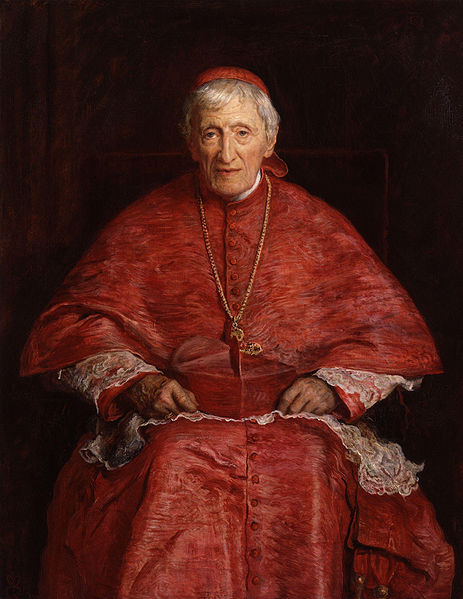
463px-John_Henry_Newman_by_Sir_John_Everett_Millais,_1st_Bt

Eamon Duffy has written a brief, helpful summation of Catholicism in the UK, on the eve of the Pope's visit:

Catholics were for centuries the hated other, against whom a single national identity might be forged for the disparate Protestant peoples of the archipelago: Confound their politics, Frustrate their knavish tricks, as the British national anthem has it (in a verse usually tactfully omitted nowadays).

That demonization was assisted in Victorian England by the flooding of the English, Scottish and Welsh Catholic communities by hordes of Irish immigrants. Catholicism now looked literally as well as notionally “foreign” – dirty, disease-ridden and disloyal, as well as religiously benighted. Time, social mobility and, not least, the atrophying of the Protestant convictions that once fueled anti-Catholicism, have changed all that. Catholics have colonized the establishment…

The English Catholic community has always encompassed a core of ancient families – the “Brideshead” phenomenon. It now includes a newer kind of elite, represented by a millionaire ex-prime minister, and the current director general of the BBC. During the last quarter of the 20th century, the cardinal archbishop of Westminster was an aristocratic ex-public school housemaster, whose brother-in-law was secretary to the cabinet, and whom the queen liked to call “my cardinal”.

Some personal reflections on this. My family was very much part of the Irish influx – immigrants into central London in the 1930s – not the Bridesheadians. My maternal grandmother, for example, was the seventh of thirteen children from Tralee in County Kerry, Ireland. As an immigrant, she worked as a cleaning lady for priests in inner London. Priests remained demi-gods for her entire life. The idea of questioning a scintilla of their pronouncements would have provoked a blur of tut-tut-tuts, with which she regularly interrupted the evening television news (she lived with us for years in her later life). As her children grew up and moved out to the suburbs and little exurbs outside of London (I was raised in a town which was the last on the railway line from the London commute), this distinction remained. But Sussex, my home county, also had a deep Catholic inheritance from the Middle Ages and the recusant aristocratic families combined with the upwardly mobile Irish-English flocks into an awkward but vibrant alliance in the post Vatican II era.

There were tensions. I was embarrassed by my grandmother's loud Irish brogue at mass, her almost primeval piety, the holy water in every room of her old house, the crossing of herself as frequent as her cups of tea, the constant familiar references to Our Lady, as if she were someone who might pop over at any time for a cuppa. But I also, even as a precocious bookish altar boy, came to revere her kind of faith, which was as deep as it was simple. Then there were the upper Catholic classes – a tiny Bridesheadian sliver, as Duffy notes – who were for ever distinguished in my mind by the pronunciation of the word "mass", a word one could hardly avoid. We Irish descendants said mass with a flat "a", much like Americans. The aristocrats said "maass". So there were two "others" – the English Anglicans and the upper-class Catholics. It was only when I studied at Oxford the brutal persecution of my faith in the sixteenth century and its subsequent relentless demonization that I came to see these old recusant Bridesheadians as outsiders as well, in their way, fellows, even, eventually, equals.

My Catholic elementary school set me and my siblings a little apart from the English mainstream – but I never felt oppressed or alienated by it. I was entranced by the church, by its aura of seriousness and beauty, its mystery and beckoning to bigger and deeper things than the shallow and failing materialism of 1970s England. At Oxford, I met the upper class Catholics as real people – the current editor of the Economist, John Micklethwait (an old friend and quite wonderful fellow) was a classic of the genre – and bonded with them. We'd all attend mass together – the Amplefordians and the grammar school oiks – in the bleak modern Newman rooms that for all their austerity, had a kind of beauty to them. It was all very Vatican II. (And in a nice irony, the rooms were also used for plays. In one, I played the gay English Communist spy, Guy Bennett, in the first amateur production of "Another Country." There was something quite thrilling about saying the line "I want to pour honey all over him and lick it off again," only a room or two away from the altar where I attended mass. But the gayness of the Catholic culture at Oxford then was overwhelming – almost as overwhelming, but far more mature and self-aware, than the current Vatican.)

It seems so far away now. I recall the thrill of Pope John Paul II's visit to England, and the enormous historic resonance it had for me, just as I recall the easy anti-Catholic jibes of my Protestant high school. In time I came to reconcile my Englishness with my Catholicism – there was a tranch of Anglo-Saxon agnostics and atheists in my family and my father never practised the faith, so I was a hybrid to begin with. In this reconciliation, Cardinal Newman was very, very important to me as a student – as he was to so many English Catholics. Duffy is really good on him too:

In terms of the inner politics of contemporary Catholicism, Newman himself was a liberal, and his vision of a healthy church was in many respects the antithesis of Pope Benedict’s. Though punctiliously loyal to the papacy, Newman was a vocal opponent of the definition of papal infallibility in 1870, which he thought unnecessary and a burden to consciences. He denounced the “aggressive and insolent faction” of Ultramontanes who centralised Catholicism too much on Rome.

He deplored clericalism, worked to create an educated and active laity, and argued for greater freedom for theology within the church.

“Truth,” he wrote, “is wrought out by many minds, working together freely.” He detested, and himself suffered from, trigger-happy dogmatists who tried to pre-empt intellectual exploration by invoking pat formulae and ecclesiastical denunciations. Structures of authority gave the church strength, he conceded, but did not give it life: “We are not born of bones and muscle.” Truth was objective, but had to be sought out by the heart and conscience as well as by the head, and he took as his motto as a cardinal the phrase of St Francis de Sales, “Heart speaks to heart.”

And then, of course, I had to reconcile my sexual orientation with my faith. Neither was easy. Displacement – constant, gnawing displacement – was, I came to understand, simply a function of being me in my place and time. It was only later that I came to understand, with a mixture of astonishment and sudden obvious recognition, that Newman himself was almost certainly gay himself. As Wiki puts it:

In accordance with his expressed wishes, Newman was buried in the grave of his lifelong friend, Ambrose St. John. Previously, they had shared a house. The pall over the coffin bore his cardinal's motto Cor ad cor loquitur ("Heart speaks to heart"). Inseparable in death as in life, a joint memorial stone was erected for the two men; the inscription bore words Newman had chosen: Ex umbris et imaginibus in veritatem ("Out of shadows and phantasms into the truth")

That Benedict, whose complicity in child-rape is as profound as his anti-intellectual authoritarianism, will beatify this great saint is as painful as it is ironic. Johann Hari urges British Catholics in this vein to protest or boycott the state visit. For me, I would marginally prefer to attend a cocktail party with Roman Polanski than bow down to this pontiff as my grandmother would expect. I certainly would not attend any events associated with his visit. But I would not protest. The church is deeper than its current awful leader and its truth deeper than his neurotic fears and sublimated desires. Newman's slow emergence into sainthood is a great thing, and perhaps one day will lead to a deeper, better Catholicism in the land he loved and the culture he helped elevate.

I wish I could say this did not make me feel deep pain. I wish I could simply feel anger. I wish I could simply leave or stop believing, rather than hang in this well of hurt and alienation and lonely prayer. I long for reconciliation with so much that made me and so much that I love and so much that I believe in and so much that I fought for and defended with Irish tenacity against English condescension. But for this English and now American Catholic, it is currently beyond me to honor this man at this time with this record amid this immense hurt.

And so I will look away. And the pain of a reconciliation I can never experience will probably intensify. Until what Newman said may actually come true for me and for the church so many of us still love:

Ex umbris et imaginibus in veritatem