Quote For The Day II

"Overreaction is the Terrorist’s Friend: Even in major cases like this, the terrorist’s real weapon is fear and hysteria. Overreacting will play into their hands," – Glenn Reynolds, September 11, 2001.

Watching Instapundit's descent through those years to his current position is a poignant example of how our emotions have destroyed our reason in the years since. I do not exempt myself from this. But I have tried to regain some perspective and make amends for some of my over-reaction.

And yet now, especially, that unreason seems to have taken an almost pathological turn. It is as if America is intent on destroying itself, its civil society, its fiscal future, and its next generation in an endless fit of mutual recrimination, neurotic nationalism, and religious division.
Money And Happiness

Enhanced-buzz-30541-1283980149-4

Money can buy happiness, but it caps off at $75,000:

“Beyond $75,000 in the contemporary United States, however,” the researchers say, “higher income is neither the road to experienced happiness nor the road to the relief of unhappiness or stress, although higher income continues to improve individuals’ life evaluations.” So richer people think their lives are better overall—another important measure—but their emotional well-being is no higher. (To understand the difference, think of it this way: Your emotional well-being is higher on the weekends, but your life evaluation isn’t; college graduates have higher life evaluation, but not emotional well-being.)

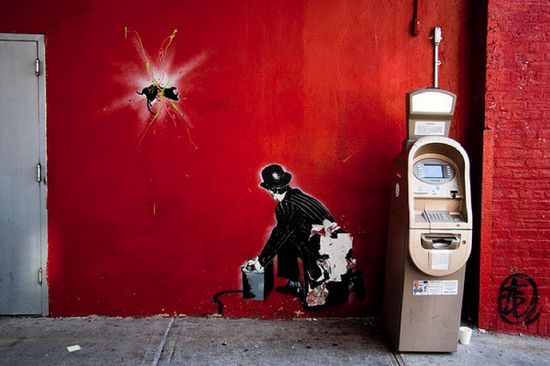
(Image from Matt Stopera's list of the world's most bizarre ATM art.)

Quote For The Day

"If Obama is a Kenyan anti-colonialist for supporting financial regulation, than Scott Brown is a Kenyan anti-colonialist. If Obama is a Kenyan anti-colonialist for supporting the proposed Islamic community center near Ground Zero, then Michael Bloomberg is a Kenyan anti-colonialist. If Obama is a Kenyan anti-Colonialist for supporting health care insurance reform, then Ben Nelson is a Kenyan anti-colonialist. The Center for American Progress is a Kenyan anti-colonialist think tank, MoveOn is a Kenyan anti-colonialist advocacy organization, and Peter Orszag is a Kenyan anti-colonialist intellectual," – Adam Serwer.

For that matter, if Obama wants to return to Clinton-era tax rates, does that make Clinton a Kenyan anti-colonialist? If Obama wants access to private health-care insurance, while Richard Nixon backed a far more expansive program, does that make Nixon a Ugandan Marxist? Once you unpack all this, especially when you consider the multiple crises that Obama had to handle when he came to office – and the extraordinary moderation he has shown throughout (infuriating those to his left) – you realize just how base this kind of "critique" is.

It is pure white cultural identity politics – now touted by a man who once made a mini-career by attacking identity politics. And it is on the cover of fricking Forbes! And fully endorsed by Newt Gingrich.

I suspected that on the right, things would get much worse before they got any better. I under-estimated the plunge toward nihilism and hate.

Understanding Versus Perception

Jonah Lehrer examines the science of reading, and why new e-readers might make the process too easy:

[T]he act of reading observes a gradient of awareness. Familiar sentences printed in Helvetica and rendered on lucid e-ink screens are read quickly and effortlessly. Meanwhile, unusual sentences with complex clauses and smudged ink tend to require more conscious effort, which leads to more activation in the dorsal pathway. All the extra work – the slight cognitive frisson of having to decipher the words – wakes us up.

So here’s my wish for e-readers. I’d love them to include a feature that allows us to undo their ease, to make the act of reading just a little bit more difficult. Perhaps we need to alter the fonts, or reduce the contrast, or invert the monochrome color scheme. Our eyes will need to struggle, and we’ll certainly read slower, but that’s the point: Only then will we process the text a little less unconsciously, with less reliance on the ventral pathway. We won’t just scan the words – we will contemplate their meaning.

Too Focused On Democracy?

Texas In Africa reviews Séverine Autesserre's book, The Trouble with the Congo: Local Violence and the Failure of International Peacebuilding:

Autesserre is also interested in the question of why the international community failed to address local-level conflicts in the Kivus and other areas when negotiating peace. Her conclusion is that the culture of international peace building doesn't allow for consideration of local conflict. In other words, it never even occurred to most of the myriad of diplomats, politicians, and other international actors involved in the process that they needed to worry about it. This was true despite solid evidence that many of the conflicts in the Kivus predated not only the civil and international wars that rocked Congo from 1996-2003, but also the Rwandan genocide, which prompted much of that violence.

In this sense, Autesserre's book is a valuable read for anyone involved or interested in international peace processes. As Autesserre notes in a study of cases from around the world in the book's conclusion, effective peace building in today's conflict situations only works when actors at all levels are involved. She notes that there is a need for both an internationally-driven, top-down effort alongside a grassroots-driven, bottom-up effort if other regions are to be spared the destruction and devastation that the citizens of the eastern Congo have endured for so long. The international community's post-Cold War obsession with writing a constitution, organizing and holding elections, and certifying the country as democratic – despite the fact that violence continued in the east – was incredibly harmful for the people of the DRC in many ways, and it's obvious that the same path didn't work in Iraq, won't work in Afghanistan, and seems highly unlikely to help in Sudan.

Cold Truths

Eileen Reynolds interviews author Jennifer Ackerman, who spells out why we get sick:

Experts say that the best advice for dodging cold bugs may be the simplest: Wash your hands and don’t touch your face. If you can adhere to these two rules, you could be well on your way to cold-free dreamland. But this is easier said than done. Just try not touching your face for a day. Most of us do so one to three times every five minutes, or two hundred to six hundred times a day. (We also pick our noses about five times an hour.)

Libertarian Doctrine And Education

Bryan Kaplan believes that there is no country on earth that is under-educated. Here is where you end up when libertarianism becomes dogma:

Education’s a good like any other.  If people refuse to spend their own money for more education, then it’s presumably just not worth it, right?  This is especially clear because governments habitually subsidize education.  Libertarians should believe that there’s an oversupply of education for the same reason they believe there’s an oversupply of sport stadiums: The status quo is desperately dependent on government funding.

Joyner's eyes widen:

And, I suppose, the fact that poor people are starving is proof that they’re not all that hungry?

Lots of Nigerians and Bolivians flock to the United States and other developed countries for higher education.  Even at lowly Jacksonville State, I had Nigerian students in my classes.  Rich Nigerians.  Their illiterate countrymen aren’t spending more of their hard-earned money on education because they’re wasting it on food, not because they think they’re better off uneducated.

Tyler Cowen has a sane response.