Crime After Crime

Despite the relatively good news that Iran has suspended stoning this week, Robert Fisk's sober account of recent honor killings is as tough as it is necessary to read:

So terrible are the details of these "honour" killings, and so many are the women who have been slaughtered, that the story of each one might turn horror into banality. But lest these acts – and the names of the victims, when we are able to discover them – be forgotten, here are the sufferings of a mere handful of women over the past decade, selected at random, country by country, crime after crime.

One example in a seemingly endless list:

Aisha Ibrahim Duhulow, 13, who in Somalia in 2008, in front of a thousand people, was dragged to a hole in the ground – all the while screaming, "I'm not going – don't kill me" – then buried up to her neck and stoned by 50 men for adultery[.] After 10 minutes, she was dug up, found to be still alive and put back in the hole for further stoning. Her crime? She had been raped by three men and, fatally, her family decided to report the facts to the Al-Shabab militia that runs Kismayo.

A Poem For Sunday

Apostles

A reader sent me this as a response to my reflections on grief earlier this week. It's called "The Acts Of The Apostles", by William Bronk. It blew me away:

The second time the flesh was harder to put on
and there was no womb to shape and soften it,
unless it were Joseph's tomb in the cut rock
that shaped, perhaps, but more misshaped to a kept
mask, as a wet shoe is hardened as it dries
to a foot shape and the print of a step, but not
to the moving muscle and bone that walking was.
What wonder then that Mary, who loved his life,
mistook him for the gardener, and humbled by love,
asked only where they had lain him that took him away.

The men, too, were uncertain they saw at first.
Thomas doubted and thrust his hand in the wounds.
There must have been some subtle difference gone
from the flesh they loved, or a difference newly come
to make a change in it.  Say the change was death
that had wrought hard with it; or say the fact
this flesh appeared and disappeared without
their knowing bewildered them.  They did rejoice,
but only as though their hope had stretched too far.
And Peter went back to cast his nets on the sea.

Some grief is stronger than any joy before
or after it, and life survives. It feeds
within itself on grief, not nourished then
by other food, as winter trees survive
because they do not feed.  Their mouths refused,
almost, the taste of the brief return; grief seared,
they could not savor it.  The time did come—
but it was afterwards, that a new joy
leafed over their grief as a tree is leafed.
It was the tree of grief that grew these leaves.

We share the movement that young birds learn
when clumsy with size, they grow to empty air
and fall, and find the empty air sustains.
So we are lofted in our downward course by the wide
void of loss through which we fall to loss
and lose again, until we too are lost
in a heavier element—the earth or sea.
We grow in stature:  grief is real and loss
is for life, as long as life.  Long flight,
soar freely, spiral and glide in the empty air.

“I Am Not Afraid”

Alex Shephard interviews Werner Herzog on why he's making a 3D movie, why Roger Ebert should be "weighed in gold," and on the advantages of "extreme" characters or situations:

I think when you are looking at a city from its outskirts on a hill you probably understand the pattern of the city much better than being right inside. And I think looking at a human being from a far-out position gives you more insight; you will have more insight into the human condition. Let me make a metaphor: If you want to test an alloy of metal you would find out about its structure by placing it under extreme heat, under extreme pressure, under extreme radiation — then you will understand the very nature of this metal alloy.

(Hat Tip: 3QD)

“Skin”

Mark Jacobson tracks the origin of a supposedly skin lampshade, from the Holocaust to post-Katrina New Orleans, with help from those who identified the victims of 9/11:

I wanted to know. And I had to confess, I wanted it to be “real,” i.e., to have once been part of a walking, talking human being. It was a sick thing, I had to admit, but it wasn’t only me. Everyone I spoke to about the lampshade said, given a choice, they would be disappointed to find out it was made from a goat or a pig’s bladder. Here, even in the age of 9/11, after a century of genocide from Armenia to Rwanda, there was a desire to possess the unthinkable.

Truth And Discomfort

A new study compares our psychological reactions to things that upend our accepted world-views. Participants responded to the simple moral of Aesop's fable about the tortoise and the hare in which perseverance wins the race, and then, in turn, to the more pessimistic take of Kafka's "An Imperial Message," a story in which no matter how hard one tries, one doesn't succeed:

When there’s a challenge to our established world-view, whether from the absurd, the unexpected, the unpalatable, the confusing or the unknown, we experience a psychological force pushing back, trying to re-assert the things we feel are safe, comfortable and familiar.

That’s a shame because stories like Kafka’s contain truths we’d do well to heed.

Not Just Cricket

Mohsin Hamid confronts Pakistan's culture of hypocrisy head-on:

A state that mandates religious practices, as Pakistan does, is a state that mandates hypocrisy, because the law can only govern outward behaviour. It can say that such-and-such behaviour is prohibited, but it cannot say that such-and-such belief is prohibited. And as the gap between belief and behaviour widens, hypocrisy sets in. People with beards still kill. People who cover their heads still steal. People who thank God for their victories still cheat. And because so many people do these things, the split between religion and morality becomes profound and widely accepted.

Secularism need not be anti-religious. A secular Pakistan could be a Pakistan in which the religious life of its citizens is enhanced, just as love is enhanced in a state that does not seek to legislate love. We need to re-evaluate the notion of politicised Islam that has worked its way into our politics, our constitution, our culture and our sports teams.

Face Of The Day

SeanHenryMattCardyGettyImage

Visitors to Salisbury Cathedral admire Sean Henry's sculpture, Catafalque, which is being displayed as part of the Cathedral's Liminality exhibition on September 10, 2010 in Salisbury, England. The two month exhibition 'Liminality: Toward the Unknown Region' features large scale, three dimensional works – including two suspended installations – in various surroundings in the 750-year-old building. By Matt Cardy/Getty Images.

Death By Dickens

If he has to go, playwright Tom Stoppard prefers a literary demise:

I have a spasm of envy for the person that was killed by a falling bookcase, as long as it doesn't happen prematurely… It would be a good way to go. You went when you were in a good frame of mind and you were doing something pleasant and interesting. A lot of people would say, 'I would rather have a heart attack at the height of sexual passion.' On the whole, I would prefer to be killed by a bookcase.

The Heavenly Gaze

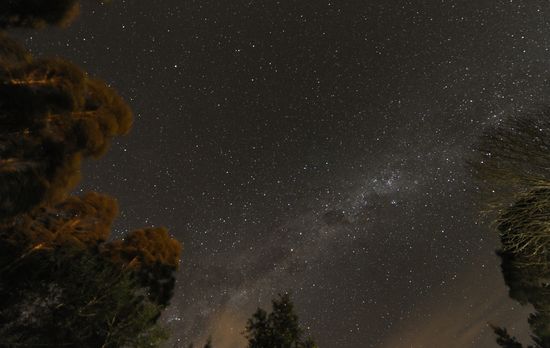
MILKYWAYJuanMabromata:AFP:Getty

Riffing on Stephen Hawking among others, Mark Vernon wonders if cosmology could be the new theology?

Cosmology is so popular, not just because of the science, but because it allows us to ask the big questions — where we come from, who we are, where we’re going. It’s metaphysics by other means. If the Scholastic theologians of the Middle Ages liked to speculate about the number of angels on the heads of pins, we today like to speculate about the number of dimensions wrapped up in string theory. The activities are similar insofar as they feed the delight we find in awe-inspiring wonder.

(Photo: Picture of The Milky Way taken on June 14, 2010 over Balgowan, South Africa, near the base camp of Paraguay's football team during the 2010 World Cup. By Juan Mabromata/AFP/Getty Images.)