Terry Jones’ German Past

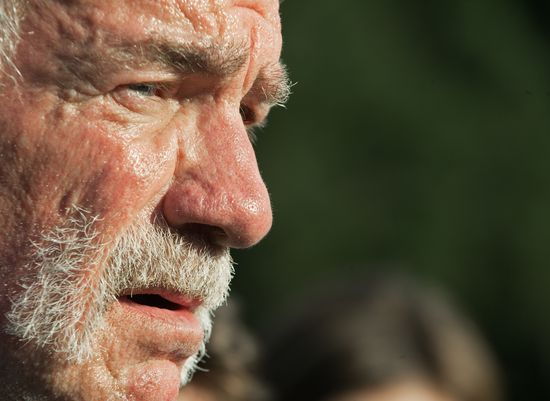
JONESPaulJRichards:Getty

A fascinating dispatch from the Guardian on the Florida nut-job’s previous gambit for religious dominion in Germany:

Among the numerous documented reports of the ways in which he used to allegedly manipulate members were demands for money, as well as complete commitment to the community. Members were reportedly forced to work in the community’s so-called Lisa Jones shops, named after his first wife, which sold and distributed secondhand clothes and furniture.

The members reportedly worked long hours, lived on next to no wages and had no health insurance despite this being required of all German employers.

Members were forced to review relationships with family and friends and in some cases to break up with partners. Parents were reportedly encouraged to beat their children because, said Jones, it was “God’s will”.

Those in the group say that Jones became increasingly radical over the years. He offered to help homosexual people “pray away” their “sins”. Later he directed his attention more towards condemning Islam. He warned the congregation they could be attacked by Muslims at any time. “Some people lived in real fear that we really would be attacked by Muslims during the religious services,” said former member Thomas.

(Photo: Paul J Richards/Getty.)

Now Just Suspended

It's bizarre watching this saga of threatened mass Koran-burning on 9/11 unfold. As I write this, it could still happen – again. The meta story from the NYT does not seem to me to be a massive indictment of the media. Stunts get covered all the time – with little attention. Think of Fred Phelps, a truly marginal figure whose outrageous stunts against gay people and military funerals have been extensively covered for years. What seems to me to have given this latest excrescence greater exposure was the context of the engineered controversy over the Cordoba mosque in the Park51. Islamists abroad – much more numerous but just as fanatical as the fringe Christianists – did the rest.

We live in an era of religious fundamentalism and fanaticism, exploited, used and manipulated by politicians, for their own purposes, and used by the media for its own. This has always been a dangerous and toxic combination, inimical to liberal society, dangerous to secular democratic politics, and today, something that can also lead to global warfare and destruction on an unimaginable scale. This blog has long warned of its dangers and consequences – and yet the role of religious fanaticism in politics only seems to grow, thanks to cynical Republicans and weak-kneed Democrats.

The new media, moreover, makes it especially combustible and unstoppable, whatever the mainstream media decides to cover or not cover. Does anyone think it will matter if the AP does not cover the now "suspended" but possible burnings? Anyone with a cell-phone camera can send these images within seconds across the globe. Any bigot can incite mass violence in a culture already primed for it. And so there is something almost inevitable about the atrocity in front of us. And sure, enough, Fred Phelps is now threatening to burn Korans this weekend if Terry Jones does not.

My point, I suppose, is that this kind of cycle in this kind of environment is something that once started, no one can stop. It is a function of fringe Christian fundamentalism finally engaging fringe Islamist fundamentalism in a war of increasing terror and intolerance in a seamless global media world. It is the responsibility of all of us of actual faith rather than fanaticism to stand up and oppose this before it engulfs us all.

But you reap what you sow. You turn a benign Muslim community center into a "stab in the heart" of Americans (in Sarah Palin's words) and someone soon will up the ante. Which is why this summer has felt so ominous to me; and the forces itching for full-scale religious warfare more powerful and more unstoppable than any of the restraints in between – from the West Bank to Kandahar and Gainesville and Wasilla. One can hope and pray that this flare-up will be a warning prevented in time for the culture to take a deep breath and understand the consequences of religious fundamentalism openly embraced in the public square. But hope is scarce in this environment.

Or we are seeing forces that cannot ultimately be stopped by anyone – until they have wrought the hideous consequences so many zealots on all sides desire.

The Daily Wrap

Today on the Dish, the rule of law took an unimaginable hit on torture and national security. On the Florida jerk front, the burning was cancelled. We paid a visit to the other Terry Joneses, we found out who is funding the Cordoba culture war, and Sarah Palin won the Yglesias Award. A divided government may be a better government; but probably not when led by the Tea Partiers. GOP heretic hunting continued; our intelligence community was shooting itself in the foot; and a burning Boulder was being saved by social media. Bad HIV reporting continued as did the harsh realities of covering Palin. 

In international news the Chinese loved their cars; North Korea was about to get an even crazier successor; and we may need more modesty in Afghanistan, while the world could use a happy planet index

In response to the recession, Beth Boyle Machlan played the lottery; college educated young women outearned young men; and the final shoe on real wages was about to drop. We harnessed the power of the personal brand; and readers responded to the emergency room debate and the peak oil problem. VFYW here; creepy ad watch here; MHB here; and FOTD here

Remembering those lost to AIDS didn't get any easier, but Iowa's gay marriages were prospering with their own version of the suburban American dream. One day, the New York Times will stop being printed, date TBD, and this guy won the award for the worst stump speech ever.

–Z.P.

Why Emergency Rooms Are Packed, Ctd

A reader writes:

People are kidding themselves if they think urgent care centers can “de-crowd” emergency departments.  The latest number from the CDC on non-urgent visits to ERs is less than 8 percent.  Non-urgent means a patient who needs to be seen in 2-24 hours, mind you, not a patient who is there for a hangnail.  Remove the 8 percent non-urgent patients from America’s emergency departments and you still have 114 million people seeking emergency care every year, a number that is likely to grow.
 
Emergency departments are crowded principally because of “boarding,” the practice many hospitals engage in whereby admitted patients are held in the ER.  Those held patients need to be monitored by emergency department staff, which prevents them from attending to new patients coming to the ER.  This is what leads to crowding and long wait times.  The rash of ER closures hasn’t helped matters as it has compressed more people into fewer ERs.   ERs close because of the rising burden of uncompensated care that ERs provide due to uninsured or underinsured patients (i.e. Medicaid).


The number of urgent care centers has continued to climb as has the number of emergency patients.  Urgent care centers provide a service, but it’s a dangerous fantasy to think that they can handle a load of emergency patients sufficient to eliminate ER crowding.  They lack the staff, expertise and resources to handle any real emergencies, and the wrong patient visiting an urgent care center in order to save money or time could well cost himself his own life.
 
Another fantasy people have is that emergency departments are eating up a huge chunk of the U.S. healthcare spending.  Not true.  Currently emergency care eats up only 3 percent of health care dollars.

Another reader:

When I hear about people using emergency rooms for what is essentially primary care because they can't get access to a doctor during regular business hours, I think of two features of the French health care system that help make this unnecessary.  First, French pharmacists are trained and authorized to do some diagnosis and to prescribe at least some drugs, without needing an order from a doctor.  In the U.S., if you have an ear infection and need antibiotics, you have to see a doctor for a prescription, even if the only way to see that doctor is to go to the emergency room.  In France, you go to your neighborhood pharmacy, the pharmacist looks at your ears and throat and prescribes a basic antibiotic.  (And in larger cities and towns, the pharmacists work out a rotating schedule to ensure that there is always one pharmacy open, with a pharmacist available, for overnight medical needs.)
 
But even better is SOS Medecins.  In 60 or so of France's largest towns and cities, you can call 24 hours a day and, after some telephone discussion to help determine whether you really should go to an emergency room, a doctor will come to your house.  Poking around their (not well-designed) website, it looks like they receive about 4 million calls a year and make 2.5 million housecalls.  About 10% of calls result in them telling the caller to call an ambulance, and a large number are able to be resolved without a visit (with the doctor taking the call able to help the caller determine that his or her condition does not require urgent care).  And the cost is significantly less than a visit to an emergency room.  The service was started over 40 years ago by a doctor who realized it was easier to get a plumber to come to your house on an emergency basis than it was to get a doctor.
 
Like the urgicenters and community health centers other readers have described, these are just a couple of commonsense ways we could help reduce medical costs in the U.S.

Peak Oil, Meh? Ctd

A reader writes:

I want to make four essential points on the subject of peak oil that Reihan and your friend Vaclav Smil are not fully appreciating:

1. Oil currently powers 94% of the transportation of people and goods in the United States.  The near complete monopoly of oil on an essential area of human activity makes it vastly different from other commodities.  When the price of natural gas goes up, people or utilities can switch to nuclear power.  When the price of oil goes up, people still need to go to work and have no choice but to pay higher prices.

2. The big decisions that we make that determine how much oil we use are (1) where we choose to live; (2) where we choose to work; and (3) what car we drive.  These things are not easy to change in response to higher oil prices.  As a result of these two factors, oil consumption is both extremely inelastic and require major, long-term investments in order to change.  There is no way around this; getting off of oil is going to take time, which is why waiting for the market to send the correct price signal will be a disaster for our economy.

3. As a result, both Reihan and Smil are understating how painful the transition away from oil will be, if we don't take steps to prepare for the coming oil crisis. 

As oil prices rise, it's going to take money out of the pockets of American consumers and put it into the bank accounts of oil producers and oil-exporting nations.  That's why in recent U.S. history, every major spike in the price of oil has been immediately followed by a significant recession, including the 1973 Embargo, the 1979 Iranian Revolution, the 1989 Persian Gulf War, and the 2007 demand-side energy crisis (the converse is also true: every major U.S. recession over the past 40 years has been preceded by a rapid rise in the price of oil).

4. You can't ignore the distributional aspects of what will happen to American consumers if we don't do something to get off oil in the near term.  As oil supply stagnates while demand surges, rising prices will be an enormous transfer of wealth from American families to  Venezuela, Saudi Arabia, Iran and indirectly to Hizb'allah and Hamas. 

Will it be the end of civilization?  No.  But surely dealing with the coming oil crisis is a major policy concern for all people across the political spectrum.

More dialogue on this here.

The Burning Is Canceled

It’s a merciful escape from what could have been a horrifying dynamic. But a weird one as well:

Terry Jones said he was calling off the event after the group behind a planned Islamic centre near Ground Zero in New York agreed to relocate it. But the cultural centre’s organisers said they had no plans to move it.

What’s fascinating to me is the linkage this hateful nutjob tried to make between Park51 and the Koran-burning stunt. It’s in his own head, apparently, and a way to save face, I suppose. But that he sees this as a way to save face, that he sees his disgusting bigotry as somehow equivalent to building a multi-faith community center with a mosque near Ground Zero is instructive of what has happened to the discourse in the last month or so.

I believe the legitimacy given by some leading Republicans to the attempts to make the Park51 complex a “provocation” have fueled the fire of religious bigotry in this country, and hurt the war of ideas against Jihadism and in favor of religious freedom. Mercifully, blessedly, this did not escalate to this degree this swiftly, and the pastor has climbed down. So we escaped what could have been a spark for a global wildfire.

But until conservative, evangelical, Republican and Christianist leaders make a clear and vital distinction between Jihadist terrorists and American Muslims, a distinction they helped erase by declaring a mainstream Muslim center near 9/11 as a “provocation”, this will happen again.

In my view, president Bush should stand up and insist upon this distinction as he did after 9/11 and take on the zealots who want to erase it, and know not what they do. It is not enough, alas, for president Obama, whose legitimacy is denied by those who support this kind of bigotry. A statement by Bush would be extremely helpful. And in the interests of the country’s unity, the troops and the war.

The Case For Modesty In Afghanistan

The Afghanistan Study Group thinks our strategy is misguided:

Even if the Taliban were to regain power in some of Afghanistan, it would likely not invite Al Qaeda to re-establish a significant presence there. The Taliban may be reluctant to risk renewed U.S. attacks by welcoming Al Qaeda onto Afghan soil. Bin Laden and his associates may well prefer to remain in Pakistan, which is both safer and a better base from which to operate than isolated and land-locked Afghanistan.

Most importantly, no matter what happens in Afghanistan in the future, Al Qaeda will not be able to build large training camps of the sort it employed prior to the 9/11 attacks. Simply put, the U.S. would remain vigilant and could use air power to eliminate any Al Qaeda facility that the group might attempt to establish. Bin Laden and his associates will likely have to remain in hiding for the rest of their lives, which means Al Qaeda will have to rely on clandestine cells instead of large encampments. Covert cells can be located virtually anywhere, which is why the outcome in Afghanistan is not critical to addressing the threat from Al Qaeda.

Lexington accepts some of the report's conclusions.

The Non-Event

A study of marriage from Iowa eighteen months after marriage equality. Early, I know. But this captures the reality as opposed to the hysteria:

“They shouldn’t be allowed to marry,” Maggie Gallagher, chairman for the National Organization for Marriage, said in an e-mail. “They shouldn’t be allowed to redefine marriage to mean whatever relationship [they] choose.”

In sharp contrast, married gays often depict a lifestyle and relationship that seems suburban stable, only now they have a marriage license like other couples. “Not much has changed,” said Ledon Sweeney of Iowa City, who married his partner of 12 years. “We live pretty boring lives. We go to work; we mow our lawn, we pay our mortgage, and we go on vacation if we can save enough money.”

Those wicked subversives.