The Untamed Prince

Marc Ambinder reports on the dictatorial powers held by many in government and upheld yesterday by a judiciary that gives unaccountable power – even the power to torture and kill – a drop-shadow, not a check. Marc has been following this state secrets issue for a long time, sensing, before some others did, that it was the key to Obama's protection of Bush's torturers and his objective disdain for the tortured.

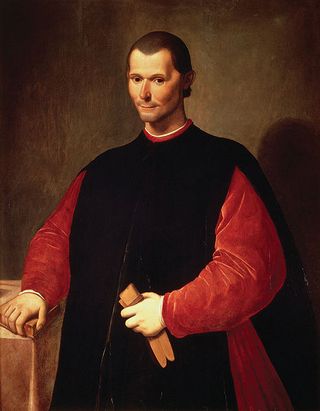
Greenwald – another early skeptic – notes that this is not news, however shocking it appears. In 2008, many of us supported Obama in part because he seemed to be a rare candidate who understood the awful potential of government-sanctioned torture to harm us in the war against Jihadism, to eviscerate core American values, and to empower the executive to new and unassailable heights in ways the Founders would have been horrified by. I always knew that Clinton would have little trouble with executive power's reach, and her speech yesterday about the importance and value of American power to direct the planet reveals her comfort with the vast, unwieldy, unaccountable, incredibly expensive apparatus that now pledges to protect us from all evil and solve every global problem – but gives us no way to know how or 466px-Portrait_of_Niccolò_Machiavelli_by_Santi_di_Tito where or when if it invokes secrecy with this kind of glib facility. Fareed is right about this. Imaginationland lives.
And Obama? I see no daylight between him and Clinton any more on this. As Glenn notes, Obama as executive quickly co-opted the kind of blanket secrecy and protection of the national security apparatus from the rule of law that plagued us in the Bush-Cheney administration. Yes, torture ended. That matters a huge amount. He will always deserve credit for that. Of course, I have to trust him on this, since there is precious little way for someone outside the government to test this or know this for sure.

But Obama's insistence on protecting every Bush era war criminal and every Bush era war crime from any redress or even scrutiny is a sign both of how cold-blooded he can be, but more, I think, of how powerful the security state now is, how it can protect itself, how it exists independently of any real accountability to anyone, how even the metrics of judging it are beyond the citizen's reach or understanding.

I tried valiantly not to believe this of Holder and Obama for months; I tried to see their legitimate concerns about exposing a war machine when it is still at war; I understand the need for some extraordinary renditions; and the necessity for executive power in emergencies to act swiftly, as the Founders intended. Yes war requires some secrecy. But Obama has gone much further than this now. The cloak of secrecy he is invoking is not protecting national security but protecting war crimes. And this is now inescapably his cloak. He is therefore a clear and knowing accessory to war crimes, and should at some point face prosecution as well, if the Geneva Conventions mean anything any more. This won't happen in my lifetime, barring a miracle. Because Obama was a test case. If an outsider like him, if a constitutional scholar like him, at a pivotal moment for accountability like the last two years, cannot hold American torturers to account, there is simply no accountability for American torture. When the CIA actually rehires as a contractor someone who held a power-drill against the skull of a prisoner, you know that change from within this system is impossible. The system is too powerful. It protects itself. It makes a mockery of the rule of law. It doesn't only allow torture; it rewards it.

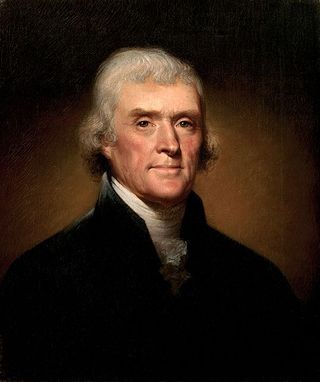
The case yesterday is particularly egregious because it forbade a day in court for torture victims even if only non-classified evidence was used. Think of that for a minute. It shreds any argument that national security is in any way at stake here. It's definitionally not protection of any state secret if all that is relied upon is 503px-Rembrandt_Peale-Thomas_Jefferson evidence that is not secret. And so this doctrine has been invoked by Obama not to protect national security but to protect war criminals from the law. There is no other possible interpretation.
The Bush executive is therefore now a part of the American system of government, a system that increasingly bears no resemblance to the constitutional limits allegedly placed upon it, and with a judiciary so co-opted by the executive it came up with this ruling yesterday. Obama, more than anyone, now bears responsibility for that. We had a chance to draw a line. We had a chance to do the right thing. But Obama has vigorously denied us the chance even for minimal accountability for war crimes that smell to heaven.

And this leviathan moves on, its budget never declining, its reach never lessening, its power now emboldened by the knowledge that this republic will never check it, never inspect it, never hold its miscreants responsible for anything, unless they are wretched scapegoats merely following orders from the unassailable above them.

And this means almost certainly that torture will return. The GOP base loves it, as long as it is done against people with dark skin and funny names in places they can look away from. And they know now something they didn't know in 2008. They will always get away with it. Even a liberal Democrat will protect you for ever with a golden shield that creates two classes of people in this country: one above the law – even a law as profound as that against torture – and those outside the government obliged to obey it.

This knowledge tells me one thing. If we are to recover as a nation under law rather under a prince, it will not be through the channels of the two major parties or through any president acceptable to the mainstream of either party. It will require a citizenry so enraged and protective of its core liberties against this security Leviathan that it compels dismantling this machinery and exposing it to the light of day – not recklessly, not abruptly, but by close examination, judicial review, press inquiry, protest. There are legitimate trade-offs between national security and liberty. But the protection of war criminals where no secrets are at stake except the scandal of torture itself is not one of them. Alas, there are few such citizens around. And, most tragic of all, those who say they care about liberty above all – the tea-partiers who invoke the founders – seem only too willing to surrender every liberty for the prize of a security against a threat we cannot even measure, and to bow down before a new king (and probably warrior-queen) rather than elect a new president.

Have I been radicalized by this? You betcha. Because this is so plainly not a nation under the rule of law anymore. And there are very few political issues more important than that.

The Lies Of The US Government

A classic from the U.S. Department of State’s Report to the U.N. High Commissioner for Human Rights in Conjunction with the Universal Periodic Review:

The United States prohibits torture and cruel, inhuman, or degrading treatment or punishment of persons in the custody or control of the U.S. Government, regardless of their nationality or physical location. It takes vigilant action to prevent such conduct and to hold those who commit acts of official cruelty accountable for their wrongful acts.

Who does president Obama think he is kidding?

The Power Of The Personal Brand

Jeff Jarvis keeps up his campaign to persuade his favorite shock jock to go it alone:

Why the hell would I pay for Howard Stern and not pay for news? Because Howard is unique. News isn’t. There’s no end of potential competition for any news provider and its unique value expires in seconds. Not so Howard. Arianna Huffington was wrong when she says that people will pay for business news and porn. There’s no need to pay for porn because there’s no scarcity of people who will strip and shtupp in front of a webcam. But there’s only one Howard. …

For Stern, the economics have to be extremely tempting. He should not work for a company. (Howard: Don’t get sucked into signing on with another employer!) He should be the company. He can charge us less than half what we pay now. He can build the infrastructure for next to nothing (as he said today, he can build a studio — big deal). All he needs is a billing mechanism (Paypal?) and a bandwidth provider (Akamai?). He won’t need to market; he already is viral. And he gets to keep the profits. Sweet.

Doc Searls is on the same page and suggests that Stern leapfrog the home computer and car:

What I hope is that he’ll do it independently, and not just through one of the carriers (say, Verizon, AT&T or Comcast). We should be able to download a Howard app for our Android, Symbian, or iOS (Apple iPhone or iPad) device and listen any way we like, anywhere we like. And pay a monthly fee for it.

Intriguing. It’s salient, isn’t it, that even aggregator sites like Huff and Drudge are anchored by a personality embedded in their very titles. In the end, what’s unique online is what’s unique in life: the human individual. And as the barriers to mass media entry fall away entirely, you become not just your own brand but, if you want, your own company. And Jeff is right about porn as well. Every day, a new star is born on XTube.

I’ve struggled with this, of course, myself. Why not just be an independent site, like TPM? The very difficult and entirely new attempt to integrate the Dish into, first Time and now the Atlantic has been a work-in-progress and sometimes confoundingly tricky. But in the end, for me at least, it really is about having the best of both worlds and finding a way there. I want to be a writer not a businessman; and I want to be part of a conversation not a monologue. And I’m a believer in tradition and the necessity of tending to institutions that stretch through time and space and give meaning to our lives and cultures. For me the Atlantic is not just a dot-com start up, although it is in some ways that. It is a connection to those early dreamers and writers and abolitionists and transcendentalists who created this space for thought and writing 150 years ago. To be a part of their inheritance, and to try and keep alive their American idea, is irreplaceable.

Yes, I’m a Tory. Because it is by integrating our generations that we build our fragile civilization. That matters more than turning human beings into brands. We’re not. We have souls; brands have markets.

What Can We Believe About Palin? Ctd

Michael Gross responds to critics of his Vanity Fair profile:

A number of commentators have noted the use of anonymous sources in my article. I explained in the article why this was necessary, but let me amplify the explanation here.

After the 2008 election, Sarah Palin and her advisers decided that it was time to “go over [the] heads” of the media, as one of her former press aides told me, and, in effect, invent a new way of doing political business. Palin began using Facebook and Twitter to send messages directly to the public. At the same time, she and her staff made themselves virtually inaccessible to reporters. Palin, moreover, is the most powerful person in a sparsely populated, geographically isolated community. She has often used intimidation. Many who have been close to Palin say they are frightened of her. They claim they have seen her ruin reputations. To speak out against such a person in a small community is risky.

This reality presents reporters with a choice: either repeat the official statements and official facts that are made in Palin’s name, or find a way to report other information under the terms that sources will permit.

Ben Smith goes a few more rounds with Gross. I'm with Michael.

Distrusting Republicans, But Voting For Them Anyway, Ctd

Karl Smith theorizes that an an invisible hand moves swing voters. Will Wilkinson might vote Republican:

Divided government has many under-appreciated virtues. As the Cato Institute's William Niskanen has pointed out, divided government is the best recipe for fiscal restraint—something America will urgently require, come the recovery. Divided governments are also less likely to charge into war. "In 200 years of US history, every one of our conflicts involving more than a week of ground combat has been initiated by a unified government," Mr Niskanen observes.

Though the electorate is mostly unaware of these benefits, the historical record suggests a fairly stable and long-standing preference for relative gridlock.

Lexington also sees an upside:

[T]he need for the Republicans to be seen to be more constructive and less ideological will grow as the presidential contest of 2012 approaches. That suggests that the Republican leadership will indeed cut some deals with Mr Obama even if the ideologically excitable have to be provoked. As for Mr Obama, he might relish the excuse to cast off the left wing of his own party and tack towards the centre. And the centre, contrary to the wilder Republican propaganda about his "secular socialist" tendencies, is precisely where I [believe] he would like to be.

“Now There Are Nine”

Lawrence Wright tells The Economist:

Our intelligence community was extremely poorly prepared before 9/11. Since then it hasn’t done a good job of hiring the kind of people who speak and understand the languages and cultures of that region. One of the heroes of my book and my film, Ali Soufan, the FBI agent who came closer than anyone at stopping 9/11, was one of eight Arabic-speaking agents at the FBI on 9/11. Now there are nine. The really woeful thing about it is that if Ali Soufan tried to work in the FBI now, he probably couldn’t get security clearance. I talked to the guy who’s the head of the army translation corp, and he said that after 9/11 many Muslims and Arab-Americans came forward and offered their services to American intelligence and were spurned. The army picked up a number of them and they went to Iraq to become interpreters, which is the most dangerous imaginable assignment. He said after four years of serving their country they still can’t get a job in American intelligence because they can’t get past the security clearance. Well what other declaration of loyalty do you need to make?