Why Emergency Rooms Are Packed, Ctd

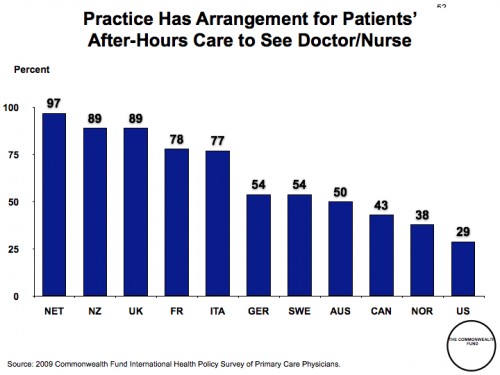
AfterHours

Chart via Ezra Klein. A reader writes:

I come from a medical family (father is a GP and head of a consortium of family practices in New York, oldest sister works for him as a physicians assistant), so maybe I can add a little to Mr. Klein's analysis.  I agree with him that the disparity between an everyday person's schedule and that of primary care doctors office hours is a major issue often forgotten in the great health debate.  However, I believe that the health care industry is beginning to address this problem through the use of urgicare centers.

While I'm fuzzy on all the contractual details of urgicenters, the basic premise is that these clinics are open in the late hours – usually 5-11pm – and provide basic primary care assessment and treatment.  Typically, the doctor will only see you for one ailment to ensure a higher number visits, so hypochondriacs need not apply.  But for the typical bumps, bruises and aches that are non-emergency related, this would be the place to go.

The benefits of urgicare centers are apparent for all three parties involved: hospitals/doctors, insurers and patients.  The average cost of an emergency room visit can go well north of $1000 dollars, so insurance companies view urgicenters as a huge cost saver.  Even if a patient visit at an urgicare clinic is $200 or $300, that is still less than half the cost of an ER visit that insurers are currently shelling out to cover.  Doctors and hospitals also see first-hand the relief that urgicare provides for overcrowded emergency rooms, as non-emergency related ailments can be correctly sourced elsewhere. 

Lastly, patients will benefit in the reduced average wait-time to be seen (although when you are sick, it probably won't feel any shorter in the waiting room).  It's no wonder that many local governments and hospitals are beginning to seriously invest in these clinics, given their seemingly positive cost-benefit trade off. 

Another writes:

My current health plan (provided via my husband’s job) provides access to Urgent Care.  Urgent care does not provide 24 hr service, but has greatly expanded hours compared to my PCP office.  I am an IT consultant, and paid hourly.  Until recently I’ve been a raging workaholic, and taking time off from work to visit a doctor seemed absurd, and impossible to schedule.  When I’m sick (sore throat, sinus infection, etc) I want to see a doctor immediately.  Try scheduling with most PCP doctors and you are faced with an appointment weeks away. 

I always thought Urgent Care was substandard – until one day when I ran out of my prescription medicine for acid reflux.  (The lapse in medicine was not my fault; it was due to yet another retirement of my previous PCP, and I was stuck waiting five months to get an initial appointment with my new PCP – another huge time drain.)  It was a long holiday weekend, and I tried every over the counter medicine I could find.  The pain continued to worsen, so finally I gave in and went to Urgent Care.  The wait was short, the care was great, they gave me prescriptions to hold me over to my visit with the new PCP.  In short, it was a terrific experience as far as health care goes.  I made a decision that day that I would much rather pay the additional $10 in copay than take time off from work, which easily costs me hundreds of dollars.  (I have no idea of the difference in cost to my insurance company.)

Fortunately I have not had any urgent issues since then, but my husband has, and I was happy to drive him there for treatment.  Again, we were both pleased with the treatment, and the availability.  I will use them for all sporadic medical issues, except for a nearly annual physical which is required to keep them writing prescriptions for my chronic conditions.

Another:

There are two large hospital conglomerates here in the St. Louis market, BJC and SSM, and both operate urgent care facilities.  I work with a group of doctors that opened their own urgent care company and presently have three locations, with another one under construction.  It takes time, but people are getting used to the idea that there are alternatives to primary care and hospital emergency care.  The thing I hear most satisfying to patients of an urgent care visit is the minimal wait at the urgent care compared to a hospital.  Emergency room waiting times can be in excess of several hours if your condition is likely not to get worse during the wait.  Urgent care waits rarely exceed 30 minutes.

Another:

There's another alternative: Walk-In Clinics. They're popping up all over my home area just outside Chicago, both in drugstores and in attractive facilities built by local hospitals. Many CVS, Walgreens and Osco stores now have walk-in clinics staffed by Physician Assistants and Nurse Practitioners. They can handle any of the minor health problems that we run into.

Last week, suffering from a bad case of poison ivy, I decided on my lunch hour I needed to see a doctor and get a prescription for steroids. I didn't bother calling my regular doctor – I couldn't have gotten in for a week, at least – so I drove 10 minutes to my usual hospital-run clinic, passing one drugstore clinic and another hospital-run storefront. There were no lines; I waited in a comfortable chair in a large waiting room with flat-screen TVs for less than five minutes to see a doctor. In less than 20 minutes I was on the way out with a prescription.

Boulder Burning

A reader writes:

Are you all covering the Boulder wildfire at all?  Fourmile Fire, 7000+ acres burning, Boulder in a state of emergency, Fed is taking over, homes lost, air tankers dropping fire retardant and water to contain it.  Here is a Google map of the fire and evacuation.  This photo was shot on Monday evening, this one from last night, and many more from the Denver Post. The timelapse was taken on Monday night.  Check out Twitter #boulderfire for lots of info.

AP updates here. Money quote:

"There was something majestic and beautiful about it, although it's terrible that some people lost their homes," Esposito said after he took a clandestine tour on Tuesday.

The Hard Work Ahead

The indispensable Jim Manzi:

I believe that improvements to our schools are possible, need to be part of how we approach the problem of wage stagnation, and should be pursued aggressively. These reforms are almost certainly going to include dragging the education industry through the kinds of changes—becoming more entrepreneurial, flexible, and market-driven—that have transformed large-scale institutions throughout our society. This is not a matter of simply “being more like Apple” or whatever, and we don’t yet know the unique manifestations of this evolution in education. Rajan is right that it will require that we run experiments and “learn quickly from them and scale up those that are most promising,” But it is also the case that we will never really do that without a huge political battle to wrest authority from providers and give it to consumers.

And, more important, improving schools is not going to be close to enough.

I believe strongly, for example, that we need a new approach to immigration that reconceptualizes immigration as recruiting rather than law enforcement. Though it is unfashionable to say it now, we need to figure out how to extend the market revolution to sectors of the economy that remain protected from it by political power. We have to figure out some way to prevent the self-destructive spiral that limits the social productivity of a huge fraction of the American population. We need to understand the limits to American power and attempt to match our defense expenditures to finite, achievable goals, rather than imperial fantasies. These examples are obviously drawn from a right-of-center perspective, and the list could be extended, but I think it gives some idea of the scale of the challenge that we face.

The Chesterton Fetish

Austin Bramwell is onto something:

All those Chesterton lovers experience themselves as having completed a long and thrilling philosophical adventure. But they can never remember the itinerary. What makes Christianity in the end so much more satisfying? The answer never sounds very convincing when Chesterton himself isn’t saying it. He creates the feeling of philosophical achievement without the reality.

Face Of The Day

  AfghanBoyPatrickBazGettyImages

US medic Roy Heggernes with the 101st Airborne Division Alpha Battery 1-320th treats injured Afgan boy Abdul Qar, 13, at Combat Outpost Nolen before his evacuation on the outskirts of Arghandab Valley's Jellawar village on September 8, 2010. Abdul Qar and his father stepped on an Improvised Explosive Device (IED), intended to target US soldiers, which killed his father instantly. Qar was carried by his uncle to Combat Outpost Nolen where he was treated, driven to Combat Outpost Terra Nova and flown by a MEDEVAC helicopter to Kandahar. By Patrick Baz/AFP/Getty Images.

“Isolationism”

Andrew Exum thinks Andrew Bacevich should "just own the term 'isolationist' and let the haters hate." Greg

To me the term isolationism has always implied more than just a country's overseas military footprint and willingness to use military force. It encompasses trade, diplomatic engagement, and an openness to immigration, among other things. Just because you think using the military to try and foster a democracy in the Middle East or Central Asia is an improper use of American power doesn't mean you want to pull up the drawbridge and retreat into Fortress America.

Larison agrees. So do I. Prudence is not isolationism. And uni-polar worlds do not last.

Let Housing Prices Fall: Why We Must And Can’t

Tyler Cowen agrees that housing prices need to come down. But he fears the consequences of that action:

[W]hat happens if we let them fall?  Arguably many banks would once again be "under water."  Enthusiasm for another set of bailouts is weak, to say the least.  Our government would end up nationalizing these banks and it still would be on the hook for their debts.  The blow to confidence would be a major one, especially if along the way we saw a recreation of a Lehman or Bear Stearns or A.I.G. episode.

I increasingly believe there is no easy way out of this dilemma and it is a major reason why the U.S. economy remains stuck.

Avent approaches this question from another direction:

That doesn't mean that the government should be trying to increase prices (though I think that maintaining the liquidity of the mortgage market is critical). It does mean that absent a real mechanism for dealing with homeowners in negative equity situations, falling prices will not clear the housing market. Let prices go where they will go; the problem is in the huge pile of mortgage debt that is no longer supported by home values.

This hangover is going to last a long, long time, isn't it? And we might as well face it.

Craig’s Blacklist, Ctd

Melissa Petro, a former sex worker on Craigslist, shares her thoughts:

I wrote my own ads, screened my own prospective dates, decided on my own what I would and would not do for money, and — best of all — I kept every penny I earned, all without the interference of an agency or other ubiquitous "middle man." Ultimately, while my experience as a "non-pro" was not the "fun" I had come looking for — I found the lifestyle physically demanding, emotionally taxing and spiritually bankrupting, and so I made a decision to desist some months after I'd gotten started, exiting the industry just as freely as I'd entered — never have I felt it was the state's obligation — nor its right, in fact — to protect me from the decisions I made.

Poignantly put.