Tearing The Room apart and putting it back together:
Month: September 2010
Soaking The Rich, America’s Pastime
Bernstein wants to know why Democrats don't engage in more class warfare:
Polls pretty clearly show that, at least in the abstract, people love soak-the-rich tax policies. So why don't Democrats run on them? Even if Democrats actually believe that soak-the-rich is bad policy (do they?), one would think that they would be inclined to run on the issue, and then trade it away or ignore it after the election. Of course, quite a few individual Democrats do run on this issue, and Obama's policy positions in 2008 were in that direction, although at least as I heard it his rhetoric really wasn't. And it's not as if Democrats are too principled to demagogue an issue, as they've proved in cases from Social Security to trade. So: why not more bash-the-rich rhetoric in support of soak-the-rich tax policy? Is there something in the polls beyond the basic numbers? Are Dems gunshy about it because of some prior experience? Any ideas?
It's just not American to bash the successful. It goes against the grain. What does make sense, I believe, is what Obama has said: that even those of us who oppose progressive taxation in principle have to come to terms with the real and troubling rise of deep social inequality and the strain on the middle class. A Tory will worry about this; a libertarian fanatic won't. A Tory libertarian like me is hopelessly conflicted.
But Obama genuinely persuaded me for the first time in my life that a little redistribution would not be the worst thing in the world in our current circumstances. And the fiscal need for more stability is so profound I have few qualms about returning to Clinton-era tax rates. He persuaded me by eschewing class warfare rhetoric and speaking of the need to keep America as one nation, to acknowledge the real crisis facing the American working class in a globalized economy, and to redress an astonishing imbalance that has emerged in the last two decades. You can see this as class warfare I suppose. I prefer to think of it as a steadying of the ship of state by a tilt to the pragmatic and not ideological left.
Peak Oil, Meh?
Reihan isn't too worried about it.
Want To Honor 9/11 With Palin And Beck?
Got $225?
The Beauty Premium
Yes, we're human. Catherine Hakim wrote about it back in March:
[P]eople working in the better-paid parts of the private sector are more attractive than those in the public and non-profit sectors. Tall and attractive people are more likely to be employed in professional jobs, like law or banking. For the ugly and short, it gets worse. Good-looking people can earn 10 to 15 per cent more than the average-looking, who in turn can earn 10 to 15 per cent more than the plain or ugly. The tall earn more than the short; the obese have earnings 10 to 15 per cent below average.
Statistical analysis shows this beauty premium is not really just about cleverly disguised differences in intelligence, social class or self-confidence. Studies of lawyers reveal that there is always a premium for attractiveness that varies in size, but is not due to employer discrimination. The most attractive can earn 12 per cent more than the unattractive, and are 20 per cent more likely to achieve partnership in their firm, because they are more effective at pulling in customers.
Reihan adds:
The idea of investing in cosmetic surgery rather than a college degree is disturbing to those of us of a bourgeois bent, but it might be the right choice for some. Hakim’s concept of erotic capital is a useful reminder that inequality is a multidimensional phenomenon.
And bariatric surgery might pay for itself.
The View From Your Window
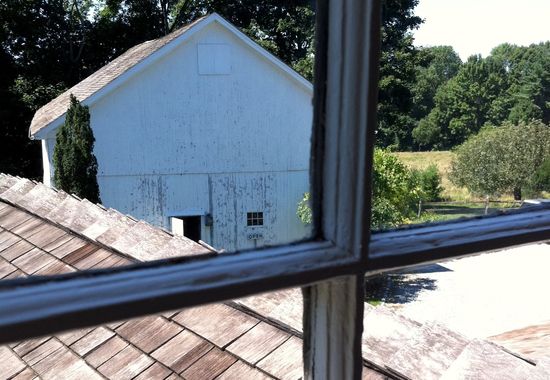
Southport, Connecticut, 11.30 am
On Collective And Individual Responsibility
Leon Wieseltier's perceptive, rigorous, and moving piece on the Cordoba controversy is simply the last word on the subject. Exquisitely crafted. And true.
Craig’s Blacklist, Ctd
Jacob Sullum weighs in:
[Connecticut Attorney General Richard Blumenthal] ignores both the law's role in fostering coercion and violence by driving [prostitution] underground and the protection that services like Craigslist can provide by allowing prostitutes to screen customers and avoid walking the streets. But to fully appreciate the audacity of his charge that money blinded Craigslist to the suffering of sex slaves, note that the company started charging for adult service ads in 2008 at the behest of law enforcement officials. The idea was that fees would thin the section, while requiring a credit card and a valid phone number would deter criminal activity.
Craigslist also hired dozens of lawyers to screen ads for compliance with the company's terms of use, which prohibit "offer or solicitation of illegal prostitution." Craigslist CEO Jim Buckmaster reports that "more than 700,000 ads were rejected by those attorneys in the year following implementation of manual screening" in May 2009, while Village Voice Media’s Backpage.com (where the ads are far more explicit) saw a big increase in business.
Bring back the ads.
Living Chastely Till 106
Scotland's pride. "She did like the odd sherry though, as a treat."
Is Obama’s Proposal Any Good? Ctd
Howard Gleckman decodes Obama's latest gambit:
Keep in mind that while Obama’s initiatives seem expansive, their real budget cost is relatively low. Because companies would have deducted this newly-expensed investment over time anyway, they will effectively pay back any short-term tax savings and Treasury will eventually recover most of its revenue loss. The White House claims business would get an immediate tax cut of $200 billion but figures the 10-year cost of this 15-month proposal would be only about $30 billion.
… while the economics is interesting, this proposal is all about politics.
 The Dish