Month: September 2010
On Burning Books, Ctd
Michael Cohen is on the side of Serwer:
I sort of hate slippery slope arguments, but it seems to me that this is the very definition of a dangerous slippery slope. For example, would people be comfortable if Petraeus characterized an anti-war march as a threat to the US mission in Afghanistan? Or what if Petraeus condemned a Congressional vote to cut funding for a weapons program as a threat to US soldiers in the field? Such behavior would almost certainly overstep not just the letter of civil-military relations, but certainly the spirit. It's very hard to see how Petraeus's actions here are much different: well except for the fact that most people would generally agree that these folks in Florida are acting like complete jackasses – but acting like a jackass is a constitutionally protected right in this country.
Ackerman is unsure about the propriety of the general's remarks:
Michael deserves credit for sticking up for a principle and using a case that he clearly disagrees with to do it. On the one hand, it’s fair for people to bristle when an active-duty general goes outside of his lane to offer his opinion on a clearly civilian issue. On the other, I’m not convinced the slope slips as far as he’s convinced it slips. Petraeus has, for instance, offered the view that the American people are justifiably distressed when it comes to the trajectory of the war in Afghanistan. So it’s not as if the guy seeks to chill free speech.
Another example, it seems to me, was the general's and defense secretary's plea not to release the remaining photographs of the torture carried out by the Bush administration.
It was, of course, not a public plea, but it was made out of a legitimate concern that the images of atrocity could deeply wound the military mission and risk US lives.
I think what this reveals is something quite critical about this war. It is just as much in the psyche as it is on the battlefield. Petraeus gets this. Gates gets this. Obama gets this. This is a war that cannot be restricted to the strict battlefield, which itself is amorphous. And how Americans conduct themselves politically and culturally, the rhetoric they use, the symbols they invoke have a direct impact on our ability to win.
In my view, the general crossed a line. But he did so out of a sense of responsibility – as in his insistence on the importance of the Israel-Palestine question to the broader war. Alas, I see the American far right – in which I include the likely Republican candidates for president – crossing far worse lines of incitement out of irresponsibility and cheap politics. And then a farce like Palin – who wants more aggressive Israeli settlement in the West Bank and conflates the Cordoba complex with bin Laden – simultaneously declares her love for the troops.
And what is the price for her? It wins her votes. It flatters her vanity. It rouses the true believers. And it helps lose the war.
Castro As You Have Never Thought Of Him
Just read Jeffrey Goldberg's staggering little piece of reportage from Havana. Just stop now and read it. Strange, creepy, funny, and also in some way, if one can even think of the old commie in this fashion, humane. I note, as an aside, that Castro is not just suddenly anti-anti-Semitic (he's actually very moving on the subject) but also anti-anti-homophobic, in what appears to be some kind of senescent bid for absolution from a God in which he does not believe.
I find any respect for this old dictator distasteful, but Jeffrey manages to describe him with the requisite aplomb. Dish fave:
When I asked him, over lunch, to answer what I've come to think of as the Christopher Hitchens question – has your illness caused you to change your mind about the existence of God? – he answered, "Sorry, I'm still a dialectical materialist."
The last one left. For what it's worth, I think Castro's right that the looming Israel-Iran clash could be the spark of a new and dark age of global war. For all our talk of recession and economics, this president may well be remembered for one thing alone: whether he manages to prevent us from entering this cataclysm.
At some point, it may be up to him alone.
And all I can say is that I feel about this looming possibility oceans of dread. Somewhere in the back of my head, I drank in this summer as deeply as I could, because it feels at times like 1913 with nukes and anthrax.
A Pessimist Manifesto
Karl Smith writes one. He believes that "badness is the natural state of the world" and that "our proper mission is easing pain, where we can, to the extent we can, the best we can":
I think it is that many modern Conservatives intuitively base their analysis of the world on a philosophy that is anathema to my worldview. Their view is that if you take a responsible, measured, well-reasoned approach to the world things will work out. Failure is thus a sign that you have not done that.
My sense is that this is fundamentally crap.. [Many modern Conservatives believe] that everything would be okay if it were not for those meddling Liberals. Everything would not be okay. It never will be. If we do our best it might, and I mean might, be a little bit better.
Feisel Rauf Speaks
As the far right seems to relish a clash of civilizations, his op-ed strikes me as so transparently constructive, so evidently in the interests not only of domestic peace but of strategic victory against Jihadist terror that I'm again at a a loss to understand why so many have reacted so ferociously to this project. I can see only one way this multi-faith community center is offensive: if you regard the mass murderers of 9/11 to be the true heart of Islam and especially American Islam. I don't. I never have. In fact, the distinction is precisely what we are fighting for. Or have I just lost my mind? I read my old friend Marty Peretz essentially calling the imam's moderation a lie and just do not understand how this can lead anywhere but more religious violence.
Who, after all, can object to this?
The wonderful outpouring of support for our right to build this community center from across the social, religious and political spectrum seriously undermines the ability of anti-American radicals to recruit young, impressionable Muslims by falsely claiming that America persecutes Muslims for their faith. These efforts by radicals at distortion endanger our national security and the personal security of Americans worldwide. This is why Americans must not back away from completion of this project. If we do, we cede the discourse and, essentially, our future to radicals on both sides. The paradigm of a clash between the West and the Muslim world will continue, as it has in recent decades at terrible cost. It is a paradigm we must shift.
But it is increasingly a paradigm that some on the right – and not just the extremes – seem to have embraced. But this was a nice touch:
President Obama and Mayor Michael Bloomberg both spoke out in support of our project. As I traveled overseas, I saw firsthand how their words and actions made a tremendous impact on the Muslim street and on Muslim leaders. It was striking: a Christian president and a Jewish mayor of New York supporting the rights of Muslims. Their statements sent a powerful message about what America stands for, and will be remembered as a milestone in improving American-Muslim relations.
I don't think I've gotten soft. I despise Islamist terror and Islamist politics. But I do not believe that we defeat them by empowering them, by giving them noxious symbols of Western intolerance in order to justify their own far far worse bigotry. We defeat them by the example of our toleration and the precision of our military power. The rest is poison.
One-Upping Orszag
Clive Crook is sounding like a right-wing version of Paul Krugman:
extend all the Bush [tax] changes for two more years, and combine it with generous payroll-tax relief.
I just worry about the debt. But Clive knows a lot more about this than I do.
Post-Factual History
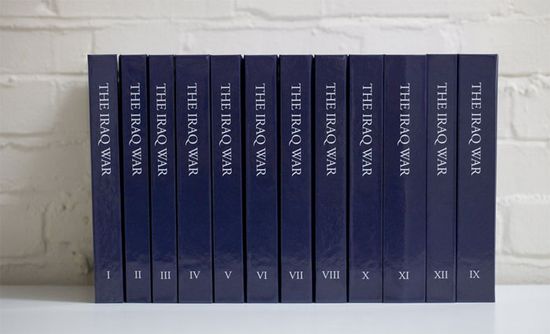
James Bridle explains his project. He writes that history is not "a set of facts, but … a process, and one in which, whether we agree or not with the writers, our own opinions and biases are always to be challenged":
This particular book—or rather, set of books—is every edit made to a single Wikipedia article, The Iraq War, during the five years between the article’s inception in December 2004 and November 2009, a total of 12,000 changes and almost 7,000 pages.
It amounts to twelve volumes: the size of a single old-style encyclopaedia. It contains arguments over numbers, differences of opinion on relevance and political standpoints, and frequent moments when someone erases the whole thing and just writes “Saddam Hussein was a dickhead”.
Well he was, of course. And much, much worse. But what worries me about this is the tendency of the new media – however brilliant crowd-sourcing intelligence is – to evaporate factual narrative. I am not a post-modernist in this – more of a Collingwood follower. To explain one thing after another and to see their connections and contingencies is not like science – falsifiable, provisionally certain – but neither is it mere competing narratives, compounded arguments, and wiki-warfare. It is, in a word, history, a discrete mode of thought, and there is a single truth to it, and especially when remembering the great historical blunder of the Iraq war (arguably the worst foreign policy decision since Vietnam), we will one day need a real historian to lay the story out with empathy and clarity.
And that's why good history is so hard: it has to make pellucid why we were so blind.
Great American Novelists
Craig Ferman digs through Time's archives:
Time put 14 authors on its cover in the 1920s, 23 in the 1930s, seven in the 1940s, 11 in the 1950s, 10 in the 1960s, eight in the 1970s, four in the 1980s, four in the 1990s, one in the 2000s, and, now, Franzen in 2010.
Alan Jacobs muses on the author's latest here. It got a rave in the Economist.
Needless Checks And Balances?
Thoreau compares the US to other mature democracies. I have to say that fiscally, the US system seems spectacularly flawed. In Britain right now, even a coalition government has to actually balance the books and cannot pass the task off by blaming the opposition. The Lib-Tories will be held directly responsible for the pain this causes, and they will have a reasonable amount of time, with a solid majority, to prove (or not) that their fiscal strategy is working. Not so Obama. And if we get divided government again – and it sure looks like it – what are the odds that the Dems will refuse to budge on entitlements and the Republicans will obstruct any tax increases … until they fight in another two years' time.
In general, I can see the wisdom of preventing swift government action. But when a sinking imperial power is facing fiscal collapse, delay and the avoidance of real accountability can be the seed of a sudden implosion. Or default.
Why Emergency Rooms Are Packed
Ezra Klein points to an obvious reason – they are always open:
One of the big problems here is time: Primary care doctors don't have much of it, and what they have is generally between 9 a.m. and 5 p.m., Monday to Friday. Patients also don't have much time, but what little time they do have is between 5 p.m. and 9 a.m., Monday to Friday, and then the weekends. Emergency rooms have long waits, but at least you can schedule when you're waiting for a time when you're not supposed to be working.
It's things like this that add up to the kind of inefficiency an allegedly more efficient market-based healthcare system is supposed to provide. Why not an emergency assistant at your doctor's for 24-hour help, or even just a phone call?
 The Dish