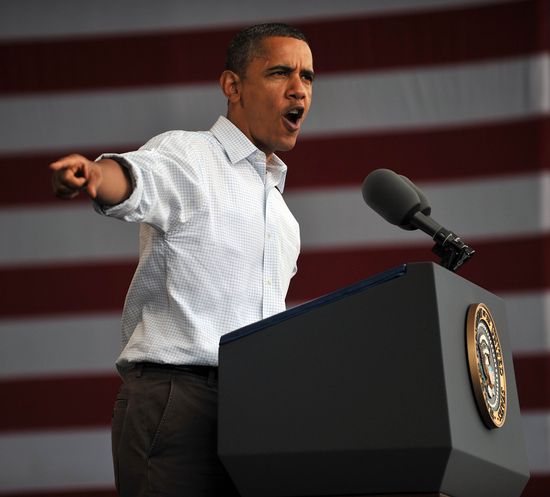
Yesterday's speech by the president, if you missed it, was a barn-stormer. Yes, it's the same old, same old pattern: he allows the opposition not just to vent and criticize (as they should) but to control the discourse for months, to drown out every other sound, to vent and crow and vilify and intimidate the cable news weenies into quivering puppies in need of crate-training. And then he comes back with a speech like that one.
I can't for the life of me see how the Democrats retain the House under these economic conditions, but that cannot and does not mean that what Obama has done in his first year and a half is a failure. On the contrary. On almost all the substantive stuff, he has in my view done the right and responsible and sane thing within the almost impossible constraints he was presented with. And given the legacy he inherited, what he has done is simply not enough to perform an economic or political or cultural miracle. That's the brutal truth and we have to face it. And if Americans thought they were voting for a savior, rather than a pragmatic president, they were deluding themselves.
When the economy imploded in the fall of 2008, there was simply precious little room for fiscal maneuver after the largely Republican-led spending and borrowing spree of the previous decade. The stimulus prevented the world falling into an economic abyss – just – but it was never going to get us out of the ditch we're in. Don Peck's brilliant cover-story is worth re-reading again on that score. And it was good to hear the president state this yesterday:
Eight million Americans lost their jobs in this recession. And even though we’ve had eight straight months of private sector job growth, the new jobs haven’t been coming fast enough. Now, here’s the honest truth, the plain truth. There’s no silver bullet. There’s no quick fix to these problems. I knew when I was running for office, and I certainly knew by the time I was sworn in, I knew it would take time to reverse the damage of a decade worth of policies that saw too few people being able to climb into the middle class, too many people falling behind. We all knew this. We all knew that it would take more time than any of us want to dig ourselves out of this hole created by this economic crisis.
The other brutal truth is that the opposition has nothing substantive to offer to remedy this. If all they've got is keeping the Bush tax cuts for those earning over $250,000 a year, they really have got nothing. What they do have is cultural symbolism and the exhausted right-left tropes that were trotted out at the mercifully vacuous parade of God and Country on the Mall with Beck and Palin. (A cynical atheist's parody of such vacuousness can be read here.) Maybe in power, by some miracle, the Tea Party Republicans will actually propose the long-term massive cuts in entitlements they claim to believe in. But I don't believe it for a second. I don't believe they are in any way serious about spending restraint and are only serious about their bewilderment at the real America where racial, religious and cultural diversity is a fact, where illegal immigration has been plummeting, where gay marriage is winning, where legal abortion will never go away, and where the new empire the last administration embarked upon has bankrupted us for a generation at least.
And this, in the end, must be what our politics is about: substantive policy responses to profound crises inherited from the past. Obama's call for transportation infrastructure investment is one tiny but real response and no panacea but it's paid for and it's something. His persistent attempt to get a real two-state solution in Israel-Palestine is unlikely to succeed given the forces arrayed against it in Washington and Tehran but it is necessary if we are to win this long war against Jihadism. His endurance in Afghanistan is, in my view, a tragic mistake, but anyone who claims that withdrawal would not have appalling moral consequences and great strategic risks is lying to you. His diplomatic and economic isolation of Iran's coup regime may also fail to prevent the Revolutionary Guards getting a nuclear capacity, but the alternative – a military strike – would initiate a new round of global religious warfare of terrifying gravity, where the Islamists would have the moral high-ground of being attacked first. His success in bringing a modicum of healthcare security to the working poor is also a work in progress but again, the practical alternative on the table is … what exactly?
In the end, these difficult practical decisions will count because they have to count. And Obama's persistent refusal to take the red-blue bait still pushed by Fox News like a cheap bump of ideological meth is to his credit. It is emphatically not about his failure to "take them on". He is taking them on – but on his terms, not theirs'. Take it away, Mr president:
When it comes to just about everything we’ve done to strengthen our middle class, to rebuild our economy, almost every Republican in Congress says no. Even on things we usually agree on, they say no. If I said the sky was blue, they say no. If I said fish live in the sea, they’d say no. They just think it’s better to score political points before an election than to solve problems. So they said no to help for small businesses, even when the small businesses said we desperately need this. This used to be their key constituency, they said. They said no. No to middle-class tax cuts. They say they’re for tax cuts; I say, okay, let’s give tax cuts to the middle class. No. No to clean energy jobs. No to making college more affordable. No to reforming Wall Street. They’re saying right now, no to cutting more taxes for small business owners and helping them get financing.
You know, I heard — somebody out here was yelling “Yes we can.” Remember that was our slogan? Their slogan is “No we can’t.”
In all this, the president deserves constructive criticism, but also moral and political support in engaging actual problems with actual solutions. Those on the left and in the middle who once saw his potential have no reason to abandon him now. If you were one of them, he needs you and this country needs you now more than ever before.
The full speech after the jump:
It is good to be back in Milwaukee. Of course, this isn't my first time at Laborfest. I stood right here with you two years ago, when I was still a candidate for this office. During that campaign, we talked about how, for years, the values of hard work and responsibility that built this country had been given short shrift, and how that was slowly hollowing out our middle class. About how some on Wall Street took reckless risks and cut corners to turn huge profits, while working Americans were fighting harder and harder just to stay afloat. And about how the decks were too often stacked in favor of the special interests and against working Americans. What we knew, even then, was that these years would be some of the most difficult in our history. And then, two weeks later, the bottom fell out of the economy. Middle-class families suddenly found themselves swept up in the worst recession in our lifetimes. So the problems facing working families are nothing new. But they are more serious than ever. And that makes our cause more urgent than ever.
For generations, it was the great American middle class that made our economy the envy of the world. It's got to be that way again. It was folks like you, after all, who forged that middle class. It was working men and women who made the twentieth century the American century. It was the labor movement that helped secure so much of what we take for granted today – the 40-hour work week, the minimum wage, family leave, health insurance, Social Security, Medicare, retirement plans, those cornerstones of middle class security that all bear the union label. And it was that greatest of generations that built America into the greatest force for prosperity, opportunity and freedom the world has ever known. Americans like my grandfather, who went off to war just boys, returned home men, and traded one uniform and set of responsibilities for another. Americans like my grandmother, who rolled up their sleeves and worked in factories on the home front. When the war was over, they studied under the GI Bill; bought homes under the FHA; raised families buttressed by good jobs that paid good wages with good benefits. It was through my grandparents' experience that I was brought up to believe that anything is possible in America.
But they also knew the feeling when that opportunity is pulled out from under you. They would tell me about seeing their fathers or uncles losing jobs during the depression; how it wasn't just the loss of a paycheck that stung. It was the blow to their dignity; their sense of self-worth. I'll bet a lot of us have seen people changed after a long bout of unemployment; how it can wear down even the strongest spirits. So my grandparents taught me early on that a job is about more than a paycheck, as important as that is. A job is about waking up every day with a sense of purpose, and going to bed each night fulfilled. A job is about meeting your responsibilities to yourself, to your family, to your community. I carried that lesson with me all those years ago when I got my start fighting for men and women on the South Side of Chicago after their local steel plant shut down. I carried that lesson with me through my time as a state senator and a U.S. Senator. I carry that lesson with me today. And I know that there are folks right here in Milwaukee and all across America who are going through these kinds of struggles.
Eight million Americans lost their jobs in this recession. And while we've had eight straight months of private sector job growth, the new jobs haven't been coming fast enough. Now, the plain truth is, there's no silver bullet or quick fix to the problem. Even when I was running for this office, we knew it would take time to reverse the damage of a decade's worth of policies that saw a few folks prosper while the middle class kept falling behind – and it will take more time than any of us wants to dig out of the hole created by this economic crisis. But on this Labor Day, there are two things I want you to know, Milwaukee. Number one: I'm going to keep fighting, every single day, to turn this economy around; to put our people back to work; to renew the American Dream for your families and for future generations.
Number two – and this I believe with every fiber of my being: America cannot have a strong, growing economy without a strong, growing middle class, and the chance for everybody, no matter how humble their beginnings, to join that middle class. A middle class built on the idea that if you work hard and live up to your responsibilities, you can get ahead – and enjoy some basic guarantees in life. A good job that pays a good wage. Health care that'll be there when you get sick. A secure retirement even if you're not rich. An education that'll give our kids a better life than we had. These are simple ideas. American ideas.
I was thinking about this last week. On the day I announced the end to our combat mission in Iraq, I spent some time, as I often do, with our soldiers and veterans. This new generation of troops coming home from Iraq has earned its place alongside that greatest generation. Like them, they have the skills and training and drive to move America's economy forward once more. And from the time I took office, we've been investing in new care, new opportunity, and a new commitment to their service that's worthy of their sacrifice. But they're coming home to an economy hit by recession deeper than any we've seen. And the question is, how do we create the same kind of middle class opportunity my grandparents' generation came home to? How do we build our economy on the same kind of strong, stable foundation for growth? Well, anyone who thinks we can move this economy forward with a few doing well at the top, hoping it'll trickle down to working folks running faster and faster just to keep up – they just haven't studied our history. We didn't become the most prosperous country in the world by rewarding greed and recklessness. We didn't come this far by letting special interests run wild. We didn't do it by just gambling and chasing paper profits on Wall Street. We did it by producing goods we could sell; we did it with sweat and effort and innovation. We did it by investing in the people who built this country from the ground up – workers, and middle-class families, and small business owners. We did it by out-working, out-educating, and out-competing everyone else. Milwaukee, that's what we're going to do again.
That's what's been at the heart of all our efforts: building our economy on a new foundation so that our middle class doesn't just survive this crisis – but thrives once we emerge. And over the last two years, that's meant taking on some powerful interests who had been dominating the agenda in Washington for too long. That's why we passed financial reform that provides new accountability and tough oversight of Wall Street; reform that will stop credit card companies from gouging you with hidden fees and unfair rate hikes; reform that ends the era of taxpayer bailouts for Wall Street once and for all. That's why we eliminated tens of billions of dollars in wasteful taxpayer subsidies to big banks that provide student loans. We're using those savings to put a college education within reach for working families. That's why we passed health insurance reform that will make coverage affordable; reform that ends the indignity of insurance companies jacking up your premiums at will or denying you coverage just because you get sick; reform that shifts control from them to you. That's why we're making it easier for workers to save for retirement, with new ways of saving your tax refunds, a simpler system for enrolling in plans like 401(k)s, and fighting to strengthen Social Security for the future. And to those who may still run for office planning to privatize Social Security, let me be clear: as long as I'm President, I'll fight every effort to take the retirement savings of a generation of Americans and hand it over to Wall Street. Not on my watch.
That's why we've given tax cuts to small business owners. Tax cuts to clean energy companies. A tax cut to 95 percent of working Americans, just like I promised you on the campaign. And instead of giving tax breaks to corporations to create jobs overseas, we're cutting taxes for companies that put our people to work here at home. That's why we're investing in growth industries like clean energy and manufacturing. And you've got leaders here like Tom Barrett and Jim Doyle who have been fighting to bring those jobs to Milwaukee and to Wisconsin. Because we want to see the solar panels and wind turbines and electric cars of tomorrow manufactured here. We don't just want to buy stuff made elsewhere; we want to grow our exports so the world buys products that say "Made in America." Because there are no better workers than American workers, and I'll place my bet on you any day of the week.
When the naysayers said we should just let the American auto industry vanish and take hundreds of thousands of jobs down with it, we said we'd stand by them if they made the tough choices necessary to compete once again – and today, that industry is on the way back. Now, another thing we've done is make sound and long-overdue investments in upgrading our outdated and inefficient national infrastructure. We're not just talking new roads, bridges, dams and levees; but also a smart electric grid and the broadband internet and high-speed rail lines required to compete in the 21st century economy. We're talking investments in tomorrow that are creating hundreds of thousands of private sector jobs today. It was because of these investments, and the tens of thousands of projects they spurred all over the country, that the battered construction sector actually grew last month for the first time in a long time. Still, nearly one in five construction workers are unemployed. And it doesn't do anybody any good when so many American workers have been idled for months, even years, at a time when there is so much of America to rebuild. That's why, today, I am announcing a new plan for rebuilding and modernizing America's roads, rails and runways for the long-term. Over the next six years, we are going to rebuild 150,000 miles of our roads – enough to circle the world six times. We're going to lay and maintain 4,000 miles of our railways – enough to stretch coast-to-coast. We're going to restore 150 miles of runways and advance a next generation air-traffic control system to reduce travel time and delays for American travelers – something I think folks across the political spectrum could agree on. This is a plan that will be fully paid for and will not add to the deficit over time – we're going to work with Congress to see to that. It sets up an Infrastructure Bank to leverage federal dollars and focus on the smartest investments. It will continue our strategy to build a national high-speed rail network that reduces congestion, travel times, and harmful emissions. It will cut waste and bureaucracy by consolidating and collapsing more than 100 different, often duplicative programs.
And it will change the way Washington spends your tax dollars; reforming the haphazard and patchwork way we fund and maintain our infrastructure to focus less on wasteful earmarks and outdated formulas, and more on competition and innovation that gives us the best bang for the buck. All of this will not only create jobs now, but will make our economy run better over the long haul. It's a plan that history tells us can and should attract bipartisan support. It's a plan that says even in the still-smoldering aftermath of the worst recession in our lifetimes, America can act to shape our own destiny, to move this country forward, to leave our children something better – something lasting.
So these are the things we've been working for. These are some of the victories that you helped us achieve. And we're not done. We've got a lot more progress to make. And I believe we will.
But there are some folks in Washington who see things differently. When it comes to just about everything we've done to strengthen the middle class and rebuild our economy, almost every Republican in Congress said no. Even where we usually agree, they say no. They think it's better to score political points before an election than actually solve problems. So they said no to help for small businesses. No to middle-class tax cuts. No to unemployment insurance. No to clean energy jobs. No to making college affordable. No to reforming Wall Street. Even as we speak, these guys are saying no to cutting more taxes for small business owners. I mean, come on! Remember when our campaign slogan was "Yes We Can?" These guys are running on "No, We Can't," and proud of it.
Really inspiring, huh? To steal a line from our old friend, Ted Kennedy: what is it about working men and women that they find so offensive? When we passed a bill earlier this summer to help states save the jobs of hundreds of thousands of teachers, nurses, police officers and firefighters that were about to be laid off, they said "no" to that, too. In fact, the Republican who's already planning to take over as Speaker of the House dismissed them as "government jobs" that weren't worth saving. Not worth saving? These are the people who teach our kids. Who keep our streets safe. Who put their lives on the line for our own. I don't know about you, but I think those jobs are worth saving. We made sure that bill wouldn't add to the deficit, either. We paid for it by finally closing a ridiculous tax loophole that actually rewarded corporations for shipping jobs and profits overseas. It let them write off the taxes they pay foreign governments – even when they don't pay taxes here. How do you like that – middle class families footing tax breaks for corporations that create jobs somewhere else! Even a lot of America's biggest corporations agreed the loophole should be closed, that it wasn't fair – but the man with the plan to be Speaker is already aiming to open it up again.
Bottom line is, these guys refuse to give up on the economic philosophy they peddled for most of the last decade. You know that philosophy: you cut taxes for millionaires and billionaires; you cut rules for special interests; you cut working folks like you loose to fend for yourselves. They called it the ownership society. What it really boiled down to was: if you couldn't find a job, or afford college, or got dropped by your insurance company – you're on your own. Well, that philosophy didn't work out so well for working folks. It didn't work out so well for our country. All it did was rack up record deficits and result in the worst economic crisis since the Great Depression.
I'm not bringing this up to re-litigate the past; I'm bringing it up because I don't want to re-live the past. It would be one thing if Republicans in Washington had new ideas or policies to offer; if they said, you know, we've learned from our mistakes. We'll do things differently this time. But that's not what they're doing. When the leader of their campaign committee was asked on national television what Republicans would do if they took over Congress, he actually said they'd follow "the exact same agenda" as they did before I took office. The exact same agenda. So basically, they're betting that between now and November, you'll come down with a case of amnesia. They think you'll forget what their agenda did to this country. They think you'll just believe that they've changed. These are the folks whose policies helped devastate our middle class and drive our economy into a ditch. And now they're asking you for the keys back. Do you want to give them the keys back? Me neither. And do you know why? Because they don't know how to drive! At a time when we're just getting out of the ditch, they'd pop it in reverse, let the special interests ride shotgun, and hit the gas, careening right back into that ditch.
Well, I refuse to go backwards, Milwaukee. And that's the choice America faces this fall. Do we go back to the policies of the past? Or do we move forward? I say we move forward. America always moves forward. And we are going to keep moving forward today. Let me just close by saying this. I know these are difficult times. I know folks are worried, and there's still a lot of hurt out here. I hear about it when I spend time in towns like this; I read about it in your letters at night. And when times are tough, it can be easy to give in to cynicism and fear; doubt and division – to set our sights lower and settle for something less. But that is not who we are. That is not the country I know.
We do not give up. We do not quit. We are a people that faced down war and depression; great challenges and great threats; and lit the way for the rest of the world. Whenever times have seemed at their worst, Americans have been at their best. Because it is in those times when we roll up our sleeves and remember that we will rise or fall together – as one nation, and one people. That's the spirit that started the labor movement. The idea that alone, we are weak. Divided, we fall. But united, we are strong. That's why we call them unions. That's why we call this the United States of America. Milwaukee, that's the case I am going to make across the country this fall – yours. And I am asking for your help. If you are willing to join me, and Tom Barrett, and Gwen Moore, and Russ Feingold, we can strengthen our middle class and make our economy work for working Americans again. We can restore the American Dream and deliver it safely to our children. That's how we built the last American century. That's how we'll build the next. We don't believe in the words "No, we can't." We are Americans, and in times of great challenge, we push forward with an unyielding faith that we can. Yes, we can. Thank you, God Bless You and the work you do, and God Bless the United States of America.
(Photo: Tim Sloan/AFP/Getty.)

 The Dish