An Algorithm For War

by Zoe Pollock

Ron Rosenbaum makes a convincing moral argument against drone-porn war crimes:

Drones mean you don't need to win hearts and minds if you're allowed to blow away the bodies of "the enemy" without risking U.S. lives. But at what cost? Few of us have wanted to scrutinize too carefully a program that holds out the tempting promise of "victory" and thus the withdrawal of large numbers of troops from Afghanistan sooner rather than later. Or to look at the downside: that drone slaughter—whether or not it's a war crime—is counterproductive, creating generations of potential terrorists from the families of the innocent victims of careless carnage. A 2009 Brookings Institution study estimated that for every "militant" killed, there were 10 civilian casualties. And critics have pointed out that each of them will have 10 grieving relatives who will become "militants" or supporters in all likelihood.

Of course, there's a lot of controversy over the percentage of noncombatants killed in the drone strikes. One study, not very convincingly, puts civilian casualties at slightly above 3 percent. Another says 10 percent, another a full one-third, Brookings far more. Do these different numbers yield different moral conclusions? Are the drone strikes defensible at 4 percent murdered innocents but indefensible at 33 percent? There's no algorithm that synchs up the degree of target importance, the certainty of intelligence that's based on, and potential civilian casualties from the attack. It's a question that's impossible to answer with precision. Which suggests that when murdering civilians is involved, you don't do it at all.

About My Job: The Baroque Countertenor

by Conor Friedersdorf

A reader writes:

Being a sort of lower level, highly-specialized professional classical vocalist is really fun (I sing mostly in smaller pro choruses and as a soloist in local concerts), but can be annoying. For example, whenever I tell anyone what I do, they try to helpfully summarize by declaring I'm an "opera singer," which I'm absolutely not. Then when I tell people that countertenors sing in their falsetto voices, they also helpfully summarize, "like a castrato?" No, there are no more castrati in the world, sorry.

Most annoyingly however is how, especially in North America, many assume that because singing is a wonderful gift and so much fun to do, I shouldn't worry too much about remuneration. I can't live exclusively off my earnings (although if I lived in Europe I probably could), and I am paid a fraction of the money of my instrumental counterparts, even though my skill is just as specialized. I find too many people associate the words "community" with "choir"—and friends of mine continue to express incredulity that I as a professional chorister with some of the best early music groups in North America should deign to get money for it. Working in the arts, as liberating and wonderful as it is, is a specialized livelihood, and it's really hard breaking through the culture here where kicking a ball accurately is worth millions of dollars whereas perfect sight-reading, constant vocal practice, and good knowledge of period performance and ornamentation is considered a fun hobby for just about anyone.

“Quentin Tarantino Crossed With Bill Gates”

by Zoe Pollock

Scott Foundas has early praise for The Social Network and captures why Facebook is perfect fodder for a director like David Fincher:

It is a movie that sees how any social microcosm, if viewed from the proper angle, is no different from another—thus the seemingly hermetic codes of Harvard University become the foundation for a global online community that is itself but a reflection of the all-encompassing high-school cafeteria from which we can never escape. …

The Social Network offers a despairing snapshot of society at the dawn of the 21st century, so advanced, so “connected,” yet so closed and constrained by all the centuries-old prejudices and preconceptions about how our heroes and villains are supposed to look, sound, and act.

The View From Your Typeface

History1
by Zoe Pollock

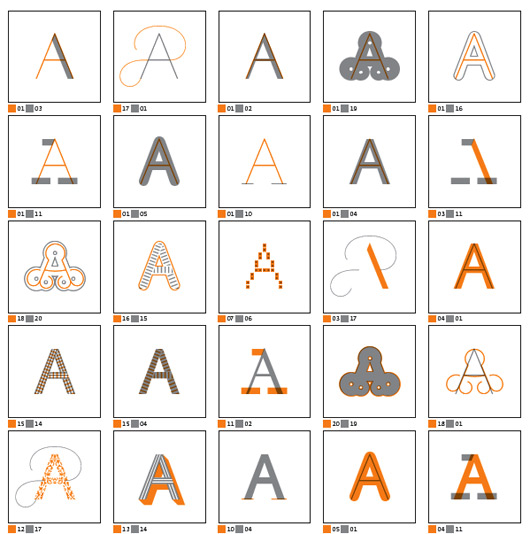
This week I finally got around to watching the documentary Helvetica, and now I can't stop seeing the font everywhere I go (Atlantic coverage of the film here). Paul Shaw over at Imprint challenged readers to guess the reasons behind his list of the top 10 most important typefaces of the last decade – not his favorite or the prettiest – but the most important. Spoiler alert: he reveals his rationale in the comments section.

(Image of History typeface; designer: Peter Bil’ak, 2008)

Against Naked Shilling

by Zoe Pollock

Matt Zoller Seitz is proud of Jean Luc Godard for staying incognito and not responding to the Academy's invitation to accept an honorary Oscar in November:

I love this. Normally the academy says, "Jump," and almost any director alive says, "How high?" Godard can't be bothered. In fact he can't be found. …

And what about you, reader? Right now you're probably reading this with two or three other windows open on your computer screen and your cellphone on. When a new e-mail or phone call or text message comes in, maybe you hear a little noise, a "ding," like the bell that made Pavlov's dog's ears perk up.  And you look to see who's trying to reach you and what it's about. Maybe you answer immediately, maybe you wait, but you always pay attention because you feel like you're missing out on something, and on some level you're terrified that the world's going to stop turning if you're not on top of it all. Godard could not care less.  The world keeps turning. I bet he's sitting in a park right now, reading Le Monde and smoking his fourth cigar of the day.

Smart Home

Happylife-vignette-550x412
by Zoe Pollock

Nathan Yau reviews the eerie experiment that is Happylife, a smart-home machine that can monitor a family's moods by reading facial expressions with a thermal image camera. Eventually the system would be able to predict different emotional states, having accumulated data over various years. From a series of vignettes by a family with Happylife in their home:

We installed Happylife. Not much happened at first: an occasional rotation, a barely appreciable change in the intensity of light. But we felt it watching us, and knew that some kind of probing analysis had begun. After only a few months, we found ourselves anticipating the position of the dials. The individual displays rarely contradicted our expectations, but when they did it encouraged us to look inwardly at ourselves.

About My Job: The Community College Professor

by Conor Friedersdorf

A reader writes:

I believe the assumption is that instructors are the product of a liberal-biased education and then we decide to join that liberal bastion and are just going with the established flow. For those of us in the junior college ranks, however, I think there is a more concrete reason for the lean left, rather than the abstract leftism offered in certain courses we took as students.

When I hear friends and family offer specific illustrations of why they list in a more conservative direction, it often has to do with anecdotes revolving around the person they check out at the grocery store using food stamps to buy a jug of Carlo Rossi zinfandel or spending their welfare check on some other decidedly non-essential item. Or the stories they hear from mutual friends in law enforcement or social services who deal with the dregs of society on a daily basis. Who could possibly support any form of social safety net when a portion of that net will be devoted to such vermin?

Well, on an equally anecdotal and emotional level (not pillars of rational thought, granted, but clearly major inspirations for why and how most people choose a side) we here at a community college tend to see the better side of our fellow humans who are struggling on the low end of the economic ladder. We see them trying to better themselves, working hard in spite of their conditions to try and take a step up said ladder. Hell, some of them may even be spending public money on a pack of Winstons, but we don't see that. We see them in their best light, for the most part.

And that's what I want people to know about my job: I don't have empathy for poor people because I read Sinclair Lewis or Karl Marx; I have it because I work in an environment in which I see them at their best. Some of them are clearly not cut out for college, some of them are unpleasant to deal with, some of them probably do spend their meager checks on stupid things. But they are also trying to change their lot. And they have much less margin for error in doing so. If I taught at an elementary school or high school, I may assume that the kids in my classes were on their way to the destinies that social research and my own perceptions had fated for them. If I taught at a university, I would never meet people who take an English class so they can legitimately compete for a promotion at the hotel chain in which they work, or pass the nursing program to get their AA degree. The world would be easier to categorize. But since I work in the gray area between, I know that it's not that easy, and that people defy your definitions for them all the time.

The Palin Model, Ctd

by Chris Bodenner

Jan Brewer runs for the border. Money quote:

[She] has put the kibosh on all future debates with her Arizona gubernatorial opponent Terry Goddard (D), after her rather embarrassing display at Wednesday's debate. "I don't believe that things come out in proper context in an adversarial atmosphere," she defended herself.