Face Of The Day

SoldierSonMattCardyGetty

Royal Marine Sgt Danny Smith smiles as his son Oliver wears his hemet, as they are reunited at Norton Manor Camp Barracks following his six month deployment to Afghanistan on October 6, 2010 in Taunton, England. The Royal Marines from 40 Commando have returned home after a six month tour Afghanistan, during which 14 marines were killied and 11 were seriously injured. About 600 marines had been serving since April in the Sangin area of Helmand Province before it was taken over by US forces in September. By Matt Cardy/Getty Images.

It’s The Candidates, Stupid

Larry J. Sabato wonks out on two races this fall where candidate selection may make all the difference. Nevada:

In a year when Democratic Majority Leader Harry Reid is being severely tested in Nevada, the state’s Democrats chose to balance the ticket by nominating his son Rory for Governor. That’s right, a controversial and embattled U.S. senator in dire straits was paired on the ballot with a dynastic candidate from his own household, thus offering the voters two helpings of an unpopular surname. Tea Party Republican nominee Sharron Angle is so controversial that she may reelect Harry Reid—though few seem willing to bet on that outcome—but the Democrats have ended their hopes for the governorship already. Republican nominee Brian Sandoval should easily dispatch Rory Reid on November 2nd. By the way, should Harry Reid survive, it is Republicans who will regret their failure to recruit a sure winner like Congressman Dean Heller, who probably would have been elected to the Senate with many votes to spare.

California:

Jerry Brown was a strange choice to be the Democratic nominee for Governor of California in an anti-establishment year. This lifelong politician and former two-term Governor is a throwback to the 1970s and a very different time in the Golden State. The truth is that few promising, fresh candidates even considered a candidacy to run this massively troubled state, and in the end Brown was virtually unopposed for the Democratic nomination. If anyone who might be in charge of California’s hopeless budget and paralyzed governmental system could be called lucky, Brown is fortunate to be running in a state that is now so deeply Blue that this intrinsic partisan advantage may get him elected over Republican Meg Whitman. Yet Whitman is pulling out all the stops, having spent over $119 million of her own money on the campaign, more than any political self-funder in American history. For Whitman, a campaign fundraiser is lunch with her accountant.

What The Hell Is Happening In Iraq?

SHIITESAhmadAlRubaye:AFP:Getty

It was reported late last week that Iraq might finally form a government by Prime Minister Nuri al-Maliki giving more power to Muqtada al-Sadr. A few thoughts from those paying attention (and it's quite amazing to me how many are not). Abe Greenwald:

This represents a potential ruling alliance of strong-arm statists and radical Islamists. To get the full measure of how depressing that is, recall that one of the best strategic justifications for the initial invasion of Iraq was to head-off this very same toxic fraternization. There is always the chance that this story is being blown out of proportion in an otherwise static political landscape. But if not, it could mean much greater Iranian influence in Iraqi politics.

Joel Wing:

A new Iraqi government is still weeks, possibly months away. Allawi, Maliki, the Supreme Council, and the Kurds all have long days ahead of them trying to win over others to their positions. What the course of events so far points out is that Maliki has been the main focus of talks. His rise to power after being a weak and compromise candidate back in 2006 has worried all of the other parties about what he might do if he stays in office. Foreign powers such as the U.S., Iran, Syria, Turkey, and Saudi Arabia only have limited influence in these negotiations. Tehran for example, put together the National Alliance before the March vote, then got Maliki to join them afterward, and many believe their pressure led to Sadr's about face on the premier. At the same time, the Supreme Council has now split from the Badr Organization, which use to be its militia, and divided the Shiite vote in the process, which Iran spent so much time trying to unite. That shows other countries can help shape events, but Iraqis will ultimately decide on the future of the next government. The problem as ever is that very few are willing to compromise. That’s the reason why a new ruling coalition is still a long way off.

Joe Klein:

The Maliki-Sadr deal raises an absolutely crucial question: what about the Sunnis? This is precisely the government that the Sunni minority feared; they backed secularist Ayad Allawi, the top vote getting in last spring's elections, who will now be firmly shut out of power. This may see a revival of the Sunni insurgency that David Petraeus quelled with cash in 2007.

And what about, well…us? It is not certain that the Maliki-Sadr alliance will tilt toward Iran. Sadr has been anti-outsiders of all sorts in the past. But this does look like something less than the "victory" that John McCain and others were noisily touting last month.

Iraq Pundit:

[Maliki] still needs four more votes in parliament to secure the job. Maliki knows he needs the Kurds, and at least one story says [Arabic] he has them. Ayad Allawi's spokeswoman says they, too, are talking [Arabic] with the Kurds. Apparently Allawi's people are talking with everyone, including the Badr Organization. They have one thing in commong with Badr, the group opposes Maliki's second term. 

Max Boot:

Is Maliki’s recent success good or bad from the American perspective? At this point, it’s still hard to say. Obviously, the fact that the Sadrists — the most anti-American faction in Iraq — will be part of the government isn’t good news. But nor would it have been good news if Maliki had made a deal with ISCI, another major Shiite party also seen as extremely close to Iran. Some analysts are suggesting that these latest developments mean that Iran is calling the shots in Iraqi politics. I wouldn’t be so sure. There is no question that Iran has an influence but it is hardly in charge. No one is. At some level, this is good news for a country like Iraq, which has been scarred by so many years of dictatorial misrule. But there is a thin line between inclusiveness and chaos and Iraq is now on the border between the two. The failure of a political class to agree on a coalition government is undermining public confidence and providing an opening to both Sunni and Shiite extremists.

Juan Cole:

All in all, Friday’s developments seem highly likely to pave the way for a second term as prime minister for Nuri al-Maliki. He and his coalition partners will be more beholden to Iran than ever, and if I were the US Department of the Treasury I wouldn’t expect much Iraqi help with those sanctions on Iranian banks.

Game, set, match to Iran.

Ranj Alaaldin:

All eyes, particularly those of the west, will be closely fixed on what Maliki offers the Sadrists in return and especially whether he gives them the security and defence ministries they have desperately coveted. Sources suggest they will instead get a total of six service ministries, crucial still for the Sadrists since this will allow them to expand their grassroots political base. Maliki may also appease them by releasing some Sadrist prisoners, if not all of them. The west will be concerned, however, about suggestions the Sadrists could get one of the deputy prime minister positions that includes with it the defence and security files.

Tom Ricks:

It will be interesting to see the relationship between American advisors and units commanded by Sadrists. ("Hey, were you at the Route Gold all-night firefight back in spring 2004? So was I!")

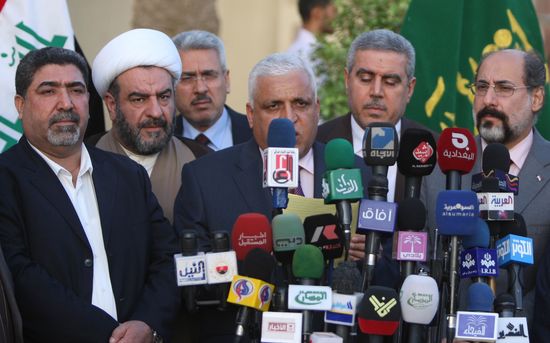
(Photo: : Nassar al-Rubaie (L) from the radical Sadrist movement, Shiekh Abdul Halim al-Zuheiri (2nd L), Minister of Education Khudair al-Khuzai (2nd R) and Hassan al-Senaid (R) of State of Law Alliance a Shiite Muslim grouping listen on as Faleh al-Fayad speaks to the press in the ground of the offices of the Sadrist movment in Baghdad on October 01, 2010, as Iraq's main Shiite parliamentary bloc chose incumbent Nuri al-Maliki as its candidate for premier, possibly clearing the way for an end to the country's seven-month political deadlock. By Ahmad al-Rubaye/AFP/Getty.)

Handicapping The Horserace

Harry Joe Enten does the math:

Republicans [are] on their way to gaining back a majority. The exact seat gain will remain uncertain until right before the election. The present Cook Political Report ratings and generic ballot suggests that Republicans will gain 50+ seats, which matches my prior February estimate. The one thing I am certain of is that something quite unusual would have to happen for Democrats to hold onto the House after November 2nd.

The question for me is whether the FNC/RNC frenzy, combined with mere usual Democratic turnout, could tip the Senate too. And since that frenzy is based on rabid fantasies about what is actually happening in the world, the next question is whether that will then pierce the current far right bubble, or enable it to grow some more.

My bet, if I had to make one, is that the FNC/RNC will do extremely well, get even more wacky, overplay their hand, nominate Palin for president and then usher in a real and more solid Democratic majority with Obama empowered in ways he hasn't been so far. Which is worse for conservatism – and the country – in the long run than constructive engagement with the president now.

But that's a scenario far too far ahead to predict for sure. The economy is the wild card. If we really are entering an endless jobless recession, all bets are off. But the wilder the right gets, and as long as Obama doesn't take the bait, his calm and reason will win the day in the end, especially if the economy recovers and the wars end.

NATO Isn’t Worth Our While?

That's what Daniel Larison thinks:

In the end, the main argument for perpetuating the NATO relic is that it provides the support structure for projecting power into remote parts of the globe where American interests are even less clearly defined. In other words, what once was a purely defensive alliance dedicated to European security now has little to do with either defense or Europe. The Alliance is not only outdated for America’s European allies, who increasingly see no reason to participate in "out-of-area" missions, but also functions as a potential enabler of American involvement in parts of Asia and Africa where no vital American interests are at stake. By keeping NATO in existence, Washington leaves itself open to the temptation to meddle in far-flung parts of the globe, even as it provides the superficial "multilateral" cover to make U.S. military intervention overseas more politically palatable.

It's hard to imagine that sans NATO that Bush/Cheney would've foregone meddling. But in the coming necessary debate about serious defense cuts, this kind of real debate, outside of what Andy Bacevich calls "Washington Rules", is exactly what we need.

Letting It Burn

The story of a home burning to the ground because the owner wasn't up to date on his fire protection payments has been picked up by an obscene number of blogs. Here's the lesson Ezra draws:

The South Fulton Fire Department was right to let the Cranicks’ house burn. You can’t sell fire insurance but let people pay after the flames have begun. If you do, people will sign up after their houses catch on fire, rather than before. That’s a bad business.

Which is why we don’t generally run firefighting as an insurance business (this, actually, was a weird case where a city’s fire service sold protection in a rural area outside the city’s limits). We run it as a collective good. People have to pay, and firefighters never let someone’s house burn. We’re comfortable letting people make bad financial decisions when it comes to their television purchases, or the car they drive, or whom they date. We’re not willing to do it when the consequence is that they and their children quite literally die in a fire. But that’s what free-market firefighting would require.

Reihan dissents. Tyler Cowen looks at the wreckage from a different vantage point:

Any social system must, at some stage of interactions, impose some morally unacceptable penalties.  If you are very hungry, and you shoplift food, they still might prosecute you.  If you don't pay your taxes, and resist wage garnishes, they might put you in jail.  If you resist arrest, they might, at some point in the chain of events, shoot you while trying to escape.  Somewhere along the line there is a doctor who can treat your rare disease except he doesn't feel like working so much, and so he lets you die or suffer; you can find both private and public sector examples here. 

Social systems proceed by (usually) covering up the brutalities upon which they are based.  The doctor doesn't let you get to his door and then turn you away, rather his home address is hard to find.  The government handcuffs you so they don't have to shoot you trying to escape.  And so on.

And Ozimek doesn't think that this incident discredits libertarianism.

The Dems And Prohibition

Jacob Sullum reminds us that supporting Democrats won't hasten drug legalization:

Obama embodies the disappointment that almost always awaits voters who think Democrats will enact more enlightened drug policies because they sound more enlightened before they gain the power they seek. As a senatorial candidate, Obama advocated marijuana decriminalization, a position he renounced when he ran for president. As a presidential candidate, he said he would end the DEA's medical marijuana raids, a promise he broke after he was elected. So far he has waged the war on drugs, which he once called an "utter failure," in pretty much the same manner as his predecessor, only with more money. The one substantial improvement in federal drug policy since Obama took office is crack sentencing reform, which he supported. But that change was in the works for years and had already attracted support from many Republicans. Meanwhile, Obama literally laughs at the voters whom Democrats hope will turn out for them now.

The United States has a very difficult time ending ruinous wars we're doomed to lose regardless.

It Gets Better, Ctd

A reader writes:

Just as the latest suicides happened this September, a new coming-of-age movie came out, Easy A.  The lead character, high school student Olive, agrees to pretend to have sex with the bullied gay boy to get his tormentors off of his back.  I took my fifteen-year-old son to see it last night with a packed audience of young people.  They loved it.  I thought the film was great, but I'm surprised I haven't heard it mentioned yet in the "It Gets Better" discussion.

I realized afterwards that one of the reasons I love the film so much is because it's about my own high school experience.  For those who knew what I was doing, the derogatory term for me was "fag hag". 

I was the stand-in girlfriend for anyone who needed a cover.  I kissed and cuddled for the benefit of parents and showed up at gay friends' workplaces roleplaying as their girlfriend.  It was necessary back then (the '70s) for them to keep their jobs or not be thrown out of their homes before they finished school.   I could create enough doubt in the bullies' minds to keep these boys from being harassed.

Like Olive, in the film, I gained a reputation, even though I was still a virgin.  I didn't care because it helped make those boys lives more bearable.  Perhaps "fag hags" like me are the unsung heros that kept countless young gay man alive until they could live their lives openly.