Larison moves the debate to firmer ground. I agree with him on the underlying point about state secrecy. I'm grateful for his nuances on some of the other issues.
Month: October 2010
The Telos Of Banking
Noah Millman asks what banks are for:
The classic function of a bank is to turn savings into capital. They borrow from the public in the form of insured deposits. They then deploy this capital in the form of loans of various kinds. Their job, in other words, was to evaluate and hold risk – the risk of those loans. And for taking that risk, they earned a return.
But in the world we actually live in, banks have labored to make themselves appear to be service businesses that earn fees rather than risk-taking businesses.
Indeed, risk is a bad word – and remains a bad word with the financial reformers. The new job of banks, say both the banks themselves and their regulators, is to be financial intermediaries. They don’t lend money against a house as collateral; they intermediate between a mortgage borrower and an investor in a mortgage-backed security. They don’t lend money to a business; they intermediate between a company looking to borrow money and an investor in a collateralized loan security. They don’t even take deposits; rather, the intermediate between short-term corporate borrowers and investors looking for near-cash instruments. And of course they intermediate between the various participants, hedgers and speculators, in the wide variety of over-the-counter derivatives markets.
The rest of the post is a really astute look at how this transition explains the financial crisis. The short version of Millman's conclusion: he thinks banks should return to their traditional role, and the recent financial reform doubles down on their new role.
It Gets Better, Ctd
A reader sends the video above. Another writes:
I'm a Democrat, liberal, progressive Christian, and the rector of my Episcopal church. My husband and I also posted a video to Dan Savage's project, because we felt it is important to show that people of deep Christian faith can also be gay, out, proud, and … HAPPY.
I think Dan is right, however: That Christians (or people of any faith, or no faith) who are silent in the face of bigotry or stereotype-engendered bullying are complicit. Parents who don't say to their kids, "That is wrong. Do not say that again," are complicit. Parents who allow their ministers to preach intolerance are complicit. And that complicity leads to tragedy.
Against Senses Of Things
David Sosa argues against life inside the matrix:
There’s an important difference between having a friend and having the experience of having a friend. There’s an important difference between writing a great novel and having the experience of writing a great novel. On the machine, we would not parent children, share our love with a partner, laugh with friends (or even smile at a stranger), dance, dunk, run a marathon, quit smoking, or lose 10 pounds in time for summer. Plugged in, we would have the sorts of experience that people who actually achieve or accomplish those things have, but they would all be, in a way, false — an intellectual mirage.
James Poulos expands on that point.
What Progress Looks Like
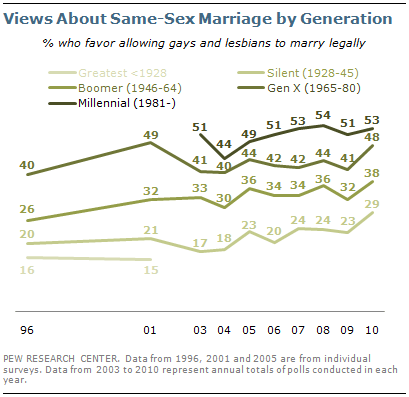
Pew finds record support for marriage equality. Notice that support has increased in every generation over time, with a clear backlash moment in the first years of the new century. And notice too that the biggest recent increases have come from the older generations. Kincaid celebrates:
[W]hile the results are predictable (supporters are younger, educated, Democratic, liberal, and female), there are sizable portions of non-traditional supporters who now favor equality:
38% – men
35% – Southerners
34% – high-school or less
30% – African Americans
28% – age 65 or older
24% – Republicans
16% – “conservative” Republicans
14% – white Evangelicals who attend church weeklyWhile some of these numbers are small, they are the one which give me the most hope. If a quarter of all Republicans (and 1 in 7 conservative Republicans) support equality, then it can no longer be assumed that the party will hold together much longer in ideological opposition to decency.
These smaller percentages still influence the conversation at the senior center or the church potluck and challenge presumptions that might otherwise yield near unanimity of opposition to our rights among some demographics. And all of these categories show increases in support over the last year.
And I think there is an odd relationship between big losses in the courts or referendums and subsequent support. I have a feeling that the failure of the gay forces in Prop 8 and the images of crushed couples and disappointment may have led to a reaction of sympathy and a subsequent rise in support. The last year certainly seems to have been remarkable in the shift in favor.
In civil rights movements, it is often when majorities see minorities losing that their sense of fairness revives and their support for civil rights increases. But when such things are seen as being imposed too quickly, the opposite occurs. What matters is how these gains and setbacks influence public opinion over the long term. The answer to that seems pretty clear by now, barring some massive cultural panic.
Yes, We Are At War: Your Thoughts I
My apologies for the delay in this. I was traveling and spent a wonderful if completely draining day at Philips Exeter Academy, and am behind on a lot. So here goes. A reader writes:
The Yamamoto analogy won’t hold water. Yamamoto was a uniformed officer of an enemy navy. There was simply no issue concerning the propriety of U.S. forces killing him, just as there would have been no issue as to the propriety of Japanese forces killing Nimitz or MacArthur if they had the means to do so. Indeed, Yamamoto probably would not have contested the right of U.S. forces to kill him, because he knew what his status as a uniformed combatant meant.
Awlaki does not have this status. The government says that he is an enemy combatant, but there are no indications of that status other than untested hearsay. Because the field of battle in this war, if it is one, is undefined, there’s nothing about where he is or what he’s wearing that proclaims his status as an enemy combatant, nor is the government’s claimed authority to kill him contingent upon him carrying a weapon.
"Untested hearsay" is absurd. He is a proud member of and supporter of al Qaeda and trainer and indoctrinator of men captured in the act of terrorism. As such, killing him if he cannot be captured is well within the laws of war. Another:
You say that Awlaki is "actually an American citizen fighting the US on enemy soil." Yet, to my knowledge, you can't cite a single overt act undertaken by Awlaki in this 'fight'. You can't name any act, carried out by others, either directed or facilitated by Awlaki. You quote Awlaki as denying any role in directing or facilitating the undie-bomber attack ("I did not tell him to do this operation, but I support it"). You claim that Awlaki told some other people to call for killing American forces operating in Yemen. Perhaps he did, but I'm not sure that's an act of war. If it is an act of war, then are not Gingrich, Bolton, etc – who constantly call for war on Iran – also guilty of an act of war against Iran?
If you are in an al Qaeda training camp in Yemen, indoctrinating people to kill in the name of God, you are part of the enemy's apparatus. If he were merely issuing fatwas from London, it would be another matter. Was Goebbels not a legitimate target because he was only a propagandist and not on the actual field of battle? And Awlaki revels in membership of al Qaeda and its aims and beliefs. This is a terror network. Not everyone in it is literally carrying out operations. Bin Laden only planned the 9/11 attack and has subsequently recorded tapes. Is he now out of bounds for military attack? And it is untested hearsay that he was the mastermind; it has never been proven in court. The undie-bomber claims he was trained in a camp by Awlaki. Another:
You bring up the example of Osama Bin Laden. Here is a counter-example: There is a guy that runs an Islamic terror website in, say, Oman. We have evidence he has met with terrorists, he uses his soapbox to "indoctrinate" and "advocate", and he takes materials from them (say, beheadings, OBL videos) and dissimeniates them, although we have no direct evidence he has ever knowingly relayed orders. This man is an American citizen, he is in a neutral country, but he is also a self-declared "member of Al Queda".
Is it just to order his assassination?
I'm not saying this to be cute, or to downplay the seriousness of the threat of the Al Queda network. I don't really know what Awlaki is up to. But it seems to me, at least based on those public domain charges you're bringing against him, that his example is closer to mine than any of yours. You take it as a given that his specifics lead to the justness of this specific sentence, when it's not at all clear to me. And isn't the very uncertainty of it reason enough to arbitrate and review these kinds of things (which, again, is anti the Obama position that NOBODY should arbitrate and review these kinds of things, which is the core administration belief that is the core of this disagreement).
But that's the problem by having these things so amorphous. You needn't be a terrorist … just terroristic. And what is terroristic is endlessly open to interpretation – only interpretation is not open to debate, but rather dictated behind closed doors. You don't have to threaten the government to be a threat to the government; you just have to dislike things the government does. You don't have to be a terrorist to trigger anti-terrorism measures; you just have to like terrorism enough.
The extent to which we take these things OUT of the hands of interpretation and put them IN the hands of transparent, reviewable, and appealable arbitration, the freer we are – by far. But under Obama, as under Bush, we are being forcibly shoved away from the latter, and towards the former.
I don't disagree with a lot of this, which is why I am not advocating the killing of many, or doing so with glibness. We are talking of at most four or five individuals in this category. And I would indeed like to be able to capture Awlaki and put him on trial. The point is whether a commander-in-chief, if he believes this man is an active threat, can practically achieve that, and if he cannot and somehow has an opportunity to kill him instead, whether it is an outrageous act of tyranny or assassination to do so. I don't think so. Another:
I’m willing to concede that Awlaki is an easy case. His own words appear to convict him. But once you say that he is fair game, where do you draw the line? If he hadn’t made any public statements, would he still be fair game? And then how would we know? I’m not sure it’s really possible to draw a bright line and say this or that is acceptable/unacceptable. The ruling that an American citizen cannot be killed – or assassinated, I don’t care about the choice of words – other than on the battlefield appears to be a bright line that we should live with today.
What concerns me most is where the notion of assassinating an American citizen overseas may go. If we were to have President Palin or President Demint, and if a U.S. citizen overseas were to vocally proclaim – like Nevada senate candidate Angle – that Americans should protect their Second Amendment rights and remove a president that is not following the Constitution’s separation of church and state, for example, would President Palin be justified in ordering his killing? I would strongly argue no, but we know she is vindictive and the policy would potentially give her cover. And the analogy needn’t be just a right-wing president taking out a left-wing agitator. You could construct a similar scenario with a President Grayson. In either of these scenarios the question would become how far could someone go in agitating against the policies of the U.S. and not be fair game for killing?
This is indeed a very strong point – and it is the weakest part of my argument. There is indeed a danger of over-reach here and of precedents leading to things much worse. I wish I had all the intelligence that would allow me – and you – to make a much more precise judgment as to the capacity to capture him and the actual danger he represents, and the imminence of it. But we don't. Another:
I think you enlightened me with the example of Yamamoto. In particular, I think many, many people would respond to say that Yamamoto's killing was an assassination. And I think they will say this because "assassination" has a definition that has slowly moved, and I think a more modern definition is this: When you kill a man with a face and a name, and you want to kill him more than the man next to him, that is assassination. I look at my slush pile (I'm an editor at a book publishing house) and read all of the alternate-history fiction where "Hitler is assassinated by commandos." I think about the ever-popular Japanese ninja, who routinely climbed into the castles of enemy generals and "assassinated them" to bring about a victory in war. This is the crowd-sourced definition of assassination.
When your hypothetical American fighting with the Nazis is stuck by a bomb or a grenade or one of a hundred bullets shot into a bunker, he has been killed in war. But when an entire mission is begun and carried out to "get Yamamoto," there is something far more personal and brutal about it. This is how war used to be, but ever since gunpowder first went bang, we've tried to make it about something else. Assassination is what it looks like when war gets personal again, and people squirm at the thought of it.
And this might be the crux of it: people see the proposal to "get Awlaki" and they see the target that has a face and a name, and they think about how we care a lot more if the drone attack kills him instead of the four guys next to him, and they think assassinate; they think "ninja." And then they combine this idea with his citizenship and the thought of a government ordering its assassins out, and they recoil against a government with the power to do such a thing. And of course the government has such power exactly because we want the government to send out its best ninjas, to find bin Laden, and to assassinate the crap out of him! I find it fascinating, to be honest.
Another:
I appreciate your effort to think this through and to try to articulate how you have come to your position. I also appreciate that, in the give and take of dialog, and as you think this through, there's bound to be some shifting of ground, backtracking, etc. I don't mean that in any pejorative sense – only that it is natural, and only to point out that it has the potential to create confusion.
By way of example: Last week you opined that the President's authority to kill Awlaki was confirmed by the SCOTUS in ex parte Quirin. I'm still not clear on what you meant – ex parte Quirin established that the President had the authority to try citizens in arms against the country, in military tribunals, without court interference. As trying Awlaki is precisely what many of us are asking for – whether by commission or otherwise – I can't see how you can reasonably read it to support not trying him before killing him. I wonder if you could clear that up?
I would like to try him in this fashion, if we could. We're taling here about exhausting all other possibilities and the practicalities involved. My point is that the ex parte Quirin case establishes that US citizenship in and of itself does not provide immunity against military justice when you are in an enemy fighting force. That implies to me that it doesn't provide immunity from being killed in combat either. What we're struggling with is how we define combat and military in this kind of war.
In the case of Awlaki, I remain of the view that he is a legitimate military target, if all other methods are exhausted.
Why They Hate Us
Glenn Greenwald reasserts the backlash thesis:
Obviously, religious fanaticism plays a role in causing people to be willing to give up their own lives, but so constant and consistent is this claimed rationale from Terrorists — we’re doing this in retaliation for U.S. actions in the Muslim world — that it should no longer be questioned or doubted what principally motivates these attacks. It’s one thing for Americans to argue that we have the right to engage in these actions, that we are justified in doing them, or that we somehow are doing Good Things for Muslims with our bombs and drones even though these primitive ingrates don’t realize it. But it’s another thing entirely to act shocked, surprised or confused when our endless (and still-escalating) stream of bombings, invasions, occupations, and other means of control in their part of the world end up provoking a desire to retaliate and return the favor. It’s not just expected that our actions will produce these reactions, but inevitable. It’s the most basic part of human nature there is.
As always, the issue is not justification — it is inherently unjust to deliberately target civilians with violence — but causation… The very idea that we’re going to spend an entire decade dropping a constant stream of bombs and other munitions on and in multiple Muslim countries and otherwise interfere in their governments — and then expect that nobody will try to attack us back — evinces such a child-like sense of imperial entitlement that it’s hard to put into words.
The fact is that the average American can’t even fathom the fact of innocent Muslims killed by Americans because when these errors are made they seldom appear in the newspaper or on the nightly news alongside photographs. This is true of casualties on our own side too. The sanitization of the War on Terrorism is a striking avoidance of reality, whatever one thinks of its justification or root causes. That’s why we try on the Dish to provide these images – the kind of images that gave Michael Ware PTSD and that actually make up this abstract war so many of us don’t ever fully see.
And therefore don’t fully understand. One small note: what will you learn nothing about in Bob Woodward’s book on Obama’s Afghanistan war? Afghanistan.
The Market For Epistemic Closure

Jon Chait explains why MSNBC won't equal the success of its rival:
…you'll never have a liberal equivalent to Fox News that has anything like the same level of success. Conservatives believe that the mainstream news is fundamentally corrupt and untrustworthy. They want a fully closed information ecosystem in which every piece of data they consume is filtered through the perspective of the conservative movement. Very, very few liberals want that.
And they're better off for it. Image from MSNBC's new "lean forward" campaign.
The Road Away From Serfdom
David Frum reminds us just how freer and more dynamic the United States economy has become over the last fifty years. It's a useful empirical rejoinder to the panic of the Beck right:
Think back to 1960. The federal government regulated the price of every airfare. It regulated every rail, truck and shipping route. It regulated the price of natural gas. It regulated stockbrokers' commissions. It regulated the interest rates that could be paid on checking accounts. It told most farmers how much they could grow of what commodity. It regulated what kind of political and religious comment could be expressed on the airwaves. And of course it conscripted millions of young men beginning their careers into the armed forces.
All of that is gone, gone, gone.
True, in other ways society is more regulated than it used to be. There was no Clean Water Act back then, no Americans with Disabilities Act. I think most Americans — even most Tea Party members — support the new environmental and antidiscrimination acts that have replaced the old regulation of transport, energy and financial pricing. But whether you support the new laws or oppose them, it's just wrong to say we're treading a one-way road to serfdom.
He goes on to acknowlegde that the size and cost of government are major concerns.
The GOP’s Fiscal Fraudulence, Ctd
As they say in France, regarde:
 The Dish