This is up there with the classic Matt Stone memo:
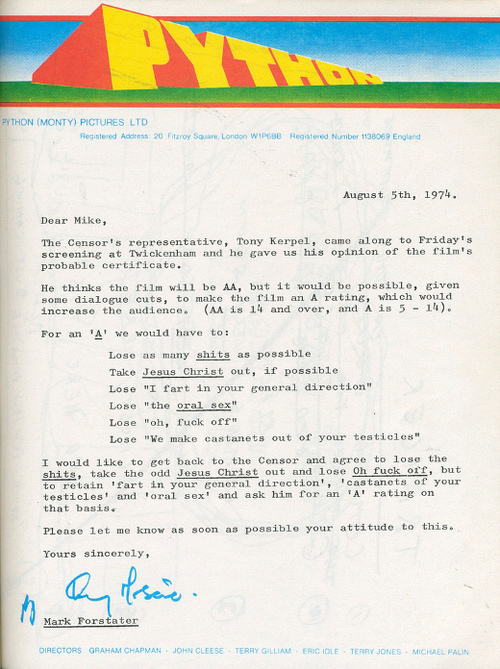
This is up there with the classic Matt Stone memo:
Douthat has a sane response to Kristol:
America’s military edge won’t be sustainable at all if we go bankrupt, lurch from debt crisis to debt crisis, or get stuck in a debt-driven economic stagnation for years or decades on end. And the Brooks-Feulner-Kristol argument for leaving defense spending untouched (“defense spending has increased at a much lower rate than domestic spending in recent years,” they write, “and is not the cause of soaring deficits …”) sometimes resembles the slightly-evasive arguments liberals use for ring-fencing Social Security spending — that it isn’t the biggest chunk of the long-term deficit, that it’s projected to claim close to the same share of G.D.P. over the next few decades while Medicare spending explodes, etc. These arguments aren’t wrong, exactly, but they’re both ways of dodging the reality of just how big a share of our budget the outlays being defended really claim.
Today on the Dish, Andrew stayed his ground in the aftermath of Greenwald's barrage and seconded Hitch on the power of the pro-Israel lobby. Conservatives had to come to terms with the war on drugs if they wanted to argue limited government in Obamacare, and Niall Harbison only needed Twitter for his news but Andrew disagreed.
Christine O'Donnell was not a witch unless you are, because she's you, but it was her China conspiracy theories that put Fallows over the edge. Ezra took Friedman to task on third party possibilities, Silver came to Friedman's defense, but was skeptical of Gallup's likely voter model. Obama's poll numbers eerily reflected Reagan's, while Glenn Beck dropped some Mormon code against Obama. Beinart envisioned failure for the Tea Party on slashing spending, while the U.S. was still number one in defense, with more than half the entire world's defense spending. Volokh disassembled the wall between church and state, the rebirth of books happens every six months, and a word to the wise: do not combine Canada with an i-phone.
Mormon Dish readers bucked Packer's homophobic remarks, The Wire had lessons for New Haven, and Schwarzenegger's progress on pot was overshadowed by the lack of progress on other drug issues. Surowiecki mined the philosophy of procrastination, and gay-bashing also threatened straight men. Abstinence only education continued to be funded, and Iran interrupted the lives of its young, but most Americans still weren't anywhere close to supporting a war with Iran. Pet Shop Boys' new single likely kept the band "Together," Andrew feared no beard, and Larry Kudlow didn't like the looks of Obama hugging Rahm. Readers defended their vegetable gardens, creepy ad watch here, Malkin award here, VFYW here, MHB/ VFYR here, FOTD here, and VFYW contest #18 here.
–Z.P.
Dan Savage defends his project against the naysayers who complain that it doesn't go far enough:
I admit that [It Gets Better Project (IGBP)] doesn't do the impossible. It doesn't solve the problem of anti-gay bullying, everywhere, all at once, forever. The point of the videos is to give despairing kids in impossible situations a little thing called hope. The point is to let them know that things do get better. For some people things get better once they get out of high school, for others things get better while they're still in high school. And some kids, like the kid above, are helping to make things better for other kids who are in still high school. But things do get better and kids who are thinking about suicide need to hear that.
Both E.D. Kain and William Brafford share their high school experiences. And a high school teacher celebrates the IGBP:
I just wanted to chime in on the thread you've been running on Dan Savage's amazing project "It Gets Better." As a straight high school teacher, I have often felt powerless to help my GLBT and questioning students see beyond the misery they confront every day. I can do a lot for them–I can offer support. I can bring in gay friendly texts (I teach English) and insist upon respectful language. I can even teach students how to talk about GLBT issues in productive ways. And I can say that it does get better, but when I do so, I am not speaking from personal experience. The video series does that for me in ways I could never achieve. What a powerful teaching companion. I feel so supported by the project, even though I am not the intended audience.
Your reader questions why high school is the way it is–why is it so miserable? What is it about how we set up high schools that makes it so difficult for so many students? The only answer I can provide is that high school is like any other social institution. It mirrors societal expectations and values. On LGBT issues, high school students are actually at the forefront of pushing toward equality. Polls routinely show that young people are much more accepting of LGBT folks than those from older generations. But there is still a lot to be done, and the "It Gets Better" project provides an accessible, honest, very human helping hand to students who often feel so alone. Just today I pulled one of my students aside and showed him the site. He was blown away, and so thankful, as he's having a really tough time at home with parents who are not dealing well with learning about who he is. So, it is helping.
Another reader remembers the difficulty of high school:
I have to say that I agree with Jason on this point. High school is essentially a prison for adolescent youth. It not only negatively affects gay people, but also highly intelligent people and fringe people as well (think “Freaks and Geeks”). The most well treated people are either people that bring the school athletic victory, or those people who are essentially viewed as successful social climbers.
I would go on and on, but I think that the person who says it best is Paul Graham, in his book “Hackers & Painters” which is really about computer science, but has a chapter long treatise at the beginning about the evils of the high school system. You can buy it here.
Essentially, his way of stating it is that high school does not value the people that are trying to seek the right answers to problems, it values those who are trying to please others, and pleasing others includes putting down those who are different, or those who are more intelligent, and, as Jason alludes to, developing cliques. Basically, ‘It Gets Better’ is the same message that some people (teachers, guidance counselors) gave me after having to deal with bullies, wedgies and the like day, after day, after day. It takes way too long after high school for that realization to actually take effect. I didn’t feel like I had developed real confidence until I was about 26, and the real picture of my success as a software engineer had taken hold. This is probably true for many gay people as well.
High school is the least supportive, most horribly incentivized environment we can possibly give our kids to grow up in, and we can do better.
Another reader's experience differs:
You know, it's strange. When I see movies or TV shows about high school, or read about it books, it's like they are talking about another country. So much of the described American high school experience seems alien to me. You would think that I might have been a candidate for the underclass: hyper-smart, not a jock, read books all the time, did speech and drama. I was not the class clown. Hell, I even played Dungeons and Dragons! But I wasn't an outcast and was even friends with more "popular" kids.
I think it was because I went to a small school in a small town. There wasn't room for kids to divide up into cliques. There were jocks in the band, drama people in Vocational Agriculture. There simply wasn't space enough for people to become the "other". And I wonder if our massive urban high schools don't create that space, full of people of wildly varying physical and mental development, given the room they need to create tribes where cross pollination isn't just frowned upon, it is almost impossible.
I don't want to suggest my experience was Nirvana. A gay person in my day would have had a tough time of it. There was still a pecking order, just a more fluid one.
A reader writes:
In the past six months I have made extraordinary efforts to find a way to quit breaking the law. I use pot, perhaps no more than the size of a pencil eraser, every night to sleep. The "legal" medications exacerbated the depression and anxiety that are a result of child-hood trauma. My primary care physician understands this and has said, more than once, that "if it helps you and keeps you mentally well then continue." I have. For almost 20 years (I'm 37). I have a graduate degree from Georgetown, I am the dept chair of a vibrant/progressive English department, I have been teaching for 15 years, I have a healthy marriage and two fabulous kids. There has not been a single negative consequence – except the one time i was busted for possession – on an otherwise normal existence.
So when I began investigating becoming a licensed patient, two things emerged.
First, my physician – whom I trust implicitly – was not willing to risk her license or practice to prescribe the medication because the state doesn't list my condition under the law. Second, when I finally found the name of a doctor willing to prescribe medical marijuana to me, the nurse told me that at the time of booking the first appointment there is a REQUIRED FEE OF $500 and a waiting list until February to see the doctor. When I called dispensaries to find out if that was common, the employees sighed and said, "well…cash is king right now." My confusion must have been evident. He went on to say that, "since there is such a rush of applicants to get licenses the doctor can charge whatever he wants."
The doctor has turned into a MUCH more expensive version of current source. If I want weed, then I'm better off asking one of my high-school students for a hook-up (something i would NEVER do, obviously) than paying that kind of money for a simple consult. I'm not sure how this is legal but it certainly seems unethical.

British Justice Secretary Ken Clarke addresses delegates on the third day of the Conservative party conference at the International Convention Centre in Birmingham, central England, on October 5, 2010. The ruling Conservatives promised Monday the biggest shake-up in decades of Britain's welfare system, two weeks before the government unveils cuts to slash a huge budget deficit. Finance minister George Osborne pledged the most dramatic changes to the state benefits system since the 1940s, including the first ever cap on benefits paid to each family and an end to child benefit payments for the more wealthy. By Ben Stansall/AFP/Getty Images.
Volokh examines it:
Like many eloquent generalities, the phrase “wall of separation between church and state” doesn’t really tell us much about the concrete disputes that we face today. It can’t be taken literally—surely, for instance, the fire department may cross the “wall” of a church to put out a fire, and the police may go to the church to investigate a crime (or even arrest people who are being sheltered in the church). And once one steps away from the literal meaning, one sees a great deal of ambiguity.
Is it a breach of the wall of separation for the government to give vouchers to parents for their children’s education, whether the vouchers are redeemed at a religious school or a secular school? I think it isn’t, just as there’s no breach of “separation” when the government provide other benefits evenhandedly to all institutions or all students without regard to religion—benefits such as trash pickup, nonprofit tax exemptions, or college student loans. But others disagree with me on that. Is it a breach of the wall of separation for the government to use religious speech in its official pronouncements (without giving any special funds or rights to any particular church), as Jefferson himself did in the Declaration of Independence and in the Virginia Bill for Religious Freedom? People disagree on that, too.
It’s clear that Jefferson opposed a union of church and state along the English lines, in which there was one established Anglican church whose bishops automatically sat in Parliament, and whose members had special rights that members of other churches did not have. And on this most Americans likely agreed with him (though on other questions of religion Jefferson was probably not that representative of public sentiment). But while “separation” clearly meant a prohibition on such a union, and would have been broadly endorsed by Americans in that sense, the metaphor of the “wall of separation” doesn’t really help us understand how we should resolve concrete church-state questions today, or how early Americans would have resolved those questions.
A reader writes:
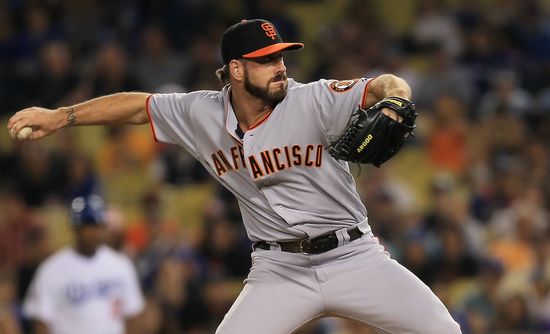
San Francisco Giants' closer Brian Wilson's beard seems to have started some sort of phenomenon with Giants fans. "Fear the Beard" has become the rally cry for their NL West Championship run. I'm wouldn't quite consider myself a Sullivan-level beardophile. But I have to say that I am impressed.
Facebook fans made a gallery of photos. Money shot here. Above photo by Jeff Gross/Getty Images. For the record, I fear no beard.
Ilya Somin is offering analysis on a constitutional question near and dear to the right: Does the commerce clause really give Congress the power to pass an individual mandate to buy health care? In his opinion, the answer is no. But what's more interesting is the argument being made by defenders of the law.
The Supreme Court’s 2005 decision in Gonzales v. Raich ruled that Congress’ power to regulate interstate commerce gives it the power to ban possession of medical marijuana that had never crossed state lines or been sold in any market anywhere. It was easily the broadest-ever Supreme Court interpretation of the Commerce Clause. When I first considered the question, I thought that Raich’s reasoning was expansive enough to justify the individual mandate. I still believed that the mandate was unconstitutional (primarily because I have always argued that Raich was a horrible decision). But I thought that it could probably go through under Raich. And the government has in fact relied heavily on Raich in its brief in the Virginia case challenging the mandate.
This is a good time to remind conservatives that the War on Drugs has undermined limited government in all sorts of ways over the years. If you want to stop a federal mandate for healthcare, you might just have to stop federal enforcement of marijuana Prohibition as well.
Tracy Clark-Flory casts a critical eye on an AP story declaring, "New sex ed funding ends decade of abstinence-only":
Indeed, it's true that [HHS] handed out $155 million in grants to teen pregnancy prevention programs "that have been shown to be effective through rigorous research as well as the testing of new, innovative approaches to combating teen pregnancy." Abstinence-only programs are not evidence-based and have been shown to fail spectacularly — so, they don't get any of this multi-million-dollar jackpot.
But, here's the thing: They are still getting money.
[…T]he HHS press release, which leaves this minor detail until the verrry end: "[M]ore than $33 million is being issued today for abstinence programs in 29 states and Puerto Rico." (Cue the sad trombone.) This is part of an eleventh-hour provision in the healthcare bill that sets aside $250 million for abstinence programs over the next five years.
Meanwhile, Bristol ramps up her advocacy campaign with a $10K speech at a Right to Life event in California:
While promoting abstinence may not be new for the teen mom, who’s already a teen ambassador for the Candie’s Foundation, her Facebook recap of the Visalia event echoes the messaging of the pro-life movement, underscoring her increasingly public role as a pro-life advocate. It’s a message that’s right on track with the Palin brand …
 The Dish
