Reagan, Obama, And The Polls

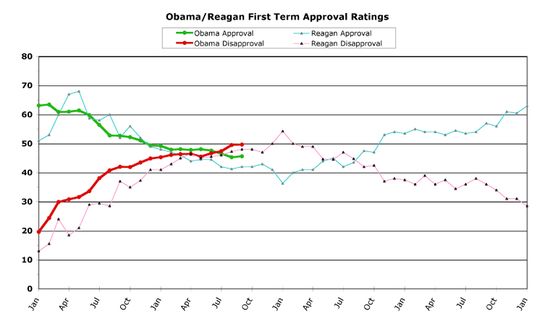
The parallels, which I've noted many times before, keep getting eerier, as Chris Weigant notes:

1009bhovrwr1

Reagan was doing worse at this point than Obama and was headed toward a low of 37 percent approval (as his party got stomped in the midterms). So when you keep hearing the meme of Obama's declining poll numbers (they're actually pretty stable recently), this is worth recalling (as are the worse numbers for Clinton and Carter at this point).

Economic recovery saved Reagan, but it is hard to see an economic bounce in the next two years of the magnitude of the recovery in the 1980s. And there's no more to borrow, is there?

Pot And Needles

Brian Doherty marks the death of bills that would have made intravenous drug users safer:

California's Gov. Schwarzenegger signed a bill reducing possession of less than an ounce of marijuana to a mere infraction (less than a misdemeanor) punishable by just fines up to $100, and no jail time. At the same time, he vetoed various bills related to the potential use of other illegal drugs, such as bills that would liberalize access to needles or reduce the legal risk of reporting overdoses to authorities.

What Simon Said

Tim Holahan claims to feel for his city what David Simon felt for Baltimore while making The Wire – so he's written an unusual post applying the television show's lessons to New Haven. Here's one of them:

…making change means making enemies, and enemies can rob you of the power to make change. Holding office in a modern city strips a politician of his courage with brutal efficiency. The process is as murderous to dreams of reform as the drug industry is to its young soldiers.

News You Can’t Use

Niall Harbison argues that Twitter isn't particularly effective at driving traffic to journalistic enterprises – and that it's diminishing the need for some professional reporting:

Last week in Ireland somebody drove a cement truck in to the main government buildings as an act of protest against the people who run the country. Although fairly tame the attack did draw the attention of the country for the day and got picked up all over the mainstream press on radio, TV and print. The problem for the media though is that even though they were all on Twitter the story was pretty much dead by the time they got it.

A simple photo taken by @davidmaybury and posted to Twitter was all I needed to see to understand the story.

I didn’t need to see it on the cover of the Irish Times, I didn’t need to tune in to the TV to see photos of the truck being towed away nor did I need to buy the paper the next day for analysis. One simple picture posted on Twitter and delivered by my own network on Twitter spoke a thousand words and marginalized the entire press in terms of delivering news to me. There is no doubt that we will always need to get more in depth analysis from the press but to a large extend some of their lunch is being eaten by punters in the street and Twitter means they are losing more and more control over how a story breaks. If you work in the industry and that control is taken away that has to be a very scary thing.

But long experience proves media consumers are attracted to stories that they've already learned about elsewhere. Once people heard Princess Diana died in a car crash, there wasn't any need to buy the issue that People rushed to press. That didn't stop multitudes from snapping it up in the supermarket checkout aisle. The press, treated as a single entity, produces all sorts of redundant, useless information.

In aggregate, the audience proves daily willing to consume it.

The Power Of The Pro-Israel Lobby

Hitch provides an obvious example:

A few months ago, I wrote here that the recent sharp deterioration in Israeli-Turkish relations was at least partially explicable by a single fact: This year, a key House committee voted to refer to the Turkish massacre of the Armenians in 1915 as genocide. In previous years, that vote had gone the other way. The difference, I pointed out, was this: Until recently, the Israel lobby on the Hill had worked to protect Turkey from such condemnation. But after the public quarrel between Turkey's prime minister and Israel's president at Davos, the lobby was in no mood to do any more favors. In other words, a vote with major implications for U.S. foreign policy—positive ones in my opinion—was determined by the supporters of a single power. I did not receive a single letter of complaint for making this observation, and I know nobody in Washington who would have quarreled with its obviousness.

So why the fuss over Rick Sanchez?

Surely the tone and generalities about media ownership, as Hitch notes, and as I posted. But this statement on its own seems completely banal to me:

Do not underestimate the Jewish lobby on Capitol Hill. That is the best-organized lobby, you shouldn't underestimate the grip it has on American politics—no matter whether it's Republicans or Democrats.

Hitch is right to argue that this cannot empirically be in dispute among sane people in Washington – although the Belgian who said it, like Sanchez, draped it in self-evident anti-Semitic hooey. Sigh. Maybe that connection tells us something. But maybe it doesn't necessarily.

Maybe it's bizarre that it remains close to taboo for anyone to say anything like this in Washington and not be branded an anti-Semite – or "something much darker" – while no one would feel similarly constrained about, say, the Cuba lobby. (Or maybe Hitch is hereby proving that thesis wrong. If so, hooray!) And yes, yes, I know all about anti-Semitic tropes, about the overtones of talking about shadowy lobbies working the halls of Congress etc etc. And one should indeed be careful not to unwittingly give aid and comfort to genuine bigots.

But please, walking the halls of Congress and quietly exercizing pressure is what all lobbies do. And if calling a very powerful lobby a very powerful lobby is inherently anti-Semitic when we're talking about the pro-Israel lobby, then how on earth can we accurately report what's going on? More to the point, how can we effectively push back against the bizarre insistence, for example, that demanding a mere freeze on West Bank settlement construction is some new "war on Israel", rather than the minimum a self-confident US government should demand of an ally in pursuit of US interests in the region and the world?
A Mormon Thaw? Ctd

A reader writes:

As a straight Mormon who knows and loves many homosexuals, rest assured that that speech is causing major ripples among the Mormon faithful (see Jana Riess' excellent blog post on this). Boyd K. Packer doesn't speak for me. I'm sorry and embarrassed by the damage my church has done to countless gays and lesbians both within our little flock and outside of it. With a leadership that is all white, all male, and all old, and that the membership accepts as "prophets, seers, and revelators," I don't know how much of an effect dissenting voices within Mormonism will have. But there are dissenting voices.

Another writes:

My husband and I were invited to that meeting in Oakland and spoke to Elder Jensen afterward. Earlier we and our daughters had dinner with the Oakland Stake President at a friend's house. I do believe there is a thaw. Notwithstanding Elder Packer's virulent words, I'm hopeful. Packer has a history of being one of the most conservative (understatement) of the apostles, and one of the oldest. Yes, his words carry a lot of weight. Yes, the leaders allowed him to say those words from the pulpit (and make no mistake, little is said at conference that isn't vetted). And yes, they were vicious in their homophobic ranting. But they are the old guard. Talking to the stake president, Elder Jensen and my very large extended family in Utah, I see hope for the future.

Another:

The article you linked to mentions the existence of some "Mormon feminists" blogs, which intrigued me.  I went to one, called Feminist Mormon Housewives, and found a lengthy and thoughtful discussion thread about the Packer sermon.   Most of the posts consider Packer's statements to be appalling.

Video and transcript of Packer’s remarks here.

More Than Half The World’s Defense Spending, Ctd

Drezner's criticism of Kristol et al:

You know the threats posed to the United States by a rising China, a nuclear Iran, terrorists and piracy? You could put all of them together and they don't equal the perceived threat posed by the Soviet Union during the Cold War. And until I see another hostile country in the world that poses a military threat in Europe, the Middle East and Asia at the same time, I'm thinking that current defense spending should be lower than Cold War levels by a fair amount.

Odd how the tired Kristol fanfare has met with such a blast of bloggy opposition, from across the spectrum. I wonder who will be the first Republican candidate (after Ron Paul) to make serious defense cuts a fiscally conservative cause. Or am I hoping for far too much? Their current math makes no sense.