Greg Sargent has radio audio here and here of O'Donnell's Chinese plot theory.
Month: October 2010
“Together”
Surely not the end of the Pet Shop Boys, right? PopJustice:
Finally, and most importantly of all when considering whether or not this would be a good farewell single, the chorus seems to be about a loveular relationship but could also be about the relationship between Neil and Chris: "together's amazing, together we're blazing, together we'll go all the way". The middle eight contains another oh-dear-this-all-sounds-a-bit-final line, in the shape of "everything's easy in this state of mind, the world starts to fade as we leave it behind".
We don't actually think this is a farewell single at all, incidentally. This said, we haven't contacted Neil and Chris to ask them to clarify in case they come back and say 'well actually yes'. It is better not to know about these things until they actually happen.
IN SUMMARY: Amazing.
Frozen Veg: A Working Class Education, Ctd
A reader writes:
I live in a blue-collar neighborhood in a mid-sized North Carolina city. About 85% of my neighbors have vegetable gardens. Folks around here were growing and canning their own fruits and vegetables long before the NY Times Style section started writing about gardening. Like hunting and fishing, it's an outdoor hobby that also puts food on the table. I'm not sure where Ozimek gets the idea that gardening is only for the well-to-do.
Another writes:
Ironically, I grew up eating fresh vegetables because we were "poor".
By no means were we impoverished, but we were far from yuppies or upper middle class. We were in rural Vermont, so we had the land. My dad didn't have the distractions of urban living, so we had the time. This wasn't about being organic or some farm-to-table movement; it was about saving money. Calling fresh vegetables and gardens the domain of the upper middle class shows how priorities have changed and how far we've come from the agrarian society our country once prized.
Another:
Adam Ozimek's view is just silly. It also shows that he hasn't spent much time in working-class neighborhoods, particularly black working-class neighborhoods.
Check out any number of community gardens in Washington, DC. They may be organized by educated white or black people who know how to work a bureaucracy (is that a sufficient definition of "yuppie types?"), but you will find that many of the most successful gardeners are older folks from the south or the Caribbean or other rural areas who came to the city to work and live and still cherish their connection to the land and are damned proud of the herbs, fruits and vegetables they produce.
Another:
If Ozimek assumes that the only good coming out of a school garden is passing on the process of vegetable growth for consumption, then he may have a point that more would be gained by teaching kids how to create meals with frozen vegetables. However, future consumption is the least of the benefits conferred by such an education. Teaching kids how to work with frozen vegetables will not show them where their food comes from; it will not introduce concepts like "photosynthesis"; it will teach them patience; it will not teach them how to work together; it will not remind them that sometimes hard work ends up as a failure, and that this is okay; it will not teach them that everything they need can be found in the earth; and, among other things, it will not teach them how to bring something to life.
With adequate reading skills, anyone can read the three-part directions on a bag of Swanson Mixed Vegetables, and one can even try some of the recipes written on the packaging. But I'd like to think our schools can aim for loftier goals than "open, heat, and pour."
Ozimek defends himself here.
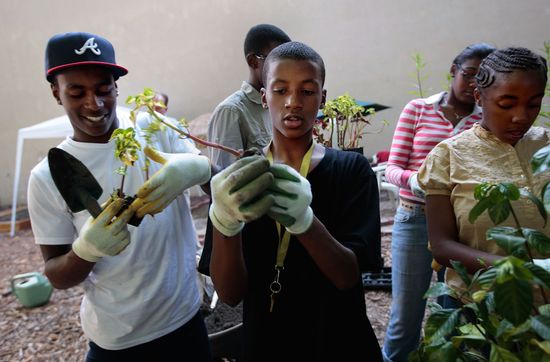
(Photo: Jubriel Holman, 15, Kujan Buggie, 14, and Emmanuella Jean-Pierre, 15 (L to R) look over sprouts before they plant them at the Hattie Carthan Community Garden in the Bedford-Stuyvesant neighborhood of Brooklyn July 9, 2009 in New York City. A number of inner-city youths have been planting vegetables in the garden for an upcoming farmers market-style sale, for which community members will be able to buy the locally-produced food with cash or even with public assistance food cards. Community gardens are growing in number in urban areas around the country, as environmental concerns dovetail with inner-city rebirth to create new ways for underprivileged families to buy fresh food. By Chris Hondros/Getty Images)
AT&T, The iPhone & Canada: Do Not Combine
Or else be ready for a $1723 bill.
“Terribly Written Great Books”
Jonathan Bernstein grumbles about them. Yglesias fleshes out the argument:
I actually think this is a pretty general problem with “great books,” for reasons that are explained in Thomas Kuhn’s The Structure of Scientific Revolutions which is, itself, a great book that suffers from the very same problem. Obviously part of the issue is simply that there’s no guarantee that conceptual innovators will be good writers. But the deeper Kuhnian issue is that great game-changing thinkers end up altering the conceptual terrain in a way that renders their original works obsolete-sounding and confusing. Meanwhile, a whole discipline grows up in the shadow of the great book and its practitioners develop a nice clear reconstruction of the framework.
But the availability of these clear reconstructions only makes the original look even worse. If that’s what he meant, then why didn’t he just say that!
It Gets Better, Ctd
Stranger editor and former skirt-wearer Brendan Kiley reminds us that "you don't even have to be gay to be gay-bashed in high school":
Hewitt Award Nominee
"Am I the only one who saw weakness when President Obama and his departing chief of staff Rahm Emanuel gave each other big, fat, full-bore hug following their speeches at the resignation event in the White House’s East Room on Friday?
Remember, this is on global television. And it has to do with the very top of the United States government. Our friends and enemies were all watching.
I think the hug lacked dignity. It did not send a message of American power and forcefulness. So I fret about the reaction around the world to this kind of fraternity-like emotionalism in full public view," – Larry Kudlow, Big Government.
(Hat tip: Balko)
86 Seats!?
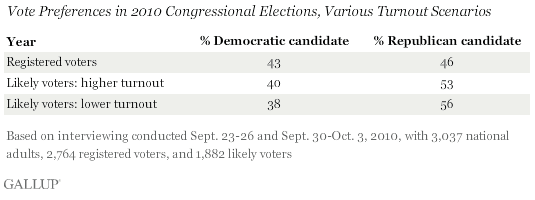
Nate Silver reviews Gallup's likely voter model:
According to one formula that models turnover in the House based on the Gallup likely voter model specifically, a 13-point lead for the G.O.P. would translate into a gain of 71 (!) seats — and an 18-point, lead, a gain of 86 (!!) seats.
Our version of a House forecasting model, which uses both Gallup and other generic ballot polls, as well as a whole host of other inputs, suggests that such gains by the Republicans are theoretically possible — but rather unlikely. As of our last forecasting run, the model had given Republicans about a 1-in-15 chance of a gain of as large as 71 seats, and a 1-in-200 chance of a gain of 86 seats or more.
A Conspiratorial Lunatic, Not A Witch
Christine O'Donnell's assertion that she is privy to classified information about a Chinese plan to take over America is too much for Fallows:
"Dabbling" in witchcraft, mice with human brains — yeah yeah, I don't care. But the idea (a) that there would be a secret document laying it all out, (b) that it would have come into her hands, and (c) that her confidentiality oaths would bind her to protect it — all this instantly connects her with the vast reserve armies of conspiratorialist lunatics that anyone in any branch of public life (media, politics, civil service) encounters over the years.
Follow up here.
Bombing Iran
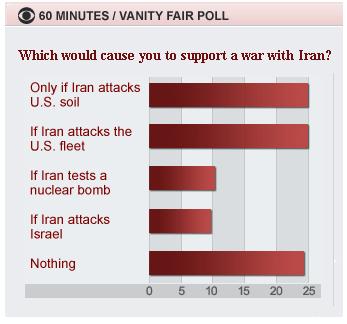
Most Americans are against the idea. Matt Duss draws a parallel:
As Ali Gharib astutely observed the other day, talk of “air strikes” are for Iran what “cakewalk” was for Iraq — the false idea that, through large-scale preventive military action, the U.S. can accomplish its goals with a minimum of fuss. It was a fantasy then, and it’s a fantasy now.
Greg Scoblete nods.
 The Dish