Israel’s Moment Of Truth

BEITFAJJARMussaAl-Shaer:AFP:Getty

The West Bank settlements are at the center of the Obama administration’s heroic effort to keep the Israel-Palestine talks going. And this week is crucial. Netanyahu has to extend the moratorium on new construction for two more months, it seems to me, or this whole thing will unravel. Regardless of his internal coalition politics, these settlements are illegal, those outside the near vicinity of Jersualem are going to have to go under any deal, and the Arab and Muslim worlds are looking to Obama to see if his Cairo speech meant anything. Washington has offered all sorts of sweeteners to the Israelis … and yet.

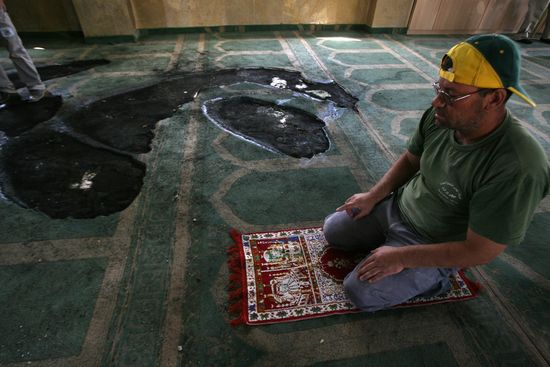
The picture above is of a mosque torched today by radical settlers trying to stop the deal:

Arsonists torched a mosque in a Palestinian village in the West Bank on Monday, scrawling “revenge” on a wall in Hebrew and charring copies of the Muslim holy book in a blaze that threatened to stoke new tensions over deadlocked Mideast peacemaking.

No Israel worth saving should appease this kind of bigotry and violence. And it is not rare on the West Bank, conducted by religious fanatics who do not and must not represent the soul of Israel or of the West.

And yet, we have the usual neocon excuses for the peace process to fail yet again. Here, Commentary’s Rick Richman takes the Israeli hard right’s position against the president of the US; Jennifer Rubin calls the Obama administration “the most anti-Israel administration in history”; elsewhere,  at this critical moment, a crashing silence.

American Jewish pressure on Netanyahu may, of course, be taking place behind the scenes. Netanyahu has indeed shown some signs of pragmatism and good will lately, to his credit, despite the fulminations of his neo-fascist foreign minister. I sure hope so. But we’ll see, won’t we?

(Photo: A Palestinian Muslim man prays at a partially burnt mosque in the West Bank village of Beit Fajjar, south of Bethlehem, which was allegedly vandalized by Jewish settlers overnight on October 04, 2010. By Musa Al-Shaer/AFP/Getty.)

“Assassination”

Larison says I'm twisting words:

It is interesting how uncomfortable the word assassination makes supporters of the President’s supposed power to order the assassination of U.S. citizens. It’s actually not that different from the contortions defenders of torture engaged in to avoid admitting that they were defending torture. Aggressive interrogation methods? Well, sure, that was all right, but torture is clearly wrong. The same meaningless distinction seems to be at work here. As long as we don’t call the assassination of U.S. citizens assassination or execution, but refer to it in some other way, it becomes a bit easier to rationalize and defend.

The word I have used is "killing" – not exactly a euphemism along the lines of "enhanced interrogation."

I regard "assassination" as the deliberate murder of a leader or individual for political purposes, not the targeted killing of a member of al Qaeda at war with the US, whom it is impossible or extremely difficult to capture. An "execution" is something I take to occur when someone is already under the physical control of another, and is usually associated with a legal or civil process, not an act of war. None of these words quite works with the very difficult case we are discussing and, to be quite frank, Daniel's attempt to equate my wrestling with this dilemma with the Orwellianisms I have done all I can to expose over the last several years is deeply, deeply offensive and unfair. I am genuinely trying to figure this out and deserve better than this.

Science Proves People Shouldn’t Smash Each Other In The Face With A Large Rock

Sam Harris keeps up the fight:

As I argue in my new book, even if there are a thousand different ways for these two people to thrive, there will be many ways for them not to thrive–and the differences between luxuriating on a peak of human happiness and languishing in a valley of internecine horror will translate into facts that can be scientifically understood. Why would the difference between right and wrong answers suddenly disappear once we add 6.7 billion more people to this experiment?

Granted, genuine ethical difficulties arise when we ask questions like, "How much should I care about other people's children? How much should I be willing to sacrifice, or demand that my own children sacrifice, in order to help other people in need?" We are not, by nature, impartial–and much of our moral reasoning must be applied to situations in which there is tension between our concern for ourselves, or for those closest to us, and our sense that it would be better to be more committed to helping others. And yet "better" must still refer, in this context, to positive changes in the experience of sentient creatures.

I haven't read the book and will, because Sam is both a friend and a brilliant man and I have learned and benefited from both his last books. But in discussing this book's arguments with him a while back, I found myself making many of the same points Kwame Anthony Appiah makes here. Utilitarianism – the search for morality grounded in pure well-being – is not new in the world of ideas. But its premises remain thoroughly debatable and the notion that these eternal questions can at some point be empirically or scientifically resolved is, to my mind, a category error, an ignoratio elenchi.

Yes, We Are At War, Ctd

Scott Horton's contribution to the debate (which I cited before here) focuses on whether a sufficient effort has been made to capture Awlaki rather than kill him, a point I did not address in my original post and which is certainly worth a response from the administration:

No doubt the government has concluded that al-Awlaki is a heinous figure who has committed serious crimes and should be made to pay for it. But for all of the massive operations recently undertaken in Yemen, I see no evidence yet that the government is trying to apprehend him and charge him for any criminal acts–even though it has spelled out facts suggesting that it could easily do just that. Is the rationale that a bullet to the head or a bomb dropped on his house would be far more expedient than an indictment and a trial? That sends a chill down my spine.

It seems increasingly that the Obama White House is using the al-Awlaki case to establish a new principle: the president’s power to order extrajudicial executions of American citizens. I don’t for a second question the principle established in Quirin, and I believe that the president can in some circumstances target and remove figures in a command-and-control position over hostile forces even if they are removed from a conventional battlefield. But I am deeply suspicious of the need to add to the president’s theoretical powers by killing a U.S. citizen in Yemen who could certainly be captured, brought back to the United States and put on trial.

Frugal Engineering

David Wolman urges small start-ups to tap into the third world market:

The Tata Group, India’s version of Acme and maker of the supercheap Nano automobile, recently introduced a $22 water purifier that works without electricity or running water. (Every few months it needs a new $6 filter.) A big-hearted, philanthropic, and important effort? You bet—cue the somber stats about preventable waterborne diseases. But check out the size of the market for a product like that: Some 900 million people worldwide lack access to clean water, 200 million of them in India alone. Tata is saving lives and making a killing.

Why aren’t more American companies doing the same?

A Taxpayer Receipt, Ctd

A reader writes:

While I like that taxpayer receipt, there is one big problem with it.  About a third of our current budget is paid for by deficit spending, not taxes.  I would suggest that another column needs to added, with numbers in red, showing how much is being borrowed to pay for the various items on the list.

Another writes:

The one that just drives me nuts: The IRS. The cost of our system of tax collections has always been too high. Just think how much better off we would be as a nation if we directed all of the human capital now spent on paying our taxes to driving our economy. We spend untold billions on educating the participation's  – plus the massive man hours  – with absolutely nothing achieved.  Ditto on the DEA.

Another:

Something is amiss in this receipt.

First of all, it's a bit misleading because it breaks up combat, military pay, vet benefits, and military retirement.  Now, on one level, that is helpful info, but it makes more sense to me to collapse those under a general "military" umbrella, which brings that total to well over $500, placing it between Medicare and Medicaid, more like where it belongs.  To make the case a different way, Social Security could have also been broken up to reflect retirement benefits, disability benefits, administrative costs, etc.  You get the picture.

Which leads to the second point, in that this list gives you no sense whatsoever of the real place of general defense spending, which is larger than Medicare and Medicaid combined, and larger than Social Security.  These 2009 figures also do not reflect the fact that most of the spending on the Iraq and Afghanistan wars were done outside the Congressionally approved budget, in discretionary spending, which contributed wildly to our overall debt.  (Thanks so much to the Bush/Cheney war machine for this Republican insanity.) This pie chart actually breaks it all down far better.

While I appreciate that the source of this information is at least relatively sane (i.e., thethirdway.org), I'm puzzled that their breakdown is so misleading.

Yglesias also questions the numbers and how much of an impact such a receipt would make. Another:

I would personally love to receive a tax receipt, but unintended behavioral consequences should be considered first. For example, I can imagine people donating less to charity. Once they have concrete numbers of tax expenditures, they might begin considering a portion of their taxes to be charitable donations that they no longer feel compelled to make. Not necessarily a reason not to implement tax receipts, but worth thinking about.

Another:

I think the receipt is a really good idea. I was just wondering a few weeks ago if there was any merit to giving people some small amount of discretionary amount in their taxes. Basically, with 2% of your tax bill, you get to choose whether it goes to some broad categories of government work (arts funding, or military hospitals, let's say). I have absolutely no idea what it would mean for tax administration (probably a lot of effort and useless headaches), but I do wonder if maybe people would feel less robbed by the government?

Another:

Thought you might like to know that the tax receipt idea was proposed by Ethan Porter in Democracy: A Journal of Ideas earlier this year. The article is called "Can't Wait Till Tax Day!", and Porter asks, "It's a heretical thought, but would people pay more taxes if they could designate where a portion of their money went?"

The Palin Model, Ctd

Republican Mary Fallin's campaign for the governorship of Oklahoma has taken the Palin model of no independent press interaction, and speeches only to supporters, one step further:

[On September 21] the Jim Thorpe Museum was host to the annual President’s Forum, a gathering of University and College Presidents, the Board of Regents, and a handful of other dignitaries and invited guests. Speaking before this distinguished audience were the two candidates for governor, Lieutenant Governor Jari Askins, and Congresswoman Mary Fallin. The format for the event was that Fallin would first deliver remarks, then take questions, and then Askins would do the same.

However, just before she was to begin, Fallin made a strange request of the event organizers; she didn’t want the Lieutenant Governor in the room while she spoke. Nor did she want any of Jari’s staff in the room.

In fact, she even scanned the room for faces that might be unfriendly, to see who else she should have ejected. Apparently she didn’t like the look on [retired] State Senator Mike Morgan’s face, because she told the event organizers she would not take the podium until he had left the room. Senator Morgan was a guest of the event. He was seated at a table enjoying his lunch, until he was unceremoniously asked to gather up his things and leave the room until it became Jari’s turn to address the crowd, at which point he was welcome to re-take his seat.

Are you as creeped out by this as much as I am? Not just the request – the fact that anyone, including a state senator! – would comply. Fallin, meanwhile, has a 26 point lead in the Rasmussen poll. (Hat tip: The Lost Ogle.)