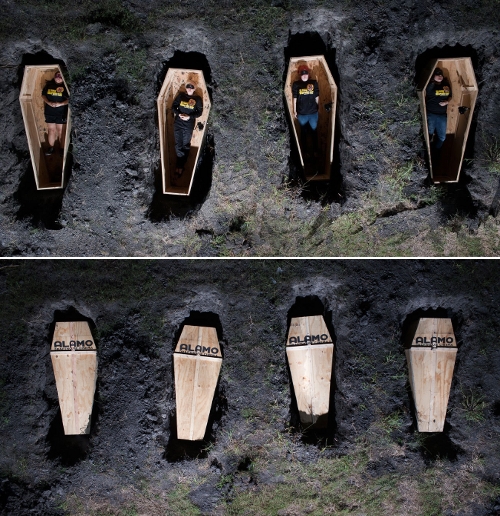
Neetzan explains:
The Alamo Drafthouse invited four people to an advance screening of Rodrigo Cortés’s claustrophobic thriller, Buried. The catch? They had to watch it on an LCD screen from inside a coffin while buried underground themselves.
Neetzan explains:
The Alamo Drafthouse invited four people to an advance screening of Rodrigo Cortés’s claustrophobic thriller, Buried. The catch? They had to watch it on an LCD screen from inside a coffin while buried underground themselves.
“We hate Woodrow Wilson!” – a fan of Glenn Beck's at a recent rally. I don't know why exactly but it made me burst out laughing.
Big Think interviews Francis Collins on the intersection of faith and science. He makes complete sense to me. Money quote:
Part of the problem is, I think the extremists have occupied the stage. Those voices are the ones we hear. I think most people are actually kind of comfortable with the idea that science is a reliable way to learn about nature, but it’s not the whole story and there’s a place also for religion, for faith, for theology, for philosophy. But that harmony perspective does not get as much attention, nobody’s as interested in harmony as they are in conflict, I’m afraid …
My study of genetics certainly tells me, incontrovertibly that Darwin was right about the nature of how living things have arrived on the scene, by descent from a common ancestor under the influence of natural selection over very long periods of time. Darwin was amazingly insightful given how limited the molecular information he had was; essentially it didn’t exist. And now with the digital code of the DNA, we have the best possible proof of Darwin’s theory that he could have imagined. So that certainly tells me something about the nature of living things. But it actually adds to my sense that this is an answer to a "how?" question and it leaves the "why?" question still hanging in the air. Other aspects of our universe I think also for me as for Einstein raised questions about the possibility of intelligence behind all of this.
Why is it that, for instance, that the constance that determines the behavior of matter and energy, like the gravitational constant, for instance, have precisely the value that they have to in order for there to be any complexity at all in the Universe. That is fairly breathtaking in its lack of probability of ever having happened. And it does make you think that a mind might have been involved in setting the stage. At the same time that does not imply necessarily that that mind is controlling the specific manipulations of things that are going on in the natural world. In fact, I would very much resist that idea. I think the laws of nature potentially could be the product of a mind. I think that’s a defensible perspective. But once those laws are in place, then I think nature goes on and science has the chance to be able to perceive how that works and what its consequences are.
Damon Linker argues that devout religious believers are unlikely to govern well without compromising their faith:
It is possible for someone of liberal or moderate belief to be a great president—because his faith will make few potentially uncompromising, illiberal demands on him. But the same cannot be said of the most devout believers, who face a stark choice. Either they can practice the art of drawing distinctions between their piety and the nation’s politics—or they can refrain from seeking high political office. What will be never be possible is a theological-political synthesis. As long as the United States remains a liberal nation with a centerless society, traditionalist religion at its peak will fail to harmonize with politics at its peak. Our saints will not be statesmen and our statesmen will not be saints.
And the attempt to fuse them – to end the conflict, to “give up everything to God”, in the chilling, primordial political vision of a Sarah Palin – is actually the end of what we have always understood as politics in America. In our current global religious conflict, where we have the technological power to destroy everything while some want to give up all human judgment to what they see God’s will, it is the most dangerous phenomenon we face. It stretches from Wasilla to the West Bank settlements to Tehran’s Revolutionary Guards.
To govern as a Christian is to engage in a tragic compromise. It is to do what we are enjoined as Christians not to do: to order killing, to make decisions that do not turn the other cheek, to fight – not love – the enemy. And that is why, as Obama’s brilliantly Niebuhrian Nobel Speech revealed, the man we now have in the White House has a far deeper understanding of Christianity in this fallen world than anyone on the Christianist right or Christianist left.
And yet they dare call him an infidel.
(You can buy Damon’s new book, The Religious Test, here.)
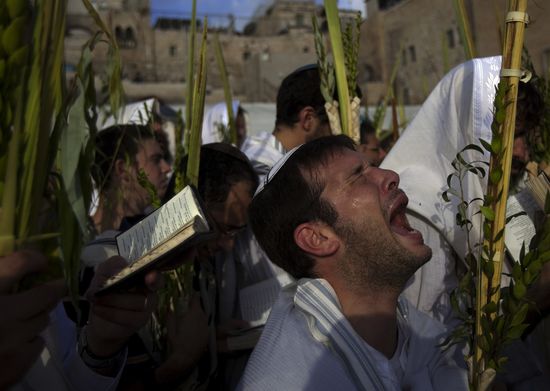
Thousands of Orthodox Jewish men perform the 'Hoshaana Raba' ritual at the end of the week-long religious Sukkoth festival at the Western Wall in Jerusalem's Old City on September 29, 2010. Sukkoth, the feast of the Tabernacles, commemorates the 40 years of wandering in the desert after the exodus of Jews from Egypt some 3,200 years ago. By Menahem/AFP/Getty Images.
John Shore castigates fellow Christians who condemn homosexual acts as sinful:
Here is that Big Difference between homosexuality and other sins: There is no sin I can commit that, by virtue of committing it, renders me incapable of loving or being loved. I can commit murder. I can steal. I can rob. I can rape. I can drink myself to death. I can do any terrible thing at all—and no one would ever claim that intrinsic to the condition that gave rise to my doing that terrible thing is that I am, by nature, simply incapable of giving or receiving love. No one tells the chronic drinker, or glutton, or adulterer, or any other kind of sinner, to stop experiencing love. Yet that’s exactly what so many Christians are insisting gay people do.
When you tell a gay person to “resist” being gay, what you are really telling them—what you really mean—is for them to be celibate. What you are truly and actually saying is that you want them to condemn themselves to a life devoid of love. Be alone, you’re demanding. Live alone. Don’t hold anyone’s hand. Don’t snuggle on your couch with anyone. Don’t cuddle up with anyone at night before you fall asleep. Don’t have anyone to chat with over coffee in the morning. Do not bind your life to that of another. Live your whole life without knowing that joy, that sharing, that peace. Just say “no” to love.
Be alone. Live alone. Die alone.
The “sinful temptation” that Christians are forever urging LGBT people to resist is love. Being, of course, the one thing Jesus was most clear about wanting his followers to extend to others.
(Hat tip: Dan Savage)
A reader writes:
Last weekend CNN aired a heartrending documentary about Pope Benedict and priests' sexual abuse of children called "What the Pope Knew." Your readers can view it on YouTube in five parts here. Hearing the victims tell what happened to them at ages 10 or 11, counterimposed with Vatican bureaucrats defending Pope Benedict and canon procedures, will galvanize opinions as nothing else can.
Jonathan McCalmont explores the relationship of men and women in one of this year's most haunting films, Winter's Bone:
‘Kyriarchy’ is a neologism coined by the Harvard theologian Elisabeth Schüssler Fiorenza. This concept, designed to clear some of the clutter from the road to clarity, reflects the fact that society is far more complex than a simple dichotomy of power between men and women. In truth, society is structured by an ever-changing swarm of inequalities that reflects the dynamic nature of our civilisation. Yes, a man may well have an easier time rising to the top than a woman but at the same time a lesbian woman may well have an easier time of it than a trans man and a black man may lead a harder life than an asian woman while a one-legged Baha’i woman may find doors opening to her that have previously been shut in the face of a HIV+ Catholic. Humanity’s inhumanity to Humanity takes myriad forms. We are ruled not by a Patriarchal father but by a Kyriarchal lord and the shape of that lord is forever changing.
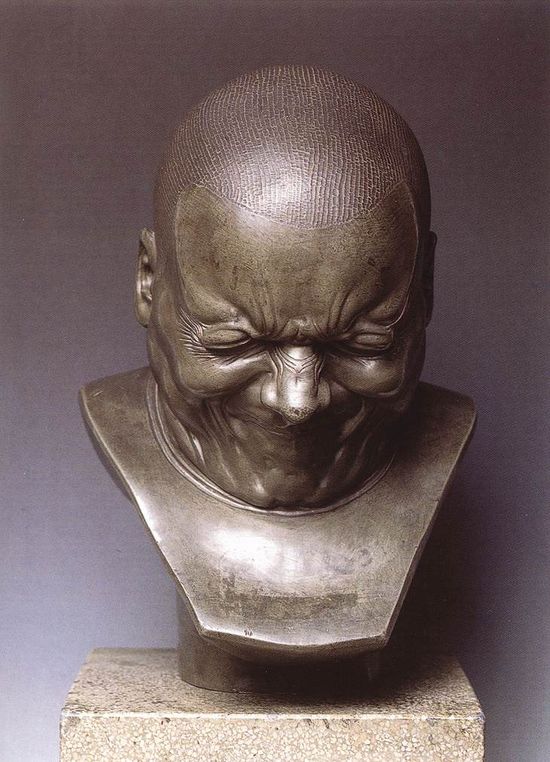
Willibald Sauerländer reads into the collection of 18th centurt artist Franz Xaver Messerschmidt's character heads at The Neue Galerie:
Facial muscles contract, eyes squint, eyebrows rise, mouths contort. These distorted faces are disturbing because we cannot place them in any familiar social setting or assign them to any known psychic condition. …
The rediscovery of Messerschmidt’s character heads in the twentieth century occurred just as psychiatrists and art historians were becoming interested in the art of the mentally ill. The excesses of his works were read as the symptoms of his illness. … The character heads were one of many attempts, beginning with Descartes’ treatise Les passions de l’ame, to codify the human passions. Messerschmidt seems to have been searching for such a system, but failed to find it. His character heads are decoupled from communication, autistically imprisoned, and that is what makes them so fascinating.
Tom Junod has penned a beautiful goodbye letter to Tony Curtis, recapping his interview with the man from 1995:
As an actor, he was never quite as convincing in heroic roles as he was when he revealed an element of cowardice, and so he was, to my mind, brave. As a young man, he was intoxicated by his own beauty, and the kind of life it would allow him; in middle age, when some of his beauty faded, he couldn't let the intoxication go, and became an addict, losing everything, from his hair (a primal wound in a man of Tony's dark vanity) to his son, who followed the course of his father and overdosed.
When I met him, he was a man who swallowed, every morning, the full draught of regret an American life could offer, and yet went about his days (and nights: his very late nights) determined to get intoxicated — intoxicated by what was left of his beauty; intoxicated by the fantastic fact of the freedom his beauty still afforded him in Hollywood and in America; intoxicated, at this late stage of the game, by his potential, even while he was intoxicated on tequila and painkillers — and stay that way. And, yes, he still got laid, in those pre-Viagra days, with a dose of prostaglandins he injected in his thigh to give him an erection post-prostate surgery.
 The Dish