Not An Easy Loss

James Bernard Frost recounts his own struggle with faith, in the face of his mother's illness:

This man, this agnostic, sits in a folding chair in the back corner. The service has long since started—he's arrived late purposefully. His timing surprises him; he's arrived at the perfect moment, the moment when the congregation prays the Prayers of the Faithful. The priest lists the names of the parish's sick, his mother's included—he's phoned in and asked them to pray. He watches the hundreds of heads bowed, hears the silence of their mental words, feels the force of their faithful wills.

And then, choking up, he gets up from his folding chair and leaves. He knows what happens next in the Catholic Litany: the Kiss of Peace, the moment when the parishioners reach out to the person next to them and wish them well.

He owes them a hand shake of gratitude. But it is not a cross that he can bear.
Patron Saint Of Whistle Blowers

James Martin writes about the once excommunicated Blessed Mary MacKillop, an Australian sister and co-foundress of a women’s religious order, who will be canonized on Oct. 17. The fascinating part of the story:

is that Mary MacKillop was excommunicated out of “revenge,” in the words of one priest familiar with her life, for her part (and her order's part) in uncovering a case of sex abuse by a Father Keating, in a nearby parish. …

In the history of persecuted saints, Martin finds one redeeming fact:

that the Catholic Church canonizes those it once reviled or rejected—Joan of Arc, Ignatius of Loyola, Thomas Aquinas, Mother Guérin and now Mary MacKillop–says a great deal about the true wisdom of the church—and its ability, especially in the canonization process, to recognize publicly its own failings and mistakes.  This has always been a sign of hope in the church: the great wrong righted.  (Finally.)

Indefinable Loss

Breugel

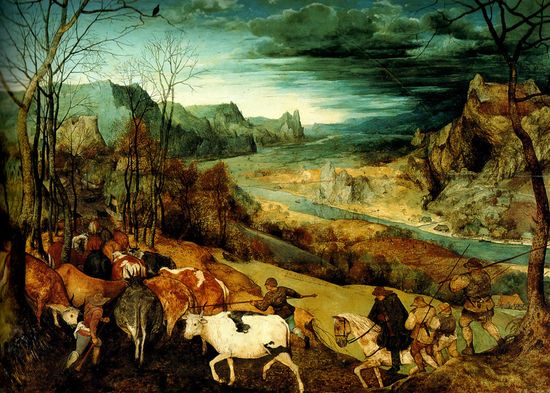
Morgan Meis associates fall with the paintings of Peter Breugel the Elder:

He didn't paint the seasons as merely aesthetic motifs. He painted them as actors, as entities with agency. The seasons make you do things, literally. They make you feel one way and not another, literally. Bruegel managed to paint the compulsion.

It is impossible to stare at Bruegel's autumnal painting “Return of the Herd,” for more than a minute or two without becoming autumn-minded in your own head. The dark clouds are creeping this way across the horizon. The animals — careless beasts! — must be rounded up and brought back over the hills. The barren trees at this crest compel one to pull the coat a little tighter and cuddle into oneself even if the temperature does not fully warrant it yet. That is what Fall want from us, and the body submits.

Breakfast Time

Dayton Ohio’s Dominos pizza is cooking up breakfast pizza as a hangover cure. Jeff Neumann summarizes:

You can have eggs, sausage, ham and other greasy toppings added just before you vomit.

In case you haven’t puked at the thought of this, here’s a Kevin Bacon statue made entirely from Bacon Bits that is being auctioned off to benefit the charity Ashley’s Team.

That Quick Unburdening

The Economist reviews Seamus Heaney's new collection of poetry, Human Chain:

A decade and a half ago Mr Heaney told The Economist that once the evil banalities of sectarianism seemed to be receding, his verse was able to admit the “big words” with which poetry had once abounded: soul and spirit, for example. In this collection both are present, at some level. The words describing a simple act—the passing of meal in sacks by aid workers onto a trailer—in the title poem, “Human Chain”, transform this 12-line poem into a kind of parable. There is the collective, shared human burden of the act itself—the “stoop and drag and drain” of the heavy lifting—and then there is the wonderful letting go: “Nothing surpassed/That quick unburdening.” Is the poet talking about the toil of life, and the aftermath of that toil?

Poem For Saturday

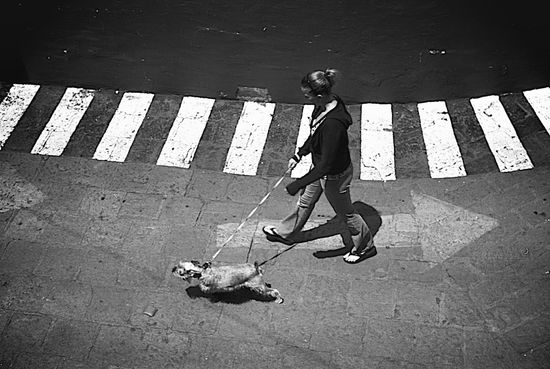
2997926081_bd3f4e92bb_b “Acceptance Speech” by David Yezzi first appeared in the Atlantic in May of 2007:
Accept the things you cannot change:
the bleating clock,
the nightly go
—dog leash in tow—
around the block, neural chemistry,
patchy hair,
a longing stare
and X-ray eye, and the niggling fact
that things will stay
roughly this way,
to be exact. Forgive the things you cannot have:
the supple bod,
taut undergrads,
a nicer pad,
long chats with God, an older name,
your peers’ respect,
the oll korrect,
unbridled fame, a sense of ease
in your own skin,
a lighter burden
by degrees.

The life you’d swap for on the train
(sight unseen)
is much like yours
though it appears
more green.

So, why this pain
that shorts the breath
and spoils your health?
You grow serene—

not yet, but after
your will resigns
a few more times
with heavy laughter.

(Image from Flickr user eduardo.meza)

Wanking As STD Protection

Ed Yong reports on a new hypothesis by Jane Waterman on why Cape ground squirrels masturbate so much:

The final explanation is that masturbation is actually a form of self-medication. By cleaning their genitals, males reduce their odds of contracting a sexually transmitted infection. It’s a new hypothesis that Waterman herself put forward, but it’s the only one that actually fits with all of her data. If it’s true, you’d expect males to masturbate more frequently after sex than before it, which they do. You’d expect them to masturbate more frequently during the time of month when females are ready to mate, which they do. And finally, you’d expect their tendency to masturbate to increase as they get more sex, which it does.

Just don't tell Christine O'Donnell, ok? This is between you, me and the Internet.

Arrgh-onomics

Eric Barker excerpts a study on pirate economics from the Journal of Economic Behavior and Organization:

First, I examine the pirate flag, "Jolly Roger," which pirates used to signal their identity as unconstrained outlaws, enabling them to take prizes without costly conflict. Second, I consider how pirates combined heinous torture, public displays of "madness," and published advertisement of their fiendishness to establish a reputation that prevented costly captive behaviors. Pirates' infamous practices reduced their criminal enterprise's costs and increased its revenues, enhancing the profitability of life "on the account."

Face Of The Day

104591828

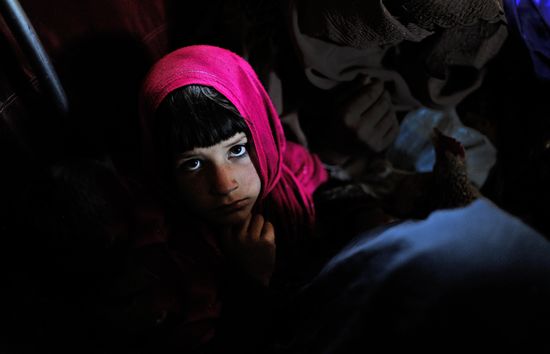
A young girl is pictured onboard a helicopter after she was evacuated from her flood affected area by the US military, near Kalam, in Swat Valley on October 1, 2010. The European Commission has decided to more than double its Pakistan flood aid to 150 million euros (205 million dollars), according to the European humanitarian aid commissioner Kristalina Georgieva. The EU's executive arm has already provided 70 million euros in aid and will now distribute another 80 million euros to its partner organisations. By Carl De Souza/AFP/Getty Images.