First, some house-keeping from my first post. It's important to note that many Israelis were and are not refugees from Europe, but refugees from other parts of the Middle East, so Helen Thomas's remarks about Poland are also factually misleading.
Secondly, when I wrote that the construction of the state of Israel was morally justified, I did not mean to say that everything that happened in that construction was morally justified. I am not going to go into the historical debate about the flight of Palestinians (or nakba) in 1948, but Benny Morris's view that a small minority of Palestinian Arabs were literally forced out or cleansed, and that vastly more were terrified out of their homes by acts of terror, including a massacre, and a propaganda war, seems consistent with the available historical evidence. Israel's subsequent refusal to let the bulk of them return, after promising to, is best described by Morris:
In retrospect, it appeared that at Lausanne was lost the best and perhaps only chance for a solution of the refugee problem, if not for the achievement of a comprehensive Middle East settlement. But the basic incompatibility of the initial starting positions and the unwillingness of the two sides to move, and to move quickly, towards a compromise — born of Arab rejectionism and a deep feeling of humiliation, and of Israeli drunkenness with victory and physical needs determined largely by the Jewish refugee influx — doomed the 'conference' from the start. American pressure on both sides, lacking a sharp, determined cutting edge, failed to budge sufficiently either Jew or Arab. The '100,000 Offer' was a classic of too little, too late.
This toxic mixture of "Arab rejectionism" and "Israeli drunkenness with victory" rings throughout the decades down to today. Which brings me to the question I ended my last post with: why, given the looming threat of Iran, and the profound demographic crisis from within, is the Israeli government and the American Jewish Establishment so rigidly opposed even to a mere freezing of illegal Jewish settlements on the West Bank as a prelude to final status talks?
More to the point: Why has Israel responded to the emergence of an American president with the willingness to devote political capital from Day One and some credibility with the Arab and Muslim world as negatively and as angrily as they have?
Let's recap Israel's actions, under two different governments, in the period since Obama was elected.
In the last month of the Bush administration, Israel launched a brutal assault on Gaza with at best indifference to civilian casualties and at worst a policy of collective punishment, and isolated war crimes. Yes, a response to Hamas war crimes was necessary, but the disproportion was extraordinary – and certainly didn't help Israel's relations with the Arab world, or its European allies. Then Israel eventually agreed only to a partial moratorium on new settlement construction, and actually announced new settlements even as the US vice-president arrived in Israel, bringing US-Israel relations to a historic low-point. Israel then stole the passports of allies to engage in a brazen assassination in Dubai; and killed 19 nine protesters and wannabe Gaza blockade busters (including a US citizen) on the Mavi Marmara flotilla. Its foreign minister is regarded by even hardline Israel supporters as a racist. Israel has also profoundly alienated its key ally in the region, Turkey. Despite the emergence of the most promising West Bank leadership in years, Israel has now refused to reimpose the ten month partial moratorium on settlement construction. It looks increasingly clear that the last chance to get direct talks going will expire at the end of this month because Netanyahu refuses to freeze new settlements, and many are being built as we speak:
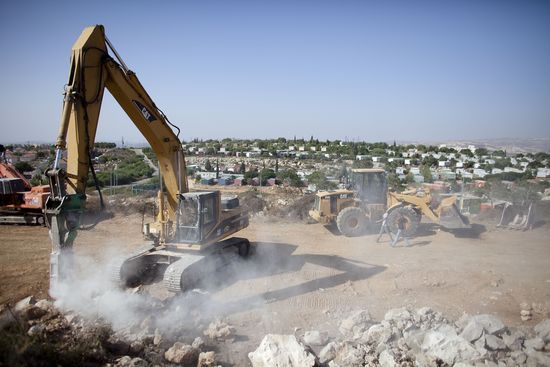
Less than four weeks since the end of Israel’s building freeze in the West Bank, hundreds of units are under construction in dozens of settlements there, settler leaders and anti-settlement advocates said Thursday. Foundations have been dug for 300 units and work is under way on a couple of hundred more, they report, many of the units in smaller settlements that would be most unlikely to remain as part of Israel in any future two-state deal with the Palestinians.
Notice that in this period, the US has issued no actual economic or diplomatic threats to Israel, and merely coaxed the government with all sorts of goodies, from intelligence to weaponry. Notice also that actually removing or dismantling any illegal settlements has never been on the pre-final status negotiation table – just a freeze of new ones and new construction. I can perfectly see why it is impossible for Abbas and Fayyad to enter negotiations toward a division of land until one side has stopped actually moving the facts on the ground aggressively forward – and engaging in one provocation after another to the wider world.
Now step back and think through the logic of Jeffrey Goldberg's piece on the mindset that leads Israelis to view Iran's nuclear development as an existential threat and therefore to threaten a military attack or bounce the US into one. Assume that Netanyahu is not bluffing – that he really does believe that Khamenei is the new Amalek. Assume that he really is trying to get an American commitment to military action if necessary to prevent an Iranian nuclear weapon, even though sanctions and sabotage appear to be working far better than anyone expected:
Iran has faced difficulties refueling airplanes in Europe, getting some ports to accept their ships and attracting much-needed investment for oil production, officials and analysts say.
Why, under those circumstances, would Netanyahu not be more willing to make concessions on illegal settlements, in order to bolster relations with the US and the Sunni Arab states that are crucial to Israel's strategy to isolate Iran and weaken Hezbollah and Hamas?
I don't get it. It doesn't make sense from any point of view – even Netanyahu's.
That's why I think Peter Beinart is onto something – that something has indeed changed within Israel's domestic politics, and that religious fundamentalism, and "drunkenness" with the temporary security achieved by the Wall and the tactically successful (but strategically dangerous) quarantining of Palestinians on the West Bank and pulverization of Gaza, has led to a near suicidal, long term, and even medium term, Israeli position. It is why I find all the American excuses for this self-defeating strategy so infuriating – along with the smearing of anyone willing to point it out, and the no-holds-barred attempt to smother in its cradle any rival to AIPAC's grip on the debate, i.e. J-Street.
This, then, is what appears to me to be Israel's current position – even as it faces an existential threat from abroad and a demographic collapse from within: No retreat – in fact, retrenchment – on settlements; no regrets on Gaza; an attempt to bounce the US into bombing Iran by making and wild, emotional threats to do the bombing itself .
These are not the actions, it seems to me, of a country acting rationally in its own interests or of that of its allies.
They are not the actions of an ally willing to give and take.
When an irrational country, armed with a monopoly of nuclear weapons in its own region, is threatening global war if its demands are not met on every front, and whose domestic politics are increasingly defined by fundamentalist religious claims that defy any compromise, and whose government is unwilling or unable to survive without pandering to those extremists, it seems to me that the US has to at some point draw a line.
I'll elaborate further in my next post.
(Photo: Bulldozers are seen at the construction site of a new neighborhood on September 27, 2010 in the Jewish settlement of Ariel, in the West Bank. Work is also set to resume in the West Bank settlements of Revava, Yakir and Kohav Hashahar, following the end of a settlement freeze. By Uriel Sinai/Getty Images.)

 The Dish