Republicans Mellow On Marijuana, Ctd

Eve Conant reports on the change in attitude:

Certainly, the Republican Party is a long way from becoming the Pot Party. Although a handful of conservative thinkers like Milton Friedman, George Shultz, and William F. Buckley have argued the merits of legalization over the years (Buckley even mocked those who called marijuana a gateway to addiction, saying it was “on the order of saying that every rapist began by masturbating”), most Republicans still oppose the idea. In the latest NEWSWEEK Poll, only 25 percent of Republicans nationwide favor legalization of pot in their state, compared with 55 percent of Democrats.

Nonetheless, conservative attitudes are changing at the grassroots level (no pun intended). The percentage of Republicans in favor of legalizing marijuana has risen quickly since 2005, jumping 7 points. And as their constituents have moved on the issue, more Republican candidates and lawmakers are refusing to toe the party line. 

The RNC/FNC Connection

Jonathan Bernstein makes an easy call:

Fox is part of the Republican Party.  American political parties are made up of both formal organizations (such as the RNC) and informal networks.  Fox News Channel, then, is properly understood as part of the expanded Republican Party, just like Hill staff of GOP Members of Congress, or pollsters who only work for Republicans, or activists who volunteer for Republican campaigns, or think tanks that generate legislation for Republicans to support.  … Fox is simply part of the communications arm of the party.

The tricky part is that FNC isn't only a component of the Republican Party.  It's also a business, so it may have profit motivations beyond its partisan goals (both on the organizational and individual level, of course).

The Enthusiasm Gap, Ctd

Tom Jensen finds that Democrats haven't made up enough ground:

One of the biggest hopes for Democrats heading toward election day has been that the party's voters will get more engaged as the election comes closer, helping to mitigate its losses. A PPP analysis of 9 states where we've polled in October and also conducted a survey in August or September finds that the likely electorate for this fall is trending more Democratic- but not nearly to the extent the party needs.

The Daily Wrap

Today on the Dish, Andrew conceded ground on Helen Thomas and initiated dialogue with Goldblog on Israel, Palestine, and the chasm between. Andrew clarified his case against Juan Williams to Saletan once more, and in response to readers, gave credit to Shep Smith, vowed never to appear on Olbermann, but allowed Maddow her due. Andrew echoed Greenwald on marrying gay foreigners and how behind America really is. The Tea Party had its heart in the right place but its head was nowhere to be found. The British take on American ingratitude for what Obama has done right was spot on for Andrew. 

On the Prop 19 front, Nick Gillespie and Matt Welch deemed it the most important issue of 2010. David Boaz made the all-too-reasonable libertarian case and Andrew couldn't agree more. Ryan Tracy saw Holder's hands tied, masked gunmen with tasers served marijuana warrants in New Haven, and Ron Hill saw Republicans mellowing on the drug war. The average pot smoker (and voter) was the one who quit, the drug war wasn't colorblind, and this is what the reality of that war looked like.

Joel Wing tried to follow Iraq's sketchy financial paper trail, and Derbyshire noticed that we're only occupying two of the top five most corrupt nations. Joe Miller admitted wrongdoing and lying about it, the curb-stomper wanted an apology, and there was news of possible Democratic ballot shenanigans. Ezra didn't see divided government helping the deficit, money couldn't buy elections, and some campaign ads stunkliterally. Americans mistook America for a country more equal than it is, former bartenders with bachelor's degrees sounded off, and Josh Barro designed a better gas tax. Dana Goldstein questioned whether we could teach our kids true grit, Ebert defended Hugh Heffner and the Playboy era, readers served up another grammar lesson, and snow days ended for ease of scheduling. 

Some things just shouldn't be sexed up for Halloween, New Yorkers were scared of clown births, but the rent was so damn high that most people would accept ghosts as roommates. Moore award here, quote for the day here, campaign ad of the day here, journalistic standards for bloggers here, MHB here, VFYW here, VFY-CPAP here, and FOTD here.

–Z.P.

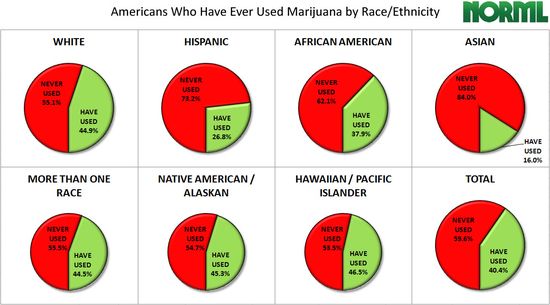
The Drug War Isn’t Colorblind

Marijuana_By_Race

Jacob Sullum preaches:

The authors of the [Drug Policy Alliance] report, led by Queens College sociologist Harry Levine, found that from 2006 to 2008 "major cities in California arrested and prosecuted Latinos for marijuana possession at double to nearly triple the rate of whites," despite the fact that "U.S. government surveys consistently find that young Latinos use marijuana at lower rates than young whites." […]

[T]he drug war's de facto discrimination against blacks and Latinos adds insult to injury. Leaving aside the explicitly racist roots of drug prohibition, when you have a law that 1) criminalizes widespread consensual activity and 2) is enforced against only a small subset of violators, there's a good chance it will impose an extra burden on vulnerable minorities. The fact that affluent, politically influential white people get away with the same drug offenses that land poor blacks and Latinos in jail makes this legal regime even more arbitrary and unfair. Furthermore, as the Prop. 19 debate shows, this aspect of the drug war's injustice can attract allies in the fight to overturn prohibition who otherwise might not focus on the issue.

(NORML has more charts and statistics.)

The Origin Of Gridlock?

Should the next Congress pass few bills, Michael Barone will blame electoral volatility rather than partisanship:

[T]he essence of most bipartisan compromises is that they contain provisions unpopular with constituencies of both parties and often provisions that are unpopular with a majority of voters. That’s why such measures tend to be passed by bipartisan coalitions of members with safe seats. The most recent example of that, TARP, is unsettling to those who hope to see bipartisan legislation in the years ahead; some members who voted for TARP have seats considerably less safe than was generally thought.

One example is Republican Senator Saxby Chambliss, who failed to get 50 percent of the popular vote in November 2008 and so, under Georgia law, was forced into a runoff. He won that contest, but other TARP supporters have not been so fortunate, as with the aforementioned Bob Bennett of Utah. And it has been cited by challengers to both Democratic and Republican incumbents in many states.

In such an unsettled political environment, it may be difficult—maybe impossible—to round up the votes needed for bipartisan legislation. Politicians will not be inclined to take on additional and avoidable risks. And that difficulty means that legislators in a position, whether because of expertise or committee membership, to cobble together such legislation may just conclude that it’s not worth the trouble. The Obama White House’s minimal interest in accommodating Republican ideas and initiatives, perhaps understandable in light of the temptation exerted by the existence of Democratic supermajorities, is not a positive indicator either. Policy experts can make a strong case for bipartisan legislation on major issues, but it is not clear that political actors are prepared to pay much heed to, much less act on, such arguments.

Absent large congressional majorities, therefore, it looks like we are stuck for a while—not only, or mainly, because of ideological polarization and party sorting, but because of electoral volatility.

Scratch & Sniff Politics, Ctd

Stink

A reader writes:

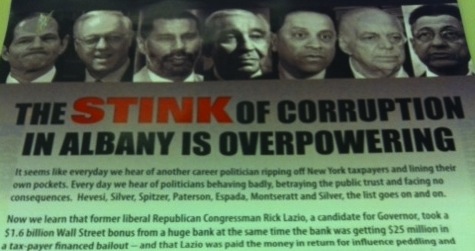
"Originality"? Paladino did this last month:

Carl Paladino, the New York gubernatorial Republican nominee, recently mailed voters a garbage-scented flier smearing Democratic politicians. About 200,000 flyers went out to New Yorkers with the headline "Something STINKS in Albany", each was scented to smell like a landfill.

(Image via Moriches Daily)

Bartending With A Bachelor’s, Ctd

A reader writes:

These statistics from Richard Vedder are a classic example of not understanding your data set. People who work as waiters and bartenders are not careerists – they don't go out, get a degree and then become restaurant staff as a full-time job for life. Most often they become restaurant workers for a part-time period as they look for a job in their field, transition to a new career, or otherwise go through a period when they are not working in the field they've trained for.

I've worked in many restaurants, and very few people I've worked with saw this as a job they would stay with. They all saw it as a way to earn money quickly and easily, since the hours are flexible and the pay is in cash. The fact that wait and bar staff are over educated for the work signifies nothing about our societal preference for higher education.

Another writes:

I find this notion that we are over-investing in education to be absurd.

How many parking lot attendants with degrees plan to do that as a career?  They may be doing it between undergrad and graduate schools.  Certainly they have a better chance of advancing than their co-workers without degrees, so having a pool of overqualified people adds a kind of dynamic potential to the economy for rapid growth and development.

Another:

When I graduated with a Master’s in Music, my first job was as a mail room clerk. But my education allowed me to move up and out of that job quickly. My non-college-educated co-workers were still in the mail room years later.

Another:

I have a bachelor's degree (two, actually).  In the 13 years since I graduated, I have at various times worked as a janitor, a line cook, and a construction laborer.  I've also worked as a financial planner, systems analyst, and currently, as a software engineer.  Leaving aside all of the non-financial reasons why education is an a priori good, I did those "less-than-bachelor's" jobs because they were the work that was available and I needed the money.  I didn't expect that those jobs were my fate for life.  Not having a degree would have foreclosed many the better opportunities which I have pursued.  It might not be a guarantee of a middle-class income anymore, but the risk-adjusted return is still much higher than not having one.

Another:

Vedder fails to ask whether their degree is playing a role in their life outside of this job. Many people (artists, musicians, writers) tend to have a "day-job" which supports their real profession. In this instance they may be using the skills from their college education in ways not indicated by their "job." Or they could be in a situation like my sister, who has an M.F.A. and teaches 6 courses a year in photography and video at a college. However, she is an adjunct and, like many adjuncts, is paid about $3,500/course, which means she needs to find temporary employment every summer. She is making full use of her degree and still occasionally works in the service sector.

Another:

The problem is not the overproduction of graduates, it's an underproduction of jobs – and an outsourcing of labor to countries that are out-producing us in college graduates.  There are fewer and fewer jobs for people with any degree, and this particularly hits people with only high school diplomas.  This issue strikes me as a distraction from that deeper structural jobs issue.

Another:

Just because we have a surplus of college degrees in America doesn't mean the world does. There's solid demand for higher education, particularly American higher education, around the world. Investing in education is about expanding the potential of the economy. Of course there are diminishing marginal returns, but I bet the marginal return to education is a heck of a lot higher than the marginal return to an extra year of work experience as an 18 year old (which is the relevant comparison).

Another:

As more and more of our economy shifts into high-tech sectors, we do need more people with college degrees – but not *any* college degree. Our economy's need for English or Liberal Arts majors has not increased, but our need in engineers/computer scientists/nurses has. Graduates with degrees in chemistry or engineering or computer science commonly land the high-tech "new economy" jobs, while the graduates with degrees in liberal arts or english literature disproportionately land "parking attendant" jobs.

Another:

A college degree is not just about money or even quality of one's immediate employment.  It's also about practical things like developing a network of other educated people, and it's about less tangible things like learning, or at least getting some exposure to, more disciplined ways of thinking than people receive in high school.  And I believe it helps make most people better adapted to modern life – as this report about college-educated cops suggests.  

I know good people without degrees, such as my parents and all my relatives who live in isolated rural areas.  But, having watched them over the years, I do believe they would be less fearful, more curious, and more open to difference if they had been opened to the world in ways that a college degree can provide.  It certainly could have made a difference when my child came out to them a few years ago.
Two Words: President Palin, Ctd

Jonathan Bernstein gauges Palin’s chances:

[T]he third party fantasy is irrelevant. If there’s a double-dip recession and unemployment is over 10%, then odds are good that any GOP nominee would win.

Yes, Palin is very unpopular right now, no question about it. That hurts her chances of winning the nomination. But if she does manage to do that, well, we’re not talking about today’s Palin any more. Republicans would rally around her; newsmagazines and network news poobahs would do features on how she’s grown since ‘08; I don’t need to tell you how enthusiastic the folks at Fox News and conservative talk show hosts will be.

Know fear.