The Most Important Issue In 2010: Proposition 19

Nick Gillespie and Matt Welch make the case:

Though limited to voters in a single state, Prop. 19 is the only policy matter on the table with the potential to restructure the lives of virtually all Americans. If Prop. 19 passes, it will force, at long bloody last, an honest reconsideration of failed prohibitionist policies throughout the United States. In fact, given the drug war's influence on our foreign policy in Latin America and central Asia, Prop. 19's reverberations would even be felt far outside our borders.

“Why It Is Vitally Necessary To Prevent The Extinction Of The Final Serial Comma” Ctd

Grammarians descend. You could see this coming. One writes:

Your reader's example – "The $1 million was divided between Mary, John and Frank," is a lot different than "The $1 million was split between Mary, John, and Frank." – is completely nonsensical.

It suggests that, without the serial comma, it is necessary to read everything after the first (only) comma as a single noun phrase; so, "The $1 million was divided between [NP1], [NP2]." But substitute any single noun phrase into that, and you can see it's ridiculous: "The $1 million was divided between Mary, John" is grammatically incorrect, and so can't be a viable way to read the sentence. Whether or not the serial comma is there, the money is being divided three ways.

Weintraub's example, as well as your reader's "Ayn Rand and God" example, points to a very specific occurrence of a serial list: where the first noun phrase in the list ("his two ex-wives," "my parents") suggests a specific count of individuals equal to the number of noun phrases following in the list. If the apocryphal dedication had been "To God, my parents and Ayn Rand" or any order other than having "my parents" first, there would be no confusion regardless of the presence or absence of the serial comma.

Not so fast. Another writes:

The dedication quoted by your reader – "To my parents, Ayn Rand and God" – is amusing, but there is a similar line that is ambiguous with the Oxford comma. The variation, "To my mother, Ayn Rand, and God," has multiple meanings with the comma and is unambiguous without it.

Another:

There's another problem with your reader's grammar lesson – word choice. "Between" refers to a relation of two, where "among" refers to three or more.  So, "The $1 million was divided between …." already implies a sense of two and not three – though I think common usage would indicate in both examples that the three would each get a slice of the pie. But more importanty, there's nothing to formalize equality here, and Mary could get $1 where John gets $999,000 and Frank $999 (sorry Mary!).

Another:

One of your readers wrote:

When the quoted text DOES have punctuation and it comes at the end of the sentence, you omit the final punctuation:

The small child asked, "Where's my mommy?"

vs

The small child asked, "Where's my mommy?".

I think the second one seems more correct.  The question mark is part of the quote, the period ends my sentence.

Maybe. But here's another example consistent with this logic:

Why did the small child ask, "Where's my mommy?"?

Sometimes punctuation rules are designed to avoid unintended consequences.

(Vampire Weekend differs with Weintraub.)

Debating Israel-Palestine I

Goldblog thinks my argument about the nature of Helen Thomas' offense doesn't hold up to scrutiny:

Andrew sees a very bright line separating anti-Semitism from anti-Zionism. I see it as substantially less bright. Helen Thomas was fired for saying that the Jews of Israel should move to Europe, where their relatives had been slaughtered in the most devastating act of genocide in history. She believes that once the Jews are evacuated from their ancestral homeland, the world's only Jewish country should be replaced by what would be the world's 23rd Arab country. She believes that Palestinians deserve a country of their own, but that the Jews are undeserving of a nation-state in their homeland, which has had a continuous Jewish presence for 3,000 years, and has been the location of two previous Jewish states. This sounds like a very anti-Jewish position to me, not merely an anti-Zionist position. Compared to the words of Rick Sanchez, Helen Thomas's statements on Jews seem far more serious and offensive.

This unpacking is very useful, I think, and I didn't disagree with much of it in the first place, as you can see from all my posts on Thomas' remarks which seemed to me callous and hateful and insensitive to an extreme degree. I don't think she should have been banished from the profession, as she has been, but if I were her employer, I would have decided to let her go after that.

But on reflection, I see Jeffrey's point with respect to Rick Sanchez's comments.

In so far as Thomas's remarks seemed to endorse removal of Israel from the map, and the mass departure of Jews to countries that helped incinerate millions of them only a couple of generations ago, I think her outburst was decidely more menacing than Rick Sanchez's lazy, factually wrong but still noxious generalization. So let me concede that, having read Jeffrey's post, and thought long and hard about it, I think he's basically right and I didn't fully absorb the implications of Thomas's remarks.

But, of course, there must be some theoretical distinction between anti-Semitism and anti-Zionism, or else there would be no Jews now who oppose the state of Israel (and some do), and no long and impassioned debate among Jews about the Zionist idea in the first place (which, of course, there was). Whether this distinction is capable of practically being held by those who are not Jewish, without being anti-Semitic, is, I concede, a blurrier line than I suggested.

So let's use that as a starting point for a deeper conversation about some of these issues where substantively Jeffrey and I do not really disagree – so we can see why these small differences loom so large (and use it as a way into Jeffrey's cover-essay on Israel's threat to bomb Iran if the US doesn't).

Here's where I think Jeffrey and I agree: the establishment of the state of Israel was morally justified, and its many economic, cultural, agricultural and technological achievements as a country since quite staggering. Who knew what such a tiny strip of land could create and generate in so short a time? And its entrepreneurial vigor seems only to be intensifying.

It is fascinating to play through historical counter-factuals – as I did in a post called "Was Israel A Mistake?" – and to draw some lessons from them for Israel's current conduct. But the truth is: Israel exists, and in many respects is thriving; it isn't going away without some hideous cataclysm; and yet its viability is as threatened as ever both by demographic change within and by a failure to win legitimacy among its neighboring populations, if not all its neighboring regimes (with some hefty American bribes along the way).

That failure, in my judgment, is largely due to the pride, bigotry and irredentism of much of the Arab Muslim world. But, as I wrote before, it would have been unparalleled in human history if such a sudden seizure of land for a new state – especially given rival religious claims to the land – had not left a legacy of bitterness:

It is prudentially idiotic for Israel to act as if Arab resentment has no legitimacy or no justification. It is tone-deaf to create a Jewish state in the middle of the Middle East and then behave as if it had been there for ever. Israel is not France or Egypt, or even Canada. It is a young and contested idea on ancient, contested land, whose original inhabitants did not all just disappear in a biological holocaust, as in America.

And with that in mind, Israel is not without its contributions to this impasse, chief of which, it seems to me, is its attempt to colonize terrritory it won in the 1967 war with settlements, and its often appalling treatment of Palestinians in those territories. It seems completely clear to me that a two-state solution is the only way out; that the longer it takes, the harder it will be for Israel to extricate itself; and that the alternative will be an Israel even more demographically weakened as a Jewish state, even more isolated from the wider world, and less able to garner American or Sunni Arab support to defend itself against the malign machinations of the Iranian Revolutionary Guards, Hezbollah and Hamas.

With Obama, Israel had a very good chance to cut this Gordian knot. And yet it seems quite clear that Israel's current leadership is unable or unwilling to cut it, and that America's Jewish leadership is unwilling or unable to exert the pressure to push it.

Why? That's what I hope to understand better in a subsequent post.
Two Words: President Palin, Ctd

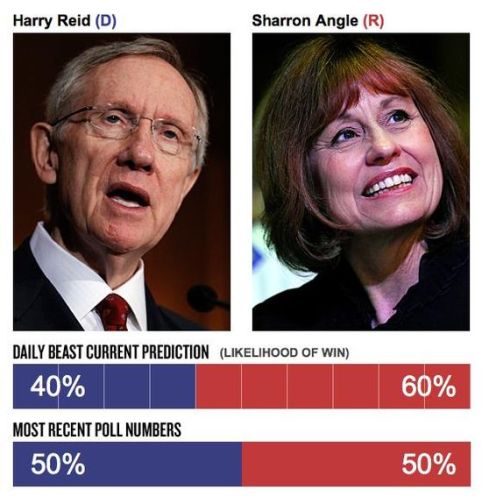
Election Oracle - Nevada - The Daily Beast_1288127529074

A reader writes:

"Why is she treated differently?" is a good question.  My partner and I have noticed that whenever NPR reports something that President Obama has said about some policy or other, the counterpoint is often … Sarah Palin. (Fox I can understand, but NPR?)  So, she gets instant credibility as a national figure, regardless of the nonsense that spews from her mouth.  And of course other news organizations, including local news, just counter President Obama with Palin’s idiotic tweets.  Why indeed.

Another writes:

Asked about the possibility by reporters, David Plouffe, Obama’s 2008 campaign manager, quipped, “Something tells me we won’t get that lucky.”

Weren't Dems hoping to get "that lucky" when Sharron Angle was running in the primaries? 

Didn't Harry Reid's people actually donate money to her campaign?  Perhaps he would be neck-and-neck with any Republican candidate these days, but I'm wondering if Reid regrets his "luck" now.  Depending on the mood in 2012, it seems possible that any Republican candidate will give Obama a run for his money as Angle has Reid.  So why not Palin herself?

Another:

Who cares if the nomination of Palin would be a nightmare for the Republican Party?  Certainly not this Democrat.  But I don’t want to gamble like that.  If she wins the nomination, there is a chance, however unlikely, that she will become president.  And that would probably be an absolute disaster for the country; if, by some chance the country escapes her tenure without suffering catastrophic consequences, it will be in spite of her.

We need to keep some focus on the consequences of elections, not just the horse race.  In this increasingly difficult and complex world, we face enormous challenges, and it is imperative that our president be smart, knowledgeable (dare I say well educated), willing to work hard to master the various issues and problems that face us, and flexible in his or her thinking and ideology.  Do any of these apply to Palin?  No.

The failures of the Bush presidency were, in large part, due to his personal weaknesses – his evident lack of interest in and knowledge of policy issues, his shallowness, and his obvious boredom with the day-to-day responsibilities of governing.  Even so, he is head and shoulders above Palin.

Basically, we’re all fucked if she becomes president. And I’m not willing to risk it.

(Image from the Beast's Election Oracle)

Why American Voters Are Suing Dr Obama

OBAMAREIDEthanMiller:Getty

A British take on the mid-term elections:

An ambulance stops by the roadside to help a man suffering from a heart attack. After desperate measures, the patient survives. Brought into hospital, he then makes a protracted and partial recovery. Then, two years later, far from feeling grateful, he sues the paramedics and doctors. If it were not for their interference, he insists, he would be as good as new. As for the heart attack, it was a minor event. He would have been far better off if he had been left alone …

Wolf rightly calls this a "propaganda coup," and it is indeed primarily Roger Ailes' achievement. But Wolf also criticizes Obama's policy on the same line as Krugman, but with less of a sledgehammer. Money quote:

The truth is not that policy was foolhardy and failed, but that it was too timid and so could not succeed. A big mistake was the failure to address the labour market directly, perhaps by temporarily slashing payroll taxation. There were other mistakes, too: the effort to reduce the overhang of household debt should have been stronger.

Yet even the hated Tarp looks remarkably effective in hindsight. As Mr Summers noted, its cost to the taxpayer looks likely to be ? per cent of GDP. This is far less than the cost of the bail-out of the savings and loans institutions in the 1980s. It is also far less than the direct fiscal cost of comparable crises elsewhere.

Given the scale and complexity of the crisis, my own view is that Obama's record is about as good as one can expect from a human being inheriting a catastrophe and acting with limited knowledge in real time. And it no more fits into the kind of  left-right paradigm that left-liberals like Nick Lemann (in an otherwise brilliant piece), John Judis and Paul Krugman want, and that Roger Ailes, Glenn Beck and Bill O'Reilly need (for easy ratings and unthinking dogma).

I continue to believe that Obama is the president many Independents voted for: pragmatic, smart, non-ideological and remarkably successful under the circumstances. But they have been blinded by propaganda, enabled by profound and resilient joblessness that, in a perfect world, Obama might have prevented, but in the real world, did about as much as he possibly could to alleviate, within prudent parameters.

In this polarized environment, I am an outlier. But if we still want to say "Goodbye To All That", we have to keep our eyes fixed on empirical reality, and not be blinded by the easy left-right tropes of the past. It looks as if I under-estimated the capacity of America to move past this – given the unexpected events and economic implosion of the past two years. But that doesn't weaken the case that we still can and should. Otherwise, the hope we had – and can still feel – will turn to Palinite ashes.

(Photo: Ethan Miller/Getty.)

Le Pen Of The West

Bryan Curtis explains how Tom Tancredo finds himself within striking distance of the Colorado statehouse:

The funny thing is, Tancredo isn’t even the Republican nominee. He’s running on the ticket of the American Constitution Party. That he’s standing on the doorstep of the governor’s mansion is due to a string of GOP implosions.

First, likely GOP nominee Scott McInnis got caught in a plagiarism scandal and fell to Dan Maes, a Tea Party-backed candidate. In short order, the Denver Post accused Maes of fudging his resume; he claimed to have worked undercover with the Kansas Bureau of Investigation. Maes is now polling in the single digits…

That left Tancredo as the only viable conservative. And what a conservative! Tancredo’s campaign recalls a European anti-immigrant crusader refashioning himself as a general-election force—Jean-Marie Le Pen comes to Colorado.

Ideologues And The Tea Party

The false consciousness goes both ways.

I think the Tea Party movement is many things; but to dismiss its aspirations for less government would be as foolish as to credit it with any serious plan to achieve less government. That's the problem; it's an emotional morass (cultural panic, economic distress, pure protest, religious fundamentalism) made coherent by a small government philosophy, with no actual positive understanding of what small government can mean today, except low taxes and entitlement- and defense-driven bankruptcy.

My fear is that in power, this total absence of actual ideas or proposals will mean a purely negative and nihilist agenda of hating on Obama, or even having an interest in making the economy worse, to heighten the contradictions.

In other words, that power will not make them responsible; it will simply make them even more mad. These people are not, in any menaingful sense, conservatives. They seek to conserve nothing of our current state; they seek to destroy, and use the language of reactionary revolution.

If I saw any reasonable figures among them capable of compromising with the president to make our long-term fiscal outlook better, I'd feel less bleak. Instead, I hear the Gingrich rhetoric of hyper-partisan posturing and recklessness.

So, yes, I will be going to the Sanity Rally. And praying hard the day after.

Epistemic Closure Watch: America

Drake Bennett reports on a new study:

[Dan Ariely of Duke University and Michael I. Norton of Harvard Business School] found that Americans think they live in a far more equal country than they in fact do.

On average, those surveyed estimated that the wealthiest 20percent of Americans own 59 percent of the nation's wealth; in reality the top quintile owns around 84 percent. The respondents further estimated that the poorest 20 percent own 3.7 percent, when in reality they own 0.1 percent.

And when asked to give their ideal distribution, they described, on average, a nation where the wealth distribution looks not like the U.S. but like Sweden, only more so—the wealthiest quintile would control just 32 percent of the wealth, the poorest just over 10 percent. "People dramatically underestimated the extent of wealth inequality in the U.S.," says Ariely. "And they wanted it to be even more equal."