What Will The Feds Do If California Legalizes Pot? Ctd

Ryan Tracy asks:

[T]he [Obama] administration’s cheapest course of action, a challenge to Prop 19 in the courts, looks doomed. Constitutional-law experts say California has no obligation to have the same criminal laws as the federal government, so Holder’s Justice Department can forget any lawsuit compelling the state to make marijuana use a crime. “Arguably a state could decriminalize murder” and the federal government could not force it to do otherwise, says Ruthann Robson, a constitutional-law professor at the City University of New York. On the legalization question, then, Holder’s hands are tied.

The End Of Snow Days, Ctd

A reader writes:

As a school attorney in Ohio, I can tell you why administrators are going to on-line schooling: money.  Schools have to offer a minimum number of instructional days (160 I think it is) and the state allows for a certain number of "calamity days."  If they exceed the number of calamity days (which could be weather, no heat, flu outbreak, etc.), they have to tack days on at the end of the year.  That means extending the teacher contracts, extending the bus driver contracts, etc. and it can create a scheduling nightmare for graduating seniors.  If the school can make up all the instruction days on line, though, then the contracts will not have to be extended.

The Daily Wrap

Today on the Dish, Andrew was aghast at the human rights abuses in Omar Khadr's "guilty" plea. Wikileaks offered Steve Coll a moment of clarity, but adding mayonaise to chicken shit didn't make it chicken salad, according to Tom Ricks. Andrew joined the boycott on Fox as a propaganda channel, but E.D. Kain thought Fox gave the people exactly what they wanted.

Andrew pushed back against David Brooks and Mickey Edwards on what they want Dems to learn this year, the GOP stood for one thing only, and Andrew wasn't optimistic about Gingrich's tax promises. Andrew wondered why John Heilemann didn't factcheck Palin, Sharron Angle played hide and seek with the press, sheriff Joe Arpaio gave Palin some pink underwear, and the Tea Partiers were just as elite as the people they disparage. WWII eerily paralleled Iraq today, readers didn't want to pardon Bush, and the Onion illuminated the true source of the Israeli-Palestinian conflict.

Decriminalization may have hurt Prop 19, Thoreau wondered where all the liberal think tank support was, Kevin Williamson shot down dishonest arguments against it, and Barbara Boxer could ride Prop 19's coattails all the way to the win. It Gets Better went global, gayness doesn't die out because of genetics, it was possible to be gay and republican, and Lincoln wasn't the only gay president.

America was number one… in incarceration. Cowen expressed uncertainty, bloggers added their two cents on "curb-stomping" in the blogosphere, and we shed a tear for the end of snow days. Our wardrobes were proof of how wealthy we are, New Hampshire loved beer, and mushrooms could be the new styrofoam. Homer would have trouble not eating meat on Fridays, highbrow TV was the new elite entertainment, and too many future bartenders might be paying for higher education. Dish grammar nerds united, soy sauce took us for a ride, but loyal readers grounded us again. Apology of the day here, political ad of the day here, app of the day here, passive aggressive note of the day here, dissents of the day here, FOTD here, VFYCPAP here, VFYW here, MHB here, and VFYW contest winner #21 here.

–Z.P.

Prop 19: Up In Smoke?

FranciscoVegaGettyImages

Ed Kilgore attempts to diagnose the proposition's slump in the polls:

One possible explanation for the polling trend is that Governor Arnold Schwarzenegger’s apparent effort to undercut Proposition 19, by pushing through legislation that all but decriminalizes small-scale pot possession, has worked. This new law, which Schwarzenegger signed on September 30, makes possession of under one ounce of pot an “infraction” punishable by a $100 fine—significantly less than the average California speeding ticket. This may have deflated support for Proposition 19 among voters who are less motivated by the desire to fire up a doobie themselves as by concerns about the injustices caused, particularly against minorities, by criminal sanctions on the use of marijuana.

Mark Kleiman shows why decriminalization isn't enough:

Possession arrests are already infrequent, except in connection with other offenses. But that’s partly because a custodial arrest is a fairly expensive process from the viewpoint of the criminal justice system. By contrast, writing tickets is cheap: probably a source of net revenue. In one of the Australian states, decriminalization actually increased the number of cannabis possessors going to jail; there were far more tickets than there had been arrests, and some of the people getting the tickets didn’t pay the fine and went to jail for that.

(Image: View of the burning of 134 tonnes of marijuana on October 20, 2010 in the border town of Tijuana, Mexico, seized by the Mexican Army after a clash with drug traffickers. By Francisco Vega/AFP/Getty Images)

Wardrobe Wealth

Virginia Postrel uses clothes to help explain why we're suffering less now than we did during the Great Depression:

In the 2009 survey, the average wardrobe had shrunk—to a still-abundant 88 items. We may not be shopping like we used to, but we aren't exactly going threadbare. Bad news for customer-hungry retailers, and perhaps for economic recovery, is good news for our standard of living.

By contrast, consider a middle-class worker's wardrobe during the Great Depression. Instead of roughly 90 items, it contained fewer than 15.

For the typical white-collar clerk in the San Francisco Bay Area, those garments included three suits, eight shirts (of all types), and one extra pair of pants. A unionized streetcar operator would own a uniform, a suit, six shirts, an extra pair of pants, and a set of overalls. Their wives and children had similarly spare wardrobes. Based on how rarely items were replaced, a 1933 study concluded that this "clothing must have been worn until it was fairly shabby." Cutting a wardrobe like that by four items—from six shirts to two, for instance—would cause real pain. And these were middle-class wage earners with fairly secure jobs.

Face Of The Day

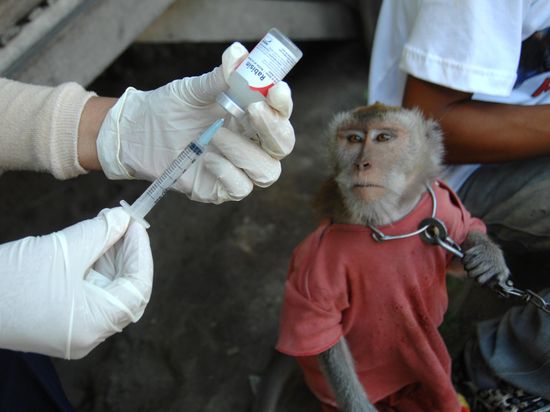
MonkeyShotSonnyTumbelakaAFPGetty

This photo taken on October 25, 2010 shows a health worker preparing a rabies vaccination for a monkey in Denpasar as part of the province's battle against the disease on the resort island of Bali. A campaign to vaccinate almost 400,000 dogs against rabies began in September, as an outbreak caused at least 100 deaths over the past two years. Bali's provincial government has also been trying to stop the outbreak by killing more than 100,000 stray dogs since 2008, although experts say culling is not the most effective or humane way to deal with rabies outbreaks. By Sonny Tumbelaka/AFP/Getty Images.

“No Solution”

Scott Horton interviews Nir Rosen about his new book, Aftermath. On striking a deal with the Taliban:

My experience showed me how diverse the groups fighting the Americans and their allies are. The men I met had diverse motives and only vague goals. They bickered among themselves. They were locals fighting for their villages, their country, their religion. They were very atomized. This means that there can be no mass defection, since leaders at the village level are so important, and there are thousands of them.

This also leads to the rise of more radical young leaders. Some were willing to strike a deal with the government in Kabul. Many Taliban leaders are tired of fighting. They have grown older and are tired of life on the run, away from home. One problem with the idea of merely striking a deal with the Taliban is that it will perpetuate one of the greatest mistakes made since 2001, the lack of justice. Warlords were empowered by the Americans and this would be more of the same, the continued denial of justice to the Afghan people and continued impunity for human rights violations.

The arrival of Petraeus in Afghanistan has come with a return of the “kill or capture” approach to winning the war as well as the creation of more militias. In Afghanistan militias have a history of easily shifting alliances, and those who reconcile today can fight again tomorrow. Until now there has been no significant reconciliation or Taliban defection, and there is no reason to expect any. So far there have only been talks about talks, and the whole thing is overblown. Why should the Taliban negotiate when they are winning and time is on their side? Why should they negotiate with a weak and illegitimate Karzai? And why would a weak and illegitimate Karzai want to strike a deal with the powerful Taliban who have far more legitimacy than him in parts of the country? What would he gain? Also, while many Afghans may welcome an end to the fighting and the return of the Taliban, many despise and fear the Taliban. Reconciliation with the Taliban can lead many Afghans to embrace their own militias in self defense. The point is that there is no apparent solution to the mess the Americans have helped create.

Which is why a firm exit date in 2011 remains necessary, it seems to me. Think of the last year as one last chance to get a face-saving lull, some kind of least-worst settlement, as in Iraq. But if we don't get one, we leave anyway. In terms of counter-terrorism, we can keep the worst of mid-level al Qaeda at bay. In terms of domestic politics, is the GOP really going to campaign on intensifying the war still further?

What troubles me is the moral case for upping the ante this past year if we knew realistically that the odds of anything better than a very compromised face-saver were always pretty close to zero. How do you send a young man to his death for that? Or worse, to prove that the war cannot be won and not be seen at home as a weakling?

From a reader's quote on Tom Ricks's blog today:

Someone dies in combat. At Brigade level, he's a social security number and a status that gets tracked to Landstuhl. At Division, he's a storyboard. At Corps, he's a statistic. At Platoon and Company, he's a gaping wound in the soul of a hundred men. To his family, it's the end of the world.

The View From Your CPAP

A reader writes:

I've been reading your posts about sleep apnea with interest.  A few years ago, I too had terrible breathing problems.  If I laid on my back, my airway would be gradually occluded until I strangled myself and woke up with a panicked start.

Three years ago, I began practicing yoga, which has gradually re-aligned my head, neck and shoulders.  I know "spine alignment" sounds like a bunch of hippy-dippy bullshit, but take it from this red-blooded (usually bearded!) rationalist: it really does make a difference. 

Standing or lying with relaxed and lengthened neck/shoulders feels approximately like fastening a breathe-right strip onto my nose.  It's that dramatic. I look at the photo another reader sent in and I could be looking at my posture three years ago.  Look at the convexity of his back: when he lies down that same curve will persist, and lift the base of his neck off the bed, which tilts his head back, which closes off his airway. 

I'd suggest that anyone with apnea, snoring or breathing problems try some kind of postural remedies before, or in addition to technological or surgical interventions.  Yoga, Alexander Technique, and Feldenkrais are all good. (I've never had chiropractic treatment, but that might help too.)  The thing is, all those approaches take time and work; you have to change the physical habits of a lifetime.  It's not easy, but for me it's made a big difference.

Another writes:

A couple of years ago, I set up home with a new partner, and she asked me if I realized how much I snored, and how often I had sleep apnea. So I tried the easy things – the moulded plastic mouthpiece, the tennis ball sewn into the back of my t-shirt, etc. Nothing helped. My doctor said that a CPAP might help, but at my age (60) and weight, and with my deviated septum, I would probably need surgery.

And then I realized something: I never snore on planes. I was doing a lot of long-haul flying – I racked up 6 trips to China last year – and I could sleep without difficulty in the coach-class seats on the plane.

So I tried sleeping sitting up. I tried various chairs, and it definitely helped, but it was hard to get the angle right. So I broke down and spent a $1,000 on a power-operated "Zero-G" chair. At the right angle, my sleep apnea disappeared. I still snore occasionally – just a mild buzz, according to my partner – but I sleep much better and awake more refreshed than I have for many years.

Another:

For the reader who is addicted to Afrin, here’s my experience:

I was diagnosed with sleep apnea and had a CPAP with only moderate success.  I found that if I also used Afrin, I slept MUCH better.  Prolonged use of Afrin is widely thought to be a bad idea, but it did convince me that my breathing problems were associated with somewhat restricted airways (this is often the case, but not with everyone.)

I told my sleep-ologist about the Afrin.  He sent me to an Ear Nose and Throat specialist.  After a thorough exam, he prescribed an alternative inhalant to Afrin, fluticasone propitionate.  This provides the benefits of Afrin, presumably without the side affects.  Used once a day, this has a greater net effect for me than the CPAP.