Blinded By Ideology

Morning's Minion seeks to correct this piece on conservatives and government intrusion, in The American Catholic:

Social structures can never make charity superfluous. But likewise, the importance of personal charity does not diminish our collective responsibility to put just  structures in place. To claim otherwise conjures up a cold dark world where grace and nature are radically sundered. For how can private charity alone meet the needs of those millions with no healthcare, or inadequate healthcare? How can private charity alone take care of pensioners and the destitute? How can private charity alone took after the 15 million people who are unemployed? And how can taking the government out of the economy protect us from the forms of greed (human nature, after all) that led to the greatest economic collapse since the Great Depression?

Catholic social teaching exists for a reason. Let’s not be blinded by ideology.

The question is one of balance: when does government aid begin to weaken the sense that we need to be personally charitable? When does a generous social welfare state actually prevent charity by taxing away our means to provide it? A Beck-style Christianity with no social welfare is unjust; a socialist state where private charity is made close to impossible is corrupting of the individual soul.
All In The Knees

DrunkenSilenus

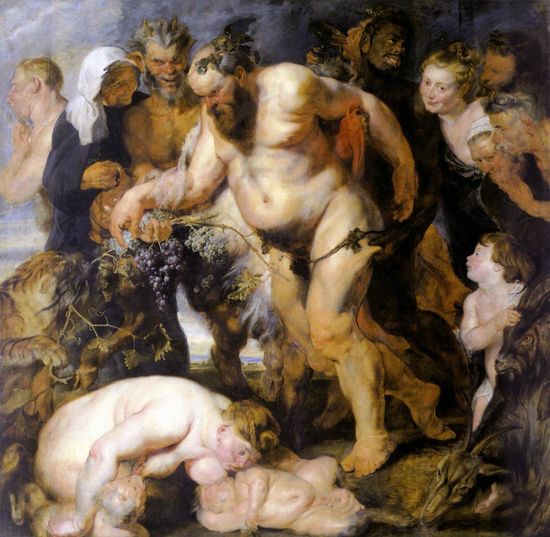
Morgan Meis goes after the painter Rubens, on why everyone in Antwerp hates him, and why he's actually worthwhile:

Knees are difficult to understand and almost impossible to love. Rubens pays a lot of attention to the knees of [the Greek mythological tutor] Silenus. He wants to show us all of the parts of the knee, all the sinewy chaos that must be going on underneath the skin during this drunken forward lurching.

Every time I get angry at Rubens, every time I get resentful at his little smile in that self-portrait, his coyness, his pompous and boring statue in the middle of the Groenplaats, I think about those knees. The knobby knees of Silenus as Rubens paints them make Silenus all the more tragic as a character. You can see the actual weight of the knowledge that Silenus carries in those knees. Silenus stumbles forward with the knowledge that life has no meaning, nothing it points to beyond its bare existence. It's all there in the knees.

Beliefs As A Defense Against Complexity

Rebecca Costa explains why American refuse to believe certain truths like climate change:

[I]n program after program, [Bill] Maher asks why facts are becoming marginalized. The answer is right under his nose.

When Darwin discovered the slow pace of evolutionary change (millions of years), he also explained what happens to us when the complexity of our problems exceeds the capabilities our brains have evolved to this point. It’s simple: when facts become incomprehensible, we switch to beliefs. In other words, all societies eventually become irrational when confronted with problems that are too complex, too large, too messy to solve. …

Until recently we haven’t been able to look under the skull and see what the brain does when a problem is highly complex. The good news? The brain has a secret weapon against complexity, a process neuroscientists are now calling “insight.” We are learning more everyday about insight’s ability to catch the brain up to complexity—the real antidote to reverting to beliefs as a default.

Do Bacteria Think?

PetriDish

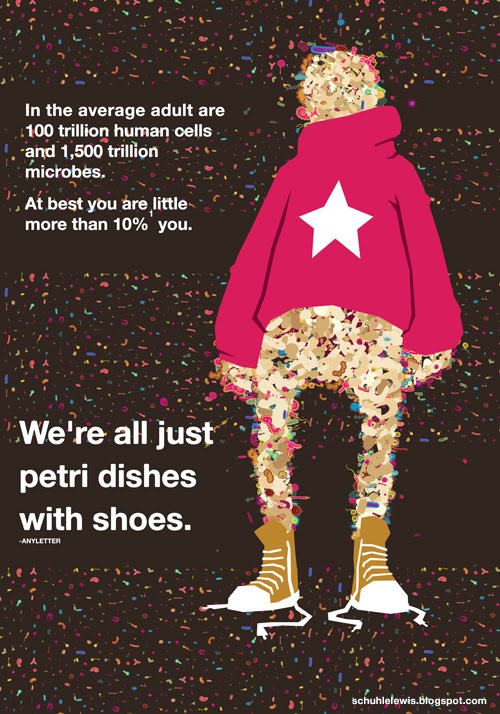
Valerie Brown has a long, humbling piece on the micro-organisms that make up "the vast majority — estimated by many scientists at 90 percent — of the cells in what you think of as your body":

Researchers have found several reasons to believe that bacteria affect the mental health of humans. For one thing, bacteria produce some of the same types of neurotransmitters that regulate the function of the human brain. The human intestine contains a network of neurons, and the gut network routinely communicates with the brain. Gut bacteria affect that communication. “The bugs are talking to each other, and they’re talking to their host, and their host talks back,” Young says. The phrase “gut feeling” is probably, literally true.

(Image by Jake Lewis. It can be bought here and here.)

From Jesus To Gandhi: Re-Reading the Gospels

A reader writes:

You reader asked, "If you don't believe in mandatory food and shelter for freeloaders, what do you think Christ meant when he said that if a man asks for your coat, give him your cloak also?" This was taught to me by Jesuits NOT as a call for forgiveness but rather a call to Social Protest.  This comes from Matthew 5:40 and it says:

And if someone wants to sue you and to take your tunic,  give him your coat also.

In Hebrew law, a person could not be deprived of "shelter". Meaning you could sue for everything a man has, but you had to leave him some shelter, which for the poor would be a cloak, which would have been a thicker garment suitable for cold nights. So what this passage is saying is that if someone sues you for everything you have, then you might as well give him your cloak as well. Which would have left you stark-naked, and therefore embarrassing everyone in the room, from the court, to the judge, to the plaintiff themselves. This comes after Matthew 5:39, which says:

But I say to you, do not resist the evildoer. But whoever strikes you on the right cheek, turn the other to him as well.

A strike on the right cheek would be a backhand (remember the striker wouldn’t have used the left, or sinister, hand). That backhand is an insult; to "offer the other cheek" is to offer an open-handed slap, which again for the time, would have been inviting a duel. A duel among equals. And this passage is followed up with Matthew 5:41

And if anyone forces you to go one mile, go with him two.

Meaning that if a master commands you to carry something a mile down the road, you carry it the mile, as commanded, but then you go the extra mile in protest.

This is the how-to guide that Gandhi and Martin Luther King would use almost 2000 years later. Non-violent protest of unfair civic institutions – a way to raise yourself up, without raising a hand. This is my Christ. This is why I still follow him.

Our Animal Empathy

Frans de Waal’s essay explores morality and religion among humans by looking at empathetic behaviors found in primates and other animals:

According to most philosophers, we reason ourselves towards a moral position. Even if we do not invoke God, it is still a top-down process of us formulating the principles and then imposing those on human conduct. But would it be realistic to ask people to be considerate of others if we had not already a natural inclination to be so? …

Instead, I am a firm believer in the Humean position that reason is the slave of the passions. We started out with moral sentiments and intuitions, which is also where we find the greatest continuity with other primates. Rather than having developed morality from scratch, we received a huge helping hand from our background as social animals.

Jerry Coyne scoffs at de Waal’s final point that an “atheist morality would wind up looking religious”:

I look forward to worshipping St. Hitchens at Our Lady of Perpetual Dickishness, and to receiving infallible proclamations from the chair of His Holiness Pope Cephalopod. The idea that secular morality would look like religion is ridiculous, and is completely dispelled by the example of modern Europe.

But Hume was onto something. And he also noted something that other moderns have forgotten, that acts of kindness and generosity actually make us happy. That natural correlation between virtue and happiness has been occluded by the Augustinian notion that being good means repression and self-denial. Often giving to others is the surest way to sanity, well-being and happiness. To give is to receive. And this seems not to be against the grain of our nature, but with it.

Updating Freud

Jeremy Dean examines the weight we give to dreams:

What [the study] found was that people who remembered a dream about their friend kissing their partner tended to think it was meaningless, but when the dream cheat was someone they didn’t like, it was filled with meaning. This suggests people only imply meaning into their dreams when the implications fit their motives.

In a final study experimenters pitted people’s dreams up against their religious beliefs. Again, participants demonstrated a motivational interpretation of their dreams. They were happy to endorse the meaningfulness of their dreams, unless it contradicted their religious beliefs, in which case they were meaningless.