Chart Of The Day

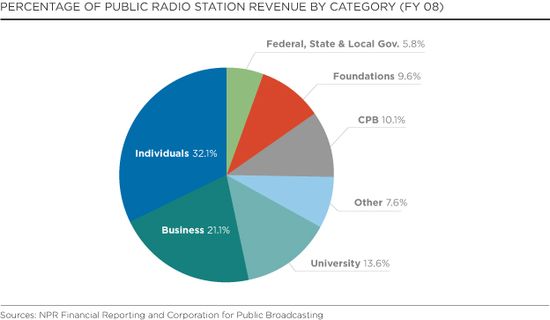
Pub_radio_rev

A reader writes:

Your reader quipped, "At least there's one good thing to come out of this whole Juan Williams v. NPR mess: we've finally found a program that Republicans are willing to say they would cut." It's a decent dig, and Mike Huckabee and Sarah Palin have made comments along these lines. 

There's just one problem: NPR does not receive any direct federal funding for operations.  Less than 2% of the budget is derived from competitive grants from federally funded groups such as the National Endowment for the Arts. Certain member stations receive some state and local funding, to the tune of about 5% of their funds. A detailed breakdown complete with audited tax forms is available on their website

"Public Radio" no longer means "government funded," if it ever did.

An Ad To Remember, Ctd

A reader writes:

Beyond the deception regarding China's successful use of government stimulus, there is another important lie in that ad: China owns most of our debt. This is absurd.

The vast majority, almost 75% of our debt, is held within the U.S. itself; only about a fourth is owned by foreign countries. Of that 25%, China owns slightly more than a fifth of it (as of July 2010), and is nearly tied with Japan. So a fifth of a fourth, or around 5%. Now, I don't claim to be a mathematical whiz, but I don't think 5% of the total constitutes "most".

Then again, these are the same people who are telling us they can cure the deficit without touching Medicare, Social Security, or Defense spending. So perhaps calling it a lie is being too harsh. Maybe they just really suck with numbers.

Yglesias Award Nominee

"Having spent a good deal of time writing about the crude left-wing history of our country by charlatans like Howard Zinn and Oliver Stone, I have become wary of politicized history in general, whether it comes from the precincts of the far left or the far right. This time the culprits are on the right, one of the biggest examples being Glenn Beck. … Now, from the precincts of the left, come two important critiques of both Beck’s and the Tea Party’s historical narrative," – Ron Radosh, heralding works by Jill Lepore and Sean Wilentz.

Ignoring Iraqi Torture

The first story from the Wikileaks doc-dump makes for grim reading. We got rid of one torturer and replaced him with countless others fighting alongside and for us:

The new logs detail how:

• US authorities failed to investigate hundreds of reports of abuse, torture, rape and even murder by Iraqi police and soldiers whose conduct appears to be systematic and normally unpunished.

• A US helicopter gunship involved in a notorious Baghdad incident had previously killed Iraqi insurgents after they tried to surrender.

The numerous reports of detainee abuse, often supported by medical evidence, describe prisoners shackled, blindfolded and hung by wrists or ankles, and subjected to whipping, punching, kicking or electric shocks. Six reports end with a detainee's apparent death.

Muslims Wearing Things

Tumblr_laph7pMbbt1qet98po1_500

A Tumblr classic. But it also shows, of course, an implication in Juan Williams' comments. In them, he says that Muslims wearing Muslim garb are somehow more scary to him than Muslims not wearing such garb. Apart from the fact that this makes no logical sense when it comes to Jihadist terrorists (who all try to look as un-Muslim as they can), it also sends a signal to Muslim-Americans that there are appropriate ways to dress publicly if you are not to provoke fear. I don't like the implications of that.

Would someone say that Jews should not wear yarmulkes in public, because it presents them "first and foremost" as Jewish? Or that gays should never appear effeminate? Or that African-Americans should always wear suits and ties – because a different appearance can legitimately provoke nervousness or discomfort? Where does this stop?

One thing that distresses me about the plain meaning of Williams' remarks, and his justification of them by his own record of writing about the civil rights struggle for African Americans, is that he is implying that this other minority has to abide by standards of public appearance that his own minority doesn't. He wasn't invoking his civil rights journalism to stand against stigmatizing minorities based on appearance, he was invoking it to allow him to stand for their stigmatization. He was creating a new other – not by endorsing removal of constitutional rights, of course (leave that to Marty Peretz) – but by defending the legitimacy of being scared because someone is obviously "the other".

Spinning Fat Into Gold

Sharon Begley has a Wired cover story on "tissue engineering," a technology being primed for use in breast enlargement. Irin Carmon explains the process:

Doctors experimented with injecting liposuctioned fat directly into other parts of women's bodies in the 80s and 90s, but the effect would be temporary as the body gradually absorbed that fat. According to Wired's Sharon Begley, it was a female post-doc, Min Zhu, who made the key discovery that if you use blood as feeder cells, you could get adipose tissue to differentiate into bone and cartilage, muscle, or neuron.

That was in 2001, and since then, a plastic surgeon and a medical device maker teamed up to create the Celution, a sort of magic box that centrifuges fat cells and readies them to be injected back into the body in pearl-like droplets. "Within 48 hours, new capillaries and blood vessels entwine through the injected cells, supplying oxygen and nutrients to the now-stable tissue," according to Wired.

The technology is about more than big breasts:

It makes sense to apply Cytori’s technology to enhance breasts instead of, say, repair urinary sphincters as a strategic way to move the patented technology out of rats and into people as soon as possible. Hearts, kidneys, and even sphincters have to work in order for us to survive. But we can live just fine without breast tissue, and, outside of feeding offspring, breasts don’t have to do much. The fact is, the scientific and regulatory hurdles to getting Cytori’s cells into clinical use will be easier to clear for breasts than for other tissue: Breasts simply aren’t as necessary as other organs, so the bar for proving to regulators that the technology works will be lower.

Today In Demagogy, Ctd

Adam Ozimek tells some hard truths about progress:

Ads like this beg the question of why we only get angry when jobs are lost to trade. Yes, there have been many manufacturing jobs lost as companies increasingly produce and assemble manufactured goods in China, Vietnam, and many other areas of Asia. But the destruction of jobs not a byproduct of trade alone, but a byproduct of progress in general. Technology, for instance, is easily as a powerful a job killer as trade. … Yet could you imagine a campaign ad criticizing a politician because he supported technology? Or productivity?

It’s important to recognize that there are very few forms of progress that don’t make some people worse off.