Man’s Best Bomb Detector

98207977

Danger Room points to it:

Drones, metal detectors, chemical sniffers, and super spycams — forget ‘em. The leader of the Pentagon’s multibillion military task force to stop improvised bombs says there’s nothing in the U.S. arsenal for bomb detection more powerful than a dog’s nose.

Despite a slew of bomb-finding gagdets, the American military only locates about 50 percent of the improvised explosives planted in Afghanistan and Iraq. But that number jumps to 80 percent when U.S. and Afghan patrols take dogs along for a sniff-heavy walk. “Dogs are the best detectors,” Lieutenant General Michael Oates, the commander of the Joint Improvised Explosive Device Defeat Organization, told a conference yesterday, National Defense reports. That’s not the greatest admission for a well-funded organization — nearly $19 billion since 2004, according to a congressional committee — tasked with solving one of the military’s wickedest problems.

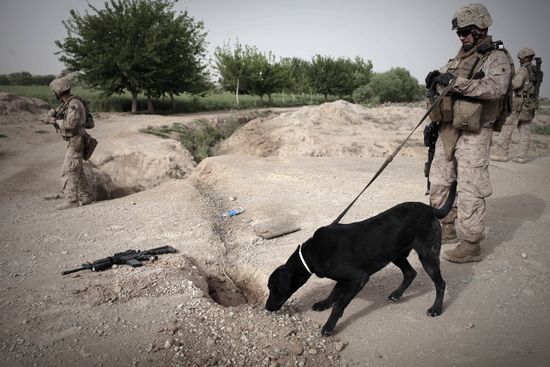
(Photo: A US Marine of 3rd Battalion, 6th Marines, puts his sniffer dog near a roadside bomb while anti-explosives squad members check final details to blow it up, during a 48-hour operation in attempt to hold back insurgency activities in a stronghold Taliban area in Marjah, Helmand province, southern Afghanistan, on April 1, 2010.  By Mauricio Lima/AFP/Getty Images.)
The Fiscal Conservatives Of San Francisco

Like so many cities, San Francisco is experiencing tough fiscal times and cutting back on many programs and services. Unlike a lot of cash strapped municipalities, its residents are revolting against rising public employee costs:

77,000 San Franciscans signed a petition to place a measure on the Nov. 2 ballot that would do what generations of politicians haven't: bring a modicum of sanity to the pension and benefit programs of San Francisco government employees. If passed, Proposition B would require all city employees to contribute up to 10% of their income to their pension plans, and to pay half of the health-care premiums of their dependents. This will save San Francisco at least $120 million a year, at a time when its pension tab is $400 million per year, up from $175 million in 2005.

These numbers help explain why:

A typical San Francisco resident with one dependent pays $953 a month for health care, while the typical city employee pays less than $10. In 2009, San Francisco's deputy police chief earned $516,000 in cash compensation and retired with a $230,000-a-year pension—a package that could cost the city $8 million over the balance of his life.

Counting The Dead

A new tally of the human toll of the Iraq war:

It appears that there were some 100,000-120,000 Iraqi deaths during the war, with a quarter or more of them hostiles (terrorists and others opposing the new Iraqi government or foreign troops.) The fact that over 90 percent of the dead were adult males is also an indication of warfare, not just random killing. Most of the women and children killed were the result of car or truck bombs in crowded places, or kids playing near where a roadside bomb was planted.

43 percent of these casualties were revenge executions of Sunnis by Shiites in the chaos and mayhem that the incompetent occupation precipitated.

Pushing Bigotry Underground

A reader writes:

The only thing that bugs me is that firings like this only serve to make people continue to keep their bigotry to themselves… I would’ve hoped for a discussion on NPR about the substance and motivations behind Williams’s comments rather than a firing, an attempt draw out his inner bigoted feelings and analyze and deconstruct them, let them breathe rather than extinguish them. Quelling these resentments only make them fester and ruminate, growing into a repressed anger that ferments false victimhood.

I take my reader’s point – up to a point. What NPR does is its own business; I think the fashion of his firing was poorly handled, but it was no different and less swift than that accorded to Rick Sanchez by CNN, and I don’t recall Fox News or the blog right defending Sanchez then. On balance I can see why both NPR and CNN did what they did. And, of course, there is no quelling or even chilling of free speech here. In fact, this contretemps after O’Reilly’s baldly bigoted comments on The View has provoked a very wide and searching debate. My view is that it is essential at all times to distinguish between Islamism and Islam, between violent Jihadists and faithful Muslims, and to ensure that we respect the latter as much as we fight the former. And that keeping this distinction clear is not just to avoid bigotry, but to win the war. I do not believe Williams is a bigot, but I do not think he was simply confessing to unfounded fears (we all have them on a whole range of issues); he was arguing that these fears were legitimate.

The Prop 19 Polls Tighten, Ctd

Prop19

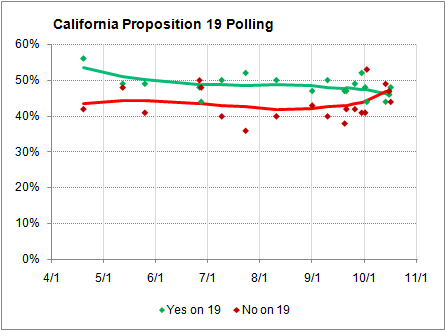
Nate Silver takes a hard look at the latest poll numbers:

There are good reasons to think the polls could either be overestimating or underestimating Proposition 19’s support. In spite of the recent trends against Proposition 19, therefore, I would be inclined to take the recent polling at face value, which suggests that the measure has about even odds of passing.

I sure hope that's true. Today's LA Times poll, which is not in Nate's analysis, shows a real shift toward opposition, with the initiative now trailing by 12 points. It could be an outlier, or a harbinger. 

The High Cost Of Heresy

Bruce Bartlett takes Republicans to task:

The conservative position on taxes is both wrongheaded and myopic in the extreme. It’s wrongheaded because it ignores the fact that a poorly designed tax system imposes a heavy deadweight cost on the economy over and above the revenue raised. A 2005 survey of research on this subject by the U.S. Government Accountability Office found that the cost could be as high as 5 percent of Gross Domestic Product. It’s myopic because most economists think that technological innovation plays a much bigger role in growth than the size of government. And it goes without saying that there is not one iota of evidence that starve-the-beast theory works; all it accomplishes is to increase the budget deficit, a fact just reconfirmed by a new International Monetary Fund study.

Yet despite the obvious failure of Republican tax policy during the George W. Bush administration, Republicans are still as dogmatic as ever about opposing a VAT. Those that enforce the party line on taxes, therefore, responded to [Republican Indiana Gov. Mitch] Daniels’ mild support instantly and viciously. 

 In my view, Daniels is one of the few established Republicans who could win the presidency in 2012. And yet he is being cast out for thinking.

Where American Influence Makes No Sense

Larison puts US meddling in Georgia into perspective:

The claim that the U.S. rejects spheres of influence is true only in the sense that our government rejects it when other states claim them. For our part, the entire world is treated more or less as our sphere of influence. As long as Washington treats the rest of the world this way, other major powers are going to try to gain influence anywhere they can. Indeed, other major powers would be doing this anyway, but there is no way that the U.S. and other major powers could ever come to any understanding about respective spheres of influence so long as our government insists that we have them all and they have none.