A Not So Sweet Hereafter

John P. McCarthy is disappointed by the religious aspect of Clint Eastwood's new film:

Theologically, “Hereafter” is unhelpful no matter what one’s beliefs may be. Straddling the fence between belief and non-belief, it does not say anything substantive about mortality. …

Yet by aiming at the center—at common ground—“Hereafter” becomes aesthetically and theologically neutral. While every perspective is treated with respect and dignity, middlebrow taste prevails. Accessible and unthreatening, the movie’s generic brand of wisdom is available at duty free shops and bookstores inside any international airport.

Few souls will be stirred.

Mourning The Trees

Johann Hari reviews V. S. Naipaul's new book on Africa:

Almost all homegrown African belief systems are, or were, based on a reverence for local ecosystems—a belief that the forests and rivers are sacred—and this helped persuade people to preserve them, alive and intact. But when the colonialists arrived, they dismissed such notions as mumbo-jumbo and forcibly imposed religions that originated in the desert and had nothing to say about the African environment. The old taboos were stamped out, and before long the forests began to be systematically destroyed.

It's an eco-catastrophe from which Africa has never recovered, and which many Africans have picked up and are continuing to perpetrate today. Wangari Maathai, the Kenyan environmentalist who won the Nobel Peace Prize in 2004, offered a personal example when I interviewed her, speaking about one particular tree near her village that she loved: "That tree inspired awe," she told me. "It was protected. It was the place of God. But in the '60s, after I had gone far away, I went back to where I grew up, and I found God had been relocated to a little stone building called a church. The tree was no longer sacred. It had been cut down. I mourned for that tree."

Graeme Wood ponders the same title.

On Gay Stuff And Honesty, Ctd

A reader writes:

You wrote:

I shudder to think what an unreflective and glib person I could have become without that process. Not that I am never unreflective or glib, of course. But less so, I think, than if, ensconced in a relatively comfortable position – white, male, smart, educated, Western – I had never been forced to see what it also is to be an outsider, and to feel, even in a much milder way than many, the pain and cruelty and misery it can involve, and equally the dignity and life and vigor of so many under such strain.

Being a heterosexual white, male, smart, educated, Westerner, I very much was never forced to take stock of my emotional life, and was certainly never forced to feel like an outsider in any walk of life. That has changed for me recently too, in a strange sort of way – my wife is leaving me. 

Being a Catholic raised in an extremely strong family untouched by divorce, I operated under what I know see as the smug assumption that, just like everyone else, I'd get married, have kids, and live my life happy.  I never imagined that my wife would decide one day that she was never going to want children (and therefore could not stay married to me), and that I'd be left alone in a city that I wouldn't ever have chosen to live in, if not for her.  It's been tough reconciling my new life with what I always thought my life would be like.  While this emotional process is clearly quite different from coming out of the closet, a lot of the feelings I have seem like they would be similar – a sense of being unmoored, of fear of being rejected by the Church (and God) for something I don't have control over, a fear of the unknown future.

And yet, as you reminded me, feeling like an outsider, feeling the pain and misery, is exactly what lies at the heart my faith – the love of the Man that was the ultimate outsider, who suffered pain and cruelty and misery, but rose to dignity and vigor and life anew.  Going through this process has forced me to change a lot of the assumptions I had about life, society, and people.  I hope — and trust — that in the end, however backwards it all seems now, it will bring me a little bit closer to the truth of Christ.

What an irony that must seem to the Church.
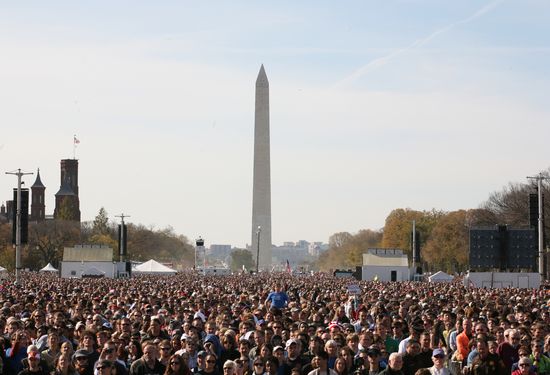
God Hates Rallies

SANITYMALLKimihiroHoshon:AFP:Getty

Well, that was my favorite sign. In the spirit of today's rally, I'm not blogging about it till tomorrow. I was there, had a ball, and took in what was a beautiful fall day in my home town. Thoughts about what it all meant tomorrow. But meanwhile, may I and the Dish endorse the following statements:

“For everything that’s happened in the past two years, “The Daily Show” is how we cope,” said one of the tea bags, a 40-year-old from Anchorage named S.J. Klein. “The battle for the American mind right now is between talk show hosts and comedians,” said Alex Foxworthy, a 26-year-old doctoral student from Richmond, Va. “I choose the comedians.”

Me too. What a blast.

What The Young Are Good For

Gavin McInnes stands up for today's hipster:

“But what about [the hipsters'] legacy?” I was recently asked by New York magazine. “What will they have left behind after it’s all said and done?” This question gets on my nerves. “Music and fashion,” I answered incredulously. Since when are young people responsible for leaving us with anything more?

Have you heard their politics? I don’t want these people voting. I want them doing what they do best: Fun. The greasers were about rock ’n’ roll and making out in rumble seats. The beatniks gave us some good books, but they were mostly about shocking their parents by dancing with Negroes. The only thing the mods cared about outside of dancing and getting laid was fighting Elvis fans. Boomers, who are masters at glorifying their past, insist they stopped a war, but we all know it was Kissinger’s relentless bombing that ended it. Hippies were horny stoners. Though I was one of them, I’m happy to admit punks were more preening peacocks with guitars than anarchists smashing the state. Rap evolved from parties in the South Bronx. The list goes on, and it’s always just teenagers partying.

There are two things that make the hipster subculture unique. One: They’re better than their predecessors. Two: Everyone says they’re worse.

The Danger Of Dressing Up

Scaryclowns

Joe Berkowitz believes Halloween is a death kiss for new relationships:

Halloween travel combines all the worst elements of vacation traveling, only now you’re covered in foam and latex and you may not have any pockets. This makes for a particularly turbulent emotional state to navigate for two people who are still new at being together. … And just like on vacation, the way you respond to contingencies and surprise stressors reveals a lot about how you function as a couple. It will either bind you together against a world conspiring to harsh your buzz, or it will turn you against one another.

(Photo from About.com)

Poem For Saturday

“Like A Star” by James Herbert Morse first appeared in The Atlantic Monthly in August 1895:

No spirit have I, when the moon is full,
To run to greet it on the round earth’s edge;
Nor, when the spring has mantled every hedge
With all the marvel and the miracle
Of blade, and leaf, and blossom white as wool,
Am I the first to cry aloud. All still,
When others shout, I lie upon the hill,
Beholding, maniple on maniple,
The ranks unfold, — leaf, blossom, beast, and bird;
Yet in my heart a high priest chants his praise,
Not less devout because it is not heard
Of men who pass me on the public ways.
I have no song, — no, not a single bar, —
But my soul, sleepless, gazes like a star.

Candy Coating Halloween

Samira Kawash traces the tradition:

Today the association of Halloween and candy seems natural, inevitable. But 100 years ago, there were many holidays that were equally un-candified. Christmas was the first, most “natural” candy holiday; it was an easy leap from oranges and cakes to candy sticks and chocolate boxes. The candy trade didn’t have to do much more than put their product out there. But other candy holidays were made, not born. The first candy promotion holiday success was Easter. Candy makers emphasized molded candies for the holiday, most of which look just like the Easter candies of today: bunnies, chicks, eggs. But in the days before trick or treat (which was not popularized until the late 1940s), there wasn’t an obvious use or demand for candy at Halloween, or at any other holiday for that matter. If candy sellers noted Halloween at all, it was as a theme for window displays which changed every month with the seasons.

More along these lines here and here

Things You Didn’t Know About Harry Houdini

He helped fight fraud:

[Houdini] came out swinging when spiritualism—the belief that the dead could communicate with the living—spawned racketeers who robbed the bereaved. Houdini’s own mother had recently died. He felt the vulnerability that death brings. So when he saw people exploiting it, he went into a white-hot rage.

He toured the country with a team of undercover investigators (sometimes even attending sé­ances in disguise). Then during his stage shows he called out the local spook-crooks by name, listed their crimes, and exposed their methods. The Spiritualist mafia responded with death threats. Houdini answered by lobbying Congress for stronger anti-fraud laws.