Map Of The Day

ClimateMap

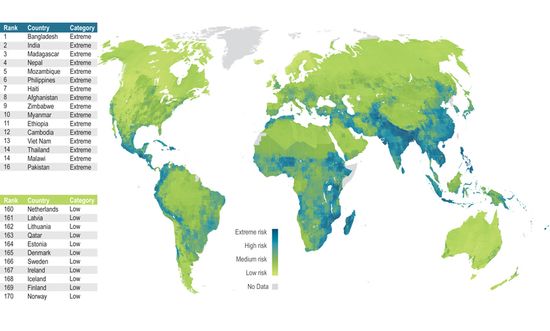
Above is the Climate Change Vulnerability Index. Dark blue indicates high risk; light green indicates low risk. Larger version of the map here. New Scientist summarizes the data:

Bangladesh comes top of the "extremely vulnerable" category because of its large population, extreme rural poverty and high risk of flooding. India is second because of its billion-plus inhabitants. Other Asian nations at risk include Nepal, the Philippines, Afghanistan, Burma, Cambodia and Pakistan, which is still recovering from floods that engulfed a tenth of the country.

African nations judged at extreme risk are Madagascar, Mozambique, Zimbabwe, Ethiopia and Malawi.

Yglesias vents:

 Presumably “I should be allowed to steal this Bangladeshi man’s land and sell it for profit” is not a free market position. Nor is “I should be allowed to have my cattle eat this Bangladeshi man’s grass and then sell it for profit” a free market position. I don’t think “I should be allowed to cut costs by dumping the toxic waste byproducts from my family on this Bangladeshi man’s agricultural land” makes a ton of sense as a free market position.

“Her Whole World Is Chaos” Ctd

Chait is put at ease by Jonathan Martin's reporting:

Either Palin has no interest in running for president — ever — or she is so terrifyingly disorganized she couldn't win in even the most friendly landscape. Okay, "couldn't win" is too strong. But even if she can get organized, she is digging a very deep hole.

Losing The Drug War

The NYT has a slideshow of "what Mexican authorities called the largest seizure of [marijuana] in the country’s history…" Morgan Fox is unimpressed:

Two days ago, Mexican authorities seized 134 tons of marijuana in Tijuana, just across the border from California. The value of the seizure was estimated at $340 million.  According to the logic of prohibitionist economics, such a huge bust should have quite a damaging effect on the marijuana market in the United States, right?

Wrong. Mexico confiscated more than 1,300 tons of marijuana in 2009 alone, and before that the average was more than 2,000 tons per year. Yet each year, production goes up and street prices in the U.S. remain relatively static.

The British Model

Kori Schake, former policy advisor to the McCain-Palin campaign and member of George W. Bush's National Security Council, applauds Cameron:

Britain's reductions are substantial, and one wishes they had not been necessary. But the Cameron government deserves an awful lot of credit for facing Britain's debt crisis and making hard choices that accept risk in the near term to put their country on stronger strategic footing. The British set sensible priorities and programmed to them, making cuts that do not damage their ability to protect and advance their interests. Lots of other countries are set to make reductions in defense spending, including the United States; probably none — including us — will do as proficient a job as Defense Minister Liam Fox and the British defense establishment have done.

“Her Whole World Is Chaos”

PALINEthanMiller:Getty

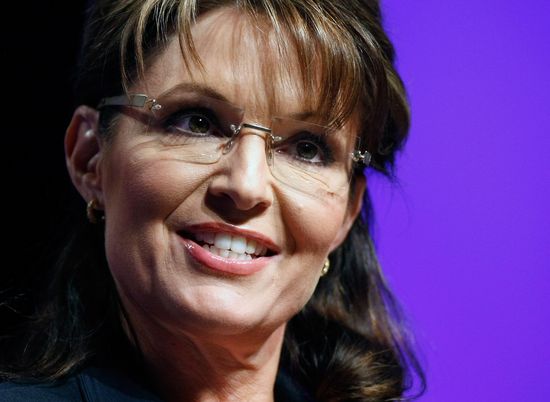
Jonathan Martin filed a story today on Sarah Palin's dysfunctional operation. Wow has she ticked off many GOPers by fickleness, elusiveness and being so paranoid she only has one staffer to deal with other campaigns. I liked this detail:

In some, but not all, cases, Palin charges campaigns for travel expenses. Georgia Republican gubernatorial hopeful Karen Handel, for example, shelled out nearly $100,000 from her campaign account to get Palin for a pre-runoff rally earlier this year. “I don’t know of anyone else who does that,” said a longtime GOP consultant who’s working on a host of statewide races this election cycle.

Jonathan Bernstein's wonders:

Why are Republican operatives feeding negative stories about Palin to Politico two weeks before the midterm elections?  I certainly don't know, but that's my first reaction when I read the story. 

Are they trying to deflate her as a 2012 contender?  If so, is it because other candidates have friends around the country?  Could be.  Is it because many GOP insiders read the polls, and think she's poison for the party?  Could be.  Is it because Republicans are at heart hierarchical and traditional, and just really can't stomach this crazy person…ahem, this crazy woman, from nowheresville, who just doesn't look like what they think a President of the United States should look?  I don't know.

I thought it was certainly very interesting that Chuck Grassley's campaign was identified by name; Grassley has an easy reelection bid right now and doesn't have to face a primary for six years, so he's pretty safe from retribution, and he may be reminding not just Palin but all prospective candidates to pay proper fealty to him as the caucuses approach.  Don't forget the obvious possibility that perhaps it's just straightforward: she really does have an incompetent operation, which has repeatedly burned and angered so many people that it's produced a subset willing to talk to a good, aggressive, reporter.  Again, could be.

The point is that when reading these stories, always think about why people talk to reporters, and why these particular sources talked to this reporter about this particular topic. 

Most are probably just tearing their hair out the way almost everyone does when trying to deal with her. But I suspect a few of them are beginning to realize that the tiger they have been riding could very well be having them for breakfast tomorrow. I'd also wager that if her star fades, these stories will multiply. Because the one thing preventing the full truth about this fraud from coming out is fear of her base star-power.

(Photo: Ethan Miller/Getty.)

FNC/RNC Doubles Down On Juan Williams

So Roger Ailes doesn't fire Juan Williams for justifying associating anyone in Muslim garb with a Jihadist mass-murderer, he gives Williams a whopping raise:

Fox News Chief Executive Roger Ailes handed Williams a new three-year contract Thursday morning, in a deal that amounts to nearly $2 million, a considerable bump up from his previous salary, the Tribune Washington Bureau has learned. The Fox News contributor will now appear exclusively and more frequently on the cable news network and have a regular column on FoxNews.com.

The RNC/FNC's concerted campaign to turn American Muslims into the new "other" – while, of course, pandering to a Republican base that believes that the president is a Muslim (and therefore legitimately viewed as a potential terrorist) – is thereby ratcheted up a notch. Sarah Palin – a lynchpin of the RNC/FNC machine – jumps in:

Are we not allowed to say that Muslim terrorists have killed thousands of Americans and continue to plot the deaths of thousands more? Are we not allowed to say that there are Muslim states that aid and abet these fanatics? Are we not allowed to even debate the role that radical Islam plays in inciting this violence?

The answers to which are, of course, yes, yes, and yes, and if Juan Williams had said any of those things, there would be no controversy. But what he actually said is that anyone looking Muslim was legitimately viewed as a potential terrorist, despite the fact that no actual Jihadists attacking the US have worn "Muslim garb", and one of the most recent Jihadists was actually wearing the military uniform of the United States. He has every right to say this, and media organizations have every right to associate or disassociate themselves from those sentiments. What we now know is that Fox News wants to endorse and celebrate the idea that it is legitimate to fear that anyone dressed as a Muslim could be a mass-killer. And we know that NPR doesn't.

So if you say that all terrorists are Muslims (untrue), you're fine with Fox. If you blanketly conflate American Muslims with al Qaeda, as O'Reilly did on The View, you're a Fox star. And if you're a "liberal" hired by Fox to legitimize the bigotry of your paymasters and say it's legit to fear anyone wearing Muslim garb as a terrorist (also empirically ludicrous), you get a raise.

This is a political pre-election campaign to whip up anti-Muslim fears in order to smear even further the president, and now associate NPR with Islamist terror, and rally to defund it. And it is deeply counter to success in the war against Jihadism, by lumping every Muslim American and every non-Jihadist around the world with al Qaeda, exactly the way to lose this war in the long run, and not win it.
“Hail Tyler Cowen”

This is as astute an explanation as you'll find of how a blogger can make his mark:

Tyler Cowen is under-appreciated.  Not as a blogger of course, he writes the most popular blog in economics and one of the most popular blogs full stop.  It may sound strange, especially to readers of Marginal Revolution, but Tyler Cowen is an under-appreciated economist.  Here is his CV.  Here is his google scholar listing.  Here is the ranking of his economics department.  If it were not for Marginal Revolution, very few economists would know who Tyler Cowen is.

But we all read Marginal Revolution.  And we all know that Tyler Cowen is smarter, broader, more knowledgeable, more intuitive than most of us and our colleagues.  If he wanted it to, his CV could run circles around ours.  I don’t claim to know why he doesn’t want that, but I infer that Tyler believes he is innovating a new way to be a successful and influential economist without compromising on the very high standards that those of us in the old regime hold.

Public signals like Google scholar cites, and top-journal publications can’t measure Tyler Cowen’s contribution to economics but we measure it privately every day when we read Marginal Revolution.  And it deserves to be made public:  Tyler Cowen is a great economist.

A Defense Of Hipsters In A Recession

Maria Bustilllos offers it up:

Bohemian values of inventiveness and not-so-much-materialism are particularly helpful to have just now in the U.S. Because there has been way too much materialism over the last fifty years, new ways of looking at “success” and so on are badly needed. It would be great if, instead of excoriating the hipsters, people took a serious look at how they like to live, and maybe tried some of the things they like, for example riding a bicycle instead of driving a fancy car, or trying a vegan diet, or learning to play music. If we could broaden the idea of excellence to include more than wealth and power-to include cultural fluency, invention and new experiences—it could be such a good thing.

This is also a reason why now should be a great moment for real religious faith: Christianity’s indifference to worldly goods (not Christianism’s, of course), the serenity Buddhism offers in the face of life’s tribulations, Judaism’s emphasis on charity, and so on … these are values that temper the stress of recession or sudden insecurity or poverty. And yet, we see so much fundamentalism – which is about control over others, not serenity in oneself, and neurotic false certainty not doubt-filled wonder at the ineffability of the divine.

Not just hipsters, but hippies. Their time has come again.

Rick’s Left; My Right, Ctd

A reader writes:

I couldn't disagree more with your reader. When did African Americans become truly free? Was it when they were liberated from slavery and given their own land – 40 acres and mule? Or was it when, in the 1960s, they finally gained a truly equal chance to vote?

Another writes:

I think the reader who wrote that "free enterprise comes before voting" misses Rick's point.

No one is arguing that the current capitalist system doesn't create the wealth that the government relies to tax and spends on public works. But capitalism can't run without government, something that many of your friends have written about over at the American Conservative. Whether or not that government is democratic or not is not the point. A central public regulatory body is necessary for free enterprise to properly function: think of the role of the Federal Reserve in regulating interest rates, printing money, controlling inflation, etc. Regulatory bodies and legislation are responsible for preventing insider trading and fraud. Free markets need government to properly function. Otherwise capitalist economies would descend into chaos.

People like Hertzberg (and me) also believe that private property and free enterprise are incredibly adept at generating wealth, but we also believe that governments are often required to ensure protect the public from the singular aim of the profit motive. That's why you have government bodies test local water supplies; that's why you have the FDA and the EPA; that's why you have a minimum wage and worker safety regulations; that's why you have even the minimum amount of a social safety net. These things are actually good for economic growth, as they mitigate the effect a recession or depression can have on the economy, especially with regard to consumer spending, foreclosures, etc. Taking care of families in poverty, giving them a means to education, lifting them up to the middle class so that they can buy products and pay more taxes to pay down the debt; that can't be bad for capitalism, can it?

There is no such thing as "pure" capitalism (show me a capitalism without need for government and I'll show a country with a government and no need for an economy). The two need each other. I think you and Rick are pretty close on this and most things – the difference I would say is only one of degree.

What I would say is that economic liberty and political liberty are very closely intertwined, and being vigilant against excessive government is as vital as being vigilant about negligent government. But as an historical fact, Anglo-American political freedom emerged from the rise of the economic freedom and power, i.e. wealth, of the aristocracy versus the monarchy, then the bourgeoisie vs the aristocracy, then the working classes in an industrial society. And a high-taxation state that reduces its citizens to economic dependents on its beneficence saps the independence and self-interest vital to political freedom.

The View From Your CPAP, Ctd

92553250

A reader writes:

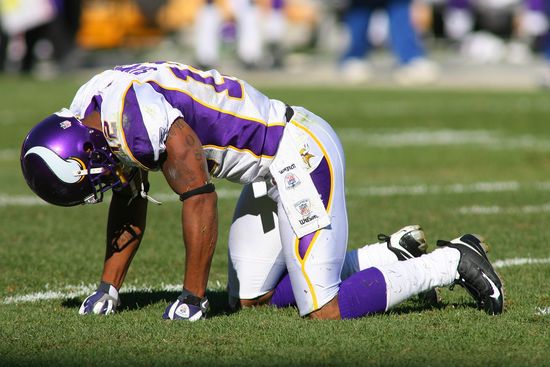
Here's one example of someone who is a lean, muscular, fit apnea patient: Percy Harvin of the Minnesota Vikings.  Mr. Harvin apparently was suffering from severe migraines that affected his ability to perform on the field.  He's listed at 5-11, 184 lbs. and is one of the fastest players in the NFL. I have no doubt that weight can contribute to sleep apnea.  However, as Mr. Harvin's experience demonstrates, there are plenty of other causes.

Another writes:

One reader commented that surely diet and exercise would be the most effective way to treat sleep apnea, since it is so often caused by obesity. Not true on several counts.

A fairly overweight aquaintance of mine was diagnosed with sleep apnea after she put on even more weight. Her lack of sleep caused her not only to gain weight, but her perpetual exhaustion prompted more eating, in the hopes that food would give her more energy to get through the day. Such a recursive loop of exhausting/eating/weight gain/exhaustion would not be effectively treated by "losing weight." And anyway, when has losing weight through diet and exercise ever been easy? I would posit that a CPAP would potentially make it easier.

Another:

A reader asserted: DSC00610

Ok, I'm thinking sleep apnea is another self inflicted wound of fat America. If readers differ, please send pictures of skinny apnea patients wearing masks.

You dissented.

Just to back you up, here I am.  I have a 22.4 BMI, a normal-width neck, large-ish tonsils (not near large enough for it to be the cause), and no diabetes.  Of course those things (and age) are risk factors.  Sometimes it just happens!

Another:

I don't have a photo of myself with the mask on, but I'm 5' 10" and weigh 160 lb. I'm in my late twenties, eat a low-fat diet, and get 40-60 minutes of exercise 5-6 times each week. I also have sleep apnea and a CPAP. The most important benefit of my CPAP is that I have the energy to work out regularly and cook healthy food at home, which creates a virtuous cycle making it easier for me to stay fit and sleep well.

When I send my CPAP through the airport scanner, the TSA usually asks someone in front of me or behind me who is older or heavier if my machine can be swabbed for explosives. And they sometimes look surprised when I tell them it's my device. So not everybody with sleep apnea is fat or old, but enough people are that the TSA engages in a little profiling to speed things along.

I agree with your reader that America is too fat. But if I had not gotten the CPAP at 23, I might have gotten fat in middle age and been diagnosed at 53. It would have been fat caused by the *lack of* treatment, and not treatment necessitated by fat. Data is not the plural of anecdote, but correlation isn't causation, either.

Another:

I'm really finding this thread interesting. Part of the reason it took me so long to get checked out for a CPAP was that I, like your reader, thought apnea was mainly an affliction of the overweight. I'm 5-11, 190 lbs, and although that puts me at sort of a high BMI, I run 40-50 miles a week and just finished my third marathon in about a year. My body fat is somewhere around 15%. So I wouldn't send in a photo of myself as a skinny CPAP user, but I'm not a fat one, either.

(Photo: Percy Harvin #12 of the Minnesota Vikings hangs his head during a break in NFL game action against the Pittsburgh Steelers at Heinz Field on October 25, 2009 in Pittsburgh, Pennsylvania. By Rick Stewart/Getty Images)