Some Police Officers Should Chill

USA Today quotes the head of the Fraternal Order of Police:

The proliferation of cheap video equipment is presenting a whole new dynamic for law enforcement. It has had a chilling effect on some officers who are now afraid to act for fear of retribution by video. This has become a serious safety issue. I’m afraid something terrible will happen.

Balko reacts:

Over the last year I’ve received email and heard from a number of police officers on radio call-in shows who’ve said that citizen-shot video vindicated them in cases where they had been accused of misconduct. If video has been edited or manipulated, that’s pretty easy to discern should it become a key piece of evidence against a police officer.

We want cops second-guessing decisions that are second-guessable. If an abundance of video cameras helps that to happen, all the better.

But there’s no reason citizen video should make a good cop think twice before using appropriate force to apprehend someone who presents a threat to others. As noted above, he should welcome it, in case the suspect later claims the force was unwarranted.

Ideally police would be recorded all the time. And they'd prefer it that way.
“Constitutionalism” As Slogans, Ctd

A reader writes:

It's certainly true that as a senatorial candidate, Christine O'Donnell has often appeared appallingly ignorant of a great many subjects, and I appreciate Larison's criticism of her in this regard.  However, I must take issue with the following statement of his: "The establishment clause has been wildly and mistakenly misinterpreted so that a restriction created solely to prevent the federal government from imposing a religion on the states has been turned into a general imperative for all levels of government."

With all due respect to Larison, the original purpose of the 1st Amendment has been modified by the 14th Amendment, making it applicable to every level of government, all the way down to school boards. 

It is true that the amendments to the US Constitution listed in the Bill of Rights, as they were originally written, were meant to apply to the federal government only.  However, the Constitution has undergone subsequent amendment.  Namely, the 14th Amendment's Due Process Clause is specifically applied to the states themselves.  The long-standing doctrine of Incorporation has applied "fundamental freedoms" found in the Bill of Rights to the states through that clause. 

This legal doctrine has not seen any sort of serious opposition from either political wing in this country in a long time; in fact the right-wing faction of the Supreme Court of the US recently utilized the doctrine of Incorporation to hold that the gun rights enshrined in the 2nd Amendment are a "fundamental freedom" in McDonald v. Chicago, curtailing states' abilities to restrict gun ownership.  Incorporation doctrine has been employed to apply the 1st, 2nd, 4th, 5th, 6th, and 8th Amendments to the states.  It's neither a new nor a controversial legal doctrine, nor does it require new (mis)interpretations of the amendments themselves, merely that they apply to state governments.

A TPM reader delves into a different part of history to highlight Jefferson's understanding of the First Amendment along church-state lines.

“You Don’t Own A City”

Megan just bought a house in a gentrifying neighborhood:

Yesterday, I rode the bus for the first time from the stop near my house, and ended up chatting with a lifelong neighborhood resident who has just moved to Arizona, and was back visiting family.  We talked about the vagaries of the city bus system, and then after a pause, he said, “You know, you may have heard us talking about you people, how we don’t want you here.  A lot of people are saying you all are taking the city from us.  Way I feel is, you don’t own a city.”  He paused and looked around the admittedly somewhat seedy street corner.  “Besides, look what we did with it.  We had it for forty years, and look what we did with it!”

I didn’t know quite what to say.  It’s true that for a variety of historical reasons–most prominently, the 1968 riots that devastated large swathes of historically black DC–our neighborhood has more in the way of abandoned buildings than retail.  And I’m hardly going to endorse the gang violence about which he presently discoursed at length.  But the reason we moved into our neighborhood is that we want to live in a place that’s affordable, and economically and racially mixed.  We don’t want to take the city from them; we just want to live there too.  Perhaps I should have said that.

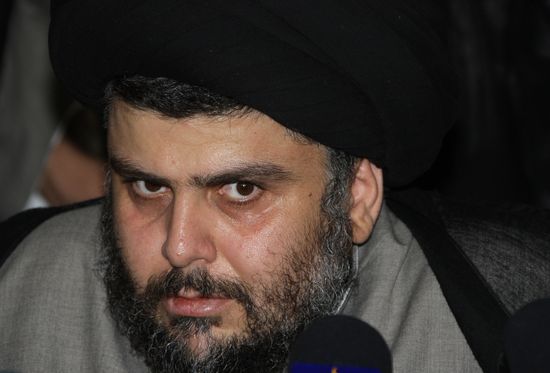
Advantage: Al-Sadr

MOQTADALouaiBeshara:AFP:Getty

Joel Wing studies the game of chess being played in Iraq:

Iraq is still probably weeks and even months away from forming a new government. Sadr’s decision to come out for Maliki was one of the first major changes in the stalemate that has been going on since the March 2010 election. Tehran had a leading role in Sadr’s choice organizing Syria, Hezbollah, and Ayatollah Haeri to all lobby him. That shows Iran’s ability to shape events in the country. This set off a chain reaction both within and … [outside] Iraq. The U.S. is now alarmed that the anti-American Sadr will have a leading role in any new government, while Maliki is on a regional tour to drum up support. That just increases Sadr’s influence, since he can rightly believe that all this activity is due to his actions.

He’s likely to get most of what he wants in a new government, since not only did he drag out talks with other parties to maximize his position, he also has a political movement and a militia that can exert his will after all the talks are over. It’s just the latest example of Sadr being a political survivor after many had discounted him when his movement fractured, Maliki went after his followers in 2008, he disbanded the Mahdi Army, and then his candidates didn’t fare as well as expected in the 2009 provincial vote. At the same time, he was in almost the exact same spot in 2006 when he put Maliki into office the first time. That relationship didn’t last, so it’s wrong to think that Moqtada has suddenly reached a new apex. Iraq’s politics are like a soap opera with drawn out relationships, backstabbing, and plenty of drama, so what’s happening now, can always change dramatically in the future.

(Photo:LouaiBeshara/AFP/Getty)

Refuse To Go Away

That's the advice Yglesias has for politicians embroiled in scandal:

When a reasonably popular public official is hit with a scandal of a personal nature, the natural immediate first reaction of his same-party colleagues is to want to get rid of him. After all, no reason this guy should be a millstone around all of our necks. That leads to an initial torrent of criticism from friendly-ish sources and a wave of pressure to resign. But if you resist that first wave, apologizing for your conduct but refusing to apologize for your years of public service and highlighting the pernicious special interests who’d love to see you brought low, you basically flip the dynamic. Now you’re definitely going to be a millstone around everyone’s necks so the question becomes how heavy a stone?

Suddenly all your same-party colleagues have an incentive to defend you and to attack your enemies.

He uses Bill Clinton as an example of someone who refused to resign and Elliot Spitzer as someone who folded under pressure.

One Way To Recognize Bigotry

Clive Crook says that

Williams was not expressing hatred or intolerance of Muslims. He was confessing to the kind of anxiety that I suspect many and possibly most Americans feel. (Watch the body language in the departure lounge.) He was acknowledging a sad reality.

No he wasn't acknowledging this sadly; he was justifying it.

He was talking in the context of America having a "Muslim dilemma" in the larger context of Bill O'Reilly's statement that "Muslims killed us on 9/11!" No one would argue that saying that Jihadist terrorism is motivated by extreme Islam, rather than Christianity or Buddhism is bigotry, for Pete's sake. But the notion that every Muslim is therefore guilty before being proven innocent, that those building Park51 have to prove they're not al Qaeda or be deemed Jihadists, that Muslims who wear Muslim garb are rightly suspected of being terrorists on airplanes (even when no actual Jihadist on an airplane has worn such garb) is fanning the flames of bigotry.

Yes, Islamism is related to Islam. But the distinction is critical to winning the war. And tarring all people in Muslim garb as somehow legitimately related to terrorism is, yes, bigotry. And, in general, it's a rule of thumb that anyone who constructs a sentence "I'm not a bigot, but …" is almost always a bigot.