The GOP’s Fiscal Fraudulence, Ctd

2009budget

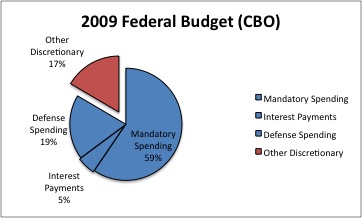
Courtesy of Phil Klein and Tim Carney:
The blue parts of that chart are the parts Republicans have said they won't cut. The red slice, well that's fair game.
Says Klein:

Even if you were to eliminate this entire slice of the budget (meaning you're willing to gut the Department of Homeland Security and defund all other federal agencies and departments) it wouldn't even eliminate half of last year's deficit.

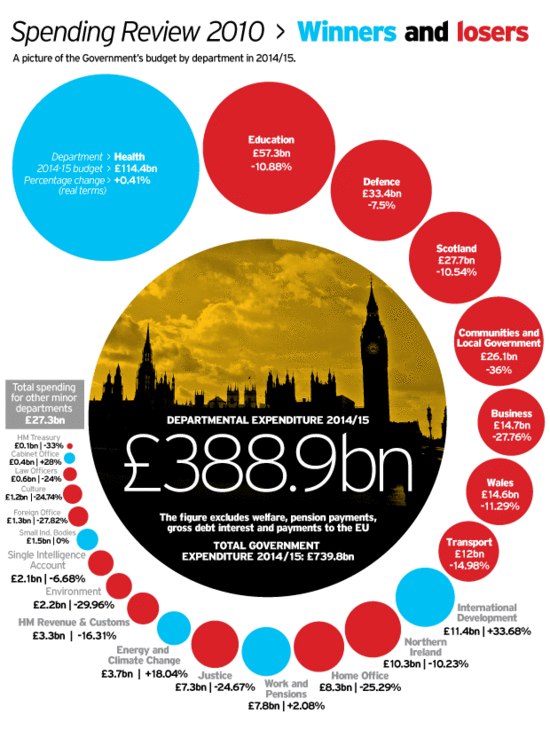
And now, courtesy of Britain's Tories, we have a real example of actual fiscal conservatives. Leave aside the legitimate debate about whether it's the right thing to do right now, the Tories bravely campaigned on major cuts – even in welfare which is beloved by their own core constituency, like child benefit – and delivered, risking their entire future on what they believe is the responsible thing to do. Here's the Telegraph's graphic of what they've cut:

Spending-review-20_1743728a

They've raised the retirement age to 66; they plan to reduce the numbers of criminals in prison; they've cut police funding; they've cut defense by 8 percent; they've slashed subsidies to the regions. And remember the British debt is not that much higher than the US debt: Yes, the welfare cuts will hurt the poor, but the biggest hit will come from middle class entitlements. The wealthy, including the Queen, are reeling:

Taxpayers on the higher rate will lose more than £2.5?billion annually from the removal of child benefit — far more than the £1billion predicted by the Chancellor earlier this month. More than one million better-off families also face losing incapacity benefit, which will be means-tested. Those deemed capable of working will be able to claim the benefit for only a year before family income and savings are assessed. It will cut £2billion from the welfare budget. Households with an income of more than $75,000 will each lose about five per cent of their annual earnings by paying thousands of pounds extra in tax while losing benefits and access to public services, Treasury figures indicate.

So Obama is far to the "right" of the British Tories on his plans for tax increases (he will raise them on those earning over $250,000, rather than $75,000); he is also to the right of the Tories by cutting Medicare spending, while they have retained spending for the NHS (government health spending, of course, is a far bigger slice of the American economy than the British one); in contrast, the current GOP is simply off the cliff of fiscal reality.

The Republicans are not conservatives; they are populists in total denial of what simply has to be done. It seems to me reporters should be demanding of the GOP why they cannot bite the bullet the way their counterparts in Britain have.
Palin’s Nixon Strategy, Ctd

A reader writes:

Comparing Palin’s “seething resentment of elites” to that of Mr Nixon is rather superficial, and frankly not fair to Tricky Dick. 

It always seemed to me that Nixon believed the elites of America wouldn’t let him into the club, try as he might to join it, whereas Palin’s tack is one of rejection of the elite precisely because she lacks either the intelligence or drive to distinguish herself in an “elite” way.  Consider that by 1966, when Nixon was making the endorsements in question, he had earned a BA from Whittier College (after having been offered a scholarship to Harvard) and went on to receive a JD from Duke.  Further, he had served in the House, then the Senate, and then successfully run for VP, where he served for 8 years.

Regardless of Nixon’s probable psychoses, a man possessing his credentials would seem the sort whose endorsements one should take seriously. Palin, on the other hand, is no Nixon.  She has paper-thin credentials, if really any at all, and I haven’t the foggiest notion as to why anyone would consider her opinion relevent on any political matter. The comparison between the two really does not strike me as very apt.

This email has persuaded me entirely that my original point was too crude. Their resentments were of very different kinds.

Bigotry On Air, Ctd

A reader writes:

As an Arab (Canadian), I completely disagree with this nomination.  Even I get nervous when I see someone on a plane decked out in full Islamic garb. Getting “nervous” is not bigotry. It’s a reaction that’s not really within our power to control. Being able to understand the reasons for one’s nervousness and to work past them, rather than indulge in them is what determines if one is a bigot. It might not be PC, but I think a lot of people would feel the same way.

But Juan could control what he said on national television. And he said he was nervous about people who "are identifying themselves first and foremost as Muslims" because they wear traditional garb. To deem someone displaying their religious faith a potential terrorist is a generalization about a religious faith with no factual basis. No Jihadist terrorist who has attacked us has worn such garb (one was actually in US military uniform), so it's simply an irrational association of the more devout of an entire religion with mass murder. That's why he was fired. Another writes:

I agree that Juan Williams is off base, but I'm not sure how I feel about your thug analogy.

There is a difference between being nervous around someone dressed as a thug, versus a person dressed as a Muslim. Muslims are not inherently bad. But isn't a "thug", by definition, someone who is going to hurt another person? I don't feel like it's bigotry to be afraid of someone who is dressed to resemble a violent enforcer for the criminal element, even if they do happen to be of a different race. This, of course, assumes you can precisely and universally define a "thug" getup, and that it differs from the normal dress of a plurality of non-criminals.

I'm thinking of "thug" as a fashion statement, that extends way into the middle class and non-violent under-class. But it wasn't the clearest analogy, I concede. Another:

"Bill, I'm not an anti-semite. You know how much I enjoy bagels and Seinfeld. But when I walk onto a plane and see a guy wearing a yarmulke, they are identifying themselves first and foremost as Jews, I get worried.  I get nervous.  I mean, these guys run the media – even NPR. They're very powerful."

Rick’s Left; My Right, Ctd

Rick replies at length and finds much to agree and disagree with in my post. A core point:

Andrew says it’s O.K. for government to take care of the basic needs of the “unlucky,” which leaves a lot of wiggle room for a welfare state. On yet another hand, he seems to think it wise to wait until the social order is visibly unravelling before trying to do something about gross and growing inequality. But my reading of The Dish tells me that he thinks we may be reaching that point already, so in practical terms we’re probably broadly in sync.

Yes, I do, alas. I think the startling rise in social and economic inequality and the erosion of the middle class are things conservatives should worry about. Unsustainable debt, however, is a dagger at the middle class too. So aiming tax hikes at the successful and even middle classes in those situations is unpleasant but sometimes necessary.

One of Aristotle's keen observations was the critical importance of the "middle" in a polity in maintaining a defense against either mob rule or oligarchy or tyranny. My conservatism is of a modern kind, rooted in bourgeois values, not aristocratic ones – but it was influenced by reading Aristotle's Politics very closely as well. Now it may be that global economic forces accelerating this are beyond our control but it should not be un-conservative to defend the middle class if we can – by taxing the successful to investing in publicly-funded education, for example (one area where the British Tories are not cutting spending, I might add). Of course, if that doesn't raise enough revenue, you're stuck. But cutting middle class entitlements is not incompatible with defending the middle class; it can be seen as restoring the middle class's self-reliance and bourgeois values.

Times change. Conservatism is defined by an ability to change prudently with them, and respond to emergent social problems with pragmatic, if cautious, reform. It is not defined by rigid ideology (no tax hikes ever) or denial of reality (climate change is a hoax; freedom is on the march in Iraq; deficits don't matter).

First Cameron, Then Obama?

Gordon Adams sees the defense cuts in Europe as a precursor to our own. Here's hoping:

 US defense spending will be hit by a double tsunami in the next two years.  One wave will be rising demand for the same kind of fiscal austerity the Europeans are facing.  It will receive new impetus from a likely Republican victory in the November elections, bringing a new wave of small government conservatives into the Congress.  Additional fuel will be poured on by post-election reports from the Bipartisan Policy Center's Debt Reduction Task Force (co-chaired by Dr. Alice Rivlin and Sen. Pete Domenici), due in mid-November, and the President's National Commission on Fiscal Responsibility and Reform (co-chaired by Sen. Alan Simpson and former White House Chief of Staff Erskine Bowles), due in early December.  All of these participants in the debate agree that deficit and debt control depend, both economically and politically, on putting all federal spending and revenues on the table.

The other tidal wave will be the end of the US deployment to Iraq, due next year, and the more-rapid-than-forecast US withdrawal from Afghanistan.

Bigotry On Air

So Helen Thomas (morally abhorrent but not deserving of the forced exit) and Rick Sanchez (rightly in my view) got fired for anti-Semitism, Octavia Nasr got fired for a complex view of a Hezbollah leader (unfairly in my view), and Juan Williams gets fired from NPR for his baldly bigoted statement about being afraid of all people in traditional Muslim garb on airplanes.

But Fox News hasn’t fired Williams and hasn’t fired the most egregiously bigoted and untrue statement of all of the above:

“All terrorists are Muslims.”

Question: would Fox have fired Brian Kilmeade if he had said “all media is run by Jews” – an equally untrue and equally bigoted statement?

By the way, on the Rick Sanchez question, I appear to be more hardline on anti-Semitism than Jeffrey Goldberg. Jeffrey thinks the only person of all these who deserved to get fired was Helen Thomas. See her on-video offense here. She didn’t say anything anti-Semitic. She said something anti-Zionist.

In Defense Of Buck-Raking

Back in the day when Jake Weisberg and I were fellows in the intern pit at Mike Kinsley's TNR, Jake set up a little bell on the edge of a cubicle with a newspaper photo of Bob Novak taped on it. Every time we saw Fred Barnes or Mort Kondracke head out in a rush for a big-bucks speech, we'd get up and ring it. Yep, my authoritah issues go back a way. But Jake, now the esteemed editor of a zillion things at once, was actually more subversive than me.

Mike Kinsley, having loved this practice at the time, subsequently wrote a classic counter-intuitive defense of the shenanigans, with one of the most persuasive two sentences I have ever read:

Let's face it–the demand for disclosure derives in large part from a prurient interest in other people's income that is actually quite similar to the prurient interest in other people's private parts. I, for one, would far rather see George Will's income tax returns than his naked body.

What really bothers some Puritans is the very idea of journalists making a lot of money, however they manage to do it.

It seems like an inversion of the natural order, and perhaps it is. No one sensible goes into journalism for the money, and no sensible journalist believes he or she is "worth" a fat lecture fee. It's important not to get complacent, and to remember to credit serendipity. But our economy pays many folks–ball-players, business executives, symphony conductors–more than they're worth. Being paid more than you're worth is the American dream. I see a day when we'll all be paid more than we're worth. Meanwhile, though, there's no requirement for journalists, alone among humanity, to deny themselves the occasional fortuitous tastes of this bliss.

Faces Of The Day

LoveMyBooTrust

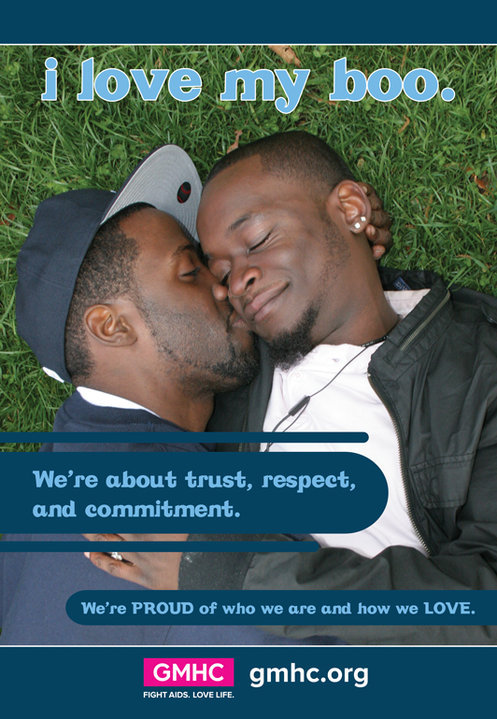
Kai Wright praises the "I Love My Boo" project:

One of the smartest, most compelling public health campaigns around took off in a big way this month: The “I Love My Boo” series by Gay Men’s Health Crisis, which originally took on sexual health among black and Latino men but has been broadened into an anti-homophobia campaign, too. The idea is as simple as it is revolutionary: Promote loving, healthy relationships rather than preach about disease, and the rest will follow. The campaign’s been around in New York City for a couple of years, but this month it expanded, with posters running on 1,000 subway cars over the month. The visuals are unprecedented: black and Latino men in tender, loving and unapologetically physical embrace of one another.