“Do Something” Money

David Zetland ponders the core argument of The Crisis Caravan: What’s Wrong with Humanitarian Aid?:

The central thesis of this book … is that the people who deliver aid are addicted to horror stories and starving kids, and this addiction is fed by those who benefit from aid, whether they be local leaders, militias committing atrocities or even victims who don’t wear their prosthetic legs because they can get more attention with their stumps.

… Here’s the simple version: If people give you money because of A, then you don’t do anything to stop A. Even better, make A bigger so you get more money.

… What’s interesting in Polman’s book is the way that … warlords and crooked politicians are actively making poor people worse off, to raise their profile and increase the flow of “do something!” money funneled through the Angelina-Bono-Geldof-Sachs pipeline.

Sounds like civil rights groups in Washington as well. Give us equality – but keep giving us money to fight for equality as well. Funny how equality never quite happens, innit? And the groups keep going and going and going …

Obama’s Stealth Tax Cut

Michael Cooper revisited it yesterday in the NYT. Jonathan Bernstein assumes the thinking man position: 

[T]his story is a good example of why media bias is so difficult to measure. On the one hand, here’s the (liberal?) New York Times running a story unprompted by events, and just two weeks before Election Day, highlighting a policy which presumably would help Democrats if people knew about it. On the other hand, the fact that such a story could be written — the fact that most people think Obama has raised taxes when in fact the opposite is true — is strong evidence against the idea that Americans are influenced by a liberal media.

I think of this as a perfect example of how Obama put good policy before good politics. I notice, however, that he is not going to fall for that again on the debt. Here he is on serious entitlement cuts in the future:

[The debt is] going to require us making tough decisions about things that are important to us. 

And the big debate that we’re going to have to have as a country is what is important enough to us that we’re willing to pay for it — and then who pays for it? I think Social Security is important and we have to pay for it. I think Medicare is important and we have to pay for it. 

I think both programs can be more efficient, but I think those provide a core safety net to the American people. I think that our investments in education are absolutely critical to our long-term economic health. 

I think we have to have infrastructure that keeps up with the demands of the 21st century. We can’t have a China that has the best airports, the best railways, the best roads, and we are still relying on infrastructure that was built 200 years ago or 100 years ago or even 50 years ago when it comes to things like broadband lines.

 I’m going to have to make an argument that if we say we revere our veterans, then when our veterans come home, we’ve got to pay for treatment for post-traumatic stress disorder. We’ve got to pay for traumatic brain injury. And we’ve got to care for families who have lost a loved one. And all that stuff costs money.

And when you tally it all up, then it turns out that there’s no such thing as a free lunch.

Notice that this math means huge tax increases to keep Medicare and social security intact. I don't actually believe that's his agenda (or the Debt Commission's likely recommendation), but he's not going to concede spending cuts up front, because of the stimulus lesson. Back then, he conceded the tax cuts and no one noticed them, the GOP pocketed them and then described the stimulus as liberal waste. The GOP will have to fight for entitlement cuts next year – and own them – in a way they did not have to fight for tax cuts in the stimulus. Obama's positioning himself for 2011 already. And in a contest as to who comes off the most reasonable, I don't think the current GOP stands a chance.

Propaganda In Painting

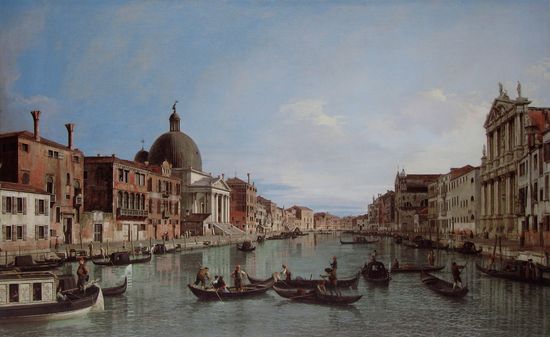
CanalettoVeniceUpperReaches

The perpetrator is Canaletto, who died in 1768:

The sun always shines in Venice; the sky is always blue. This is how visitors like to remember that most beautiful island city. Not coincidentally, that is how Canaletto most often painted the place. His clients, after all, were Grand Tourists, many of them back home in dark English country houses, worrying about farm rents. They longed for the gorgeous, licentious place their memories turned into paradise.

The fact is that in the 18th century and today, Venice would win the title of bronchitis capital of the world if such a contest existed.

One December when I lived there (I know, lucky me—and I felt that way too, when I wasn’t shivering and coughing), the sun came out exactly once. It was a feeble appearance, too, as if Sol exhausted himself in the struggle to get through the fog. In Canaletto’s time, of course, there were more worrying illnesses to worry about, such as syphilis, to name one. But never mind, as the English are inclined to say. Never mind the smell of drains and wilting heat in summer, the pickpockets and the cheating restaurateurs. Venice is heaven, or as close to it as urban life can get. That is the important thing. Some 60 examples of painted propaganda in support of this make up “Venice: Canaletto and his Rivals”, which just opened at London’s National Gallery. The works of Giovanni Antonio Canal (1697—1768), otherwise known as Canaletto, are rightfully the heart of the show.

(Image: Wikipedia Commons)

Dan Choi’s Vindication

He re-enlists while the ban remains unenforced during the injunction imposed by Judge Virginia Phillips:

(Hat tip: Joe.My.God.) More details on new gay enlistments in this window here. I remain very proud of my friend. And of his tenacity and clarity. Money quote from the NYT:

R. Clarke Cooper, the executive director of the Log Cabin Republicans, applauded the Pentagon decision as “a huge deal.” … Mr. Cooper, a member of the Army Reserve, said that he was taking part in training last week at Fort Huachuca in Arizona when the injunction was issued, and that he was surprised by the lack of visible opposition or outcry. He likened it to a “giant shoulder shrug of ‘so what?’ ” Most of the people he was with, he added, were younger members of the service, and “a few people actually thought repeal had already occurred.”

The Road Not Taken

Two honest right-leaning writers, libertarian Matt Welch and conservative Tim Carney, agree that had John McCain been elected in 2008, domestic policy largely look the way it does now, healthcare excepted, and that our foreign policy would likely be far worse. They're also concerned, as the Dish is,  that if Republicans retake the House, especially under current leadership, the K Street faction will coopt them, or else they'll take up social issues because the real fiscal choices are way too hard for them to win re-election on.

If more voices on the right were similarly skeptical of folks on their own side, there might be enough accountability to advance small government ends through a GOP controlled Congress. More power to them. Unfortunately, the most trusted voices on the right — people like Limbaugh, Hannity, Palin, Levin, and Beck — are either partisan hacks, ideologues who abandon small government principles whenever the word terrorism is uttered, or… well, who can say what Glenn Beck is?

Reality-Based Conservatism

David Frum preaches compromise:

Much of government is an exercise in choosing the least bad option. A movement that demands everything and punishes any politician who strikes a bargain that is better than the status quo but less than libertarian perfection – well, we’ll have our chance to see how much that movement achieves.

The Wyden-Bennett health plan that wrecked the career of Senator Bob Bennett would have been better from a conservative point of view than Obamacare.

TARP and the rescue of the banking system are better from a conservative point of view than a new Great Depression that would have involved a decade of massive government support of the private economy.

Some form of consumption or energy tax will be better from a conservative point of view than what we are on our way to getting instead: the lapse of the Bush tax cuts on saving, work and investment – and new payroll taxes to fund Social Security and Medicare.

People are responsible not only for their actions, but for the reasonably foreseeable consequences of their actions.

And this engagement with the real world, with people who disagree with you, with reality, and not ideology, is temperamentally and dispositionally conservative as well. I think some of us were blinded by the radicalism of Reagan and Thatcher. But both inherited economies far more regulated than ours, far more highly taxed than anything Obama is suggesting, and in Thatcher's case, a country where the state owned vast amounts of industry. They were responding to the conditions of their time. Thatcher didn't need to compromise much because of a divided opposition; but Reagan dealt with the Democrats and would today, by raising taxes be seen as outside "acceptable bounds of Republican thought."

Conservatism if it becomes an ideology will suffer the fate of all ideologies. But if it becomes a fixed ideology – or, even worse, an unchangeable theology (as it has in America) – it has already abolished itself.

The View From Your CPAP, Ctd

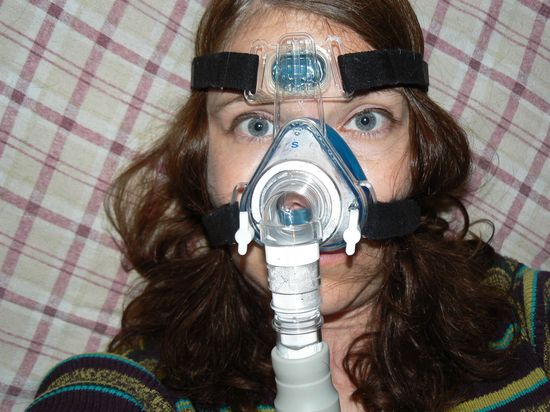
3593566517_b019698fed_b

A reader writes:

Being a single twentysomething woman with sleep apnea sucks.

I'm overweight, so there's that, but then when I'm wearing my mask, I feel unladylike and mechanical. Not that I've ever been dainty and sweet and serene while sleeping, but that machine makes it look much worse. I tell myself that snoring isn't exactly attractive, but I'm nervous to even meet somebody. I wonder if anybody will wake me up with a smile and a kiss ever again.

It took me two years after diagnosis to scrape up the cash and the willingness to try a CPAP. When I was diagnosed, an old boyfriend – he of the morning kisses and smiles – and I were talking about getting back together. He warned me that he thought the CPAP wasn't "sexy." He was confused as to why I needed it because he had never noticed me snoring. I was too embarrassed to tell him that I never slept at all when I "slept" over. I was afraid I would bother him while snoring or that my difficulty waking up in the morning would annoy him. Mostly I would lie very still and let myself doze a little but never sleep.

That was college. I wouldn't do that now, but I'm still sensitive to the un-sexiness of the CPAP. A few weeks ago, I told a possible romantic partner about the machine and he said, "You don't wear it during sex, right? If you don't, I guess it will be alright."

Another writes:

Like you, my partner was clueless that he would cease breathing while asleep and couldn't figure out why he was perpetually tired. I had noticed that he would stop breathing during the night, although I didn't think it was complete cessation. I also didn't say anything to him about it for some time, because all it took was a gentle nudge and he would resume breathing. After a few years, it became more difficult to rouse him from apneic cessation and we both began to suffer from sleep deprivation. He from the apnea, and I from conditioning. His long periods without breathing trained me to sleep so lightly that I would jolt fully awake within seconds of an apneic cessation. At this point a gentle nudge, nay, even a violent nudge had no effect. Many nights it would take me straddling him, shaking him by the shoulders and shouting his name to get him to resume breathing.

After months of this, I did some research, told him I thought he was suffering from sleep apnea and begged him to see his doctor. Fortunately, he listened. The doctor prescribed a CPAP machine, which he wore for several months. To our dismay, the apnea continued even with the machine. I can't even begin to describe the sheer panic of thinking he had died when he would stop breathing while wearing the mask.

After several episodes of his awakening to the bedroom lights on, and me yanking the mask off of his face while desperately shouting his name, he saw his doctor once again. This time the doctor scheduled him for a sleep study – the results of which were not good. He stopped breathing 24 times in a period of only two hours.

Considering the results, the doctor recommended surgery, which my partner agreed to. It was rather invasive; they removed his tonsils, his uvula, some of the soft palate at the back of his throat, and much of his adenoid sinus tissue. The recovery was painful and lengthy, but to this day he neither snores nor ceases breathing. The surgery was a last-resort measure – a decision neither of us took lightly. However, the alternative was was not something either of us wanted to take a chance on.

If the machine works for you, keep using it. If it stops being effective, please talk to your doctor.

(Photo by Flickrite Vicky TGAW)