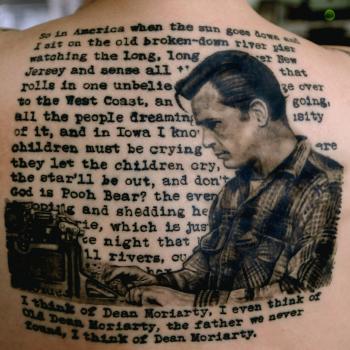
“Body Of Work”

Tattoo

Jenny Hendrix reviews The Word Made Flesh: Literary Tattoos from Bookworms Worldwide, edited by Justin Taylor and Eva Talmadge:

The literary tattoo is at least as old as Hester Prynne’s scarlet “A,” and like any tattoo still bears some connotation of punishment. But as with Hester's, it is also a way of using literature as a public symbol of character. It also invites serious considerations of font and typesetting, even to the point of recreating a specific edition of a book. …

As with any form of self-publishing, the literary tattoo takes pluck. Montaigne wrote, in a phrase I imagine no one has tattooed themselves with, “Only fools have made up their minds and are certain.” But it seems to me to be a wonderful group of fools that, like the memorizers in "Fahrenheit 451," carry the written word with them everywhere.
Marketing In Miniature

Harry West notes recent improvements in design and branding:

In the battle between global corporations, design attention is being paid to aspects of products and services that used to be considered too mundane to bother. This is the counterpart to Adam Smith's division of labor story: it turns out that attention to detail also depends on the extent of the market. Today, companies are examining the most trivial aspects of our lives, trying to find an edge.

Screw Darfur?

Robert Farley reviews David Axe's War is Boring, a graphic novel depicting his experience as a war correspondent from 2006 -2008. Here Farley recounts Axe's appearance at a conference on Africa:

David gave a very grim appraisal of the state of conflict in Chad and Darfur, suggesting that it was very hard to know who the good guys and bad guys were, and that Western intervention efforts may have helped extend the life of the conflict. A student asked him "What would you do to save Darfur?" David seemed a bit surprised with the question, then finally responded "Don't save Darfur. Screw Darfur."

It's fair to say that the audience was surprised by this. Indeed, at least one member of the audience was quite irritated; the "screw Darfur" idea seemed oblivious to the suffering of refugees, and could be understood to imply a certain racist indifference to the fate of non-Europeans. This isn't how I read the comment, however; I understood it to be an argument along the lines of Edward Luttwak's "Give War a Chance," which argued that Western intervention tends to prolong wars by preventing victory. In the case of Chad and Darfur, I thought that Axe had an entirely reasonable point.

Chart Of The Day

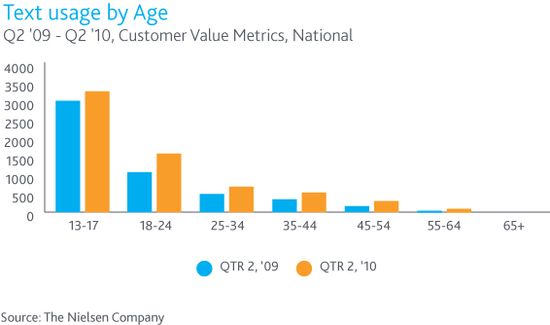
Texting_By_Age

Teens love to text:

If it seems like American teens are texting all the time, it’s probably because on average they’re sending or receiving 3,339 texts a month. That’s more than six per every hour they’re awake – an 8 percent jump from last year.

Drum wants details:

I wonder how this really breaks down? The obvious headline result is that teen girls send a text every 6 minutes of every waking hour. But they probably don't. More likely, it comes in bursts: a couple of texts an hour most of the time, but 40 or 50 an hour during serious texting times.

Killing Two Turds With One Stone

Alex Goldmark reports on Micromidas, a company that has a variety of bacteria that eat poop and poop plastic. The technology may help with sanitation and reduce the amount of plastic in our landfills:

[The people at Micromidas] take sewage and feed it to bacteria. “The bacteria store the organics as a bio-polymer … ” Just like when we eat sugar and, through a series of metabolic processes, turn that into a fat, those little micro-buggers turn sewage into plastic in their bodies. …[T]he end product is a high-value, low­-cost plastic resin ready to be sold off, and it biodegrades in under 18 months once disposed of.

On Gay Stuff And Honesty, Ctd

A reader writes:

Your response would have been more powerful if you had added what has become part of the gay lexicon: "When did you choose to be straight?" It is subtly subversive because it leads to the point your reader made, i.e. it is easy to get caught up in the hetero tide and never take the time to understand yourself better.  Does this lack of introspection go some way to explaining the 50% divorce rate, not necessarily on gay/straight issues but incompatible personalities, likes/dislikes, etc?

A reader last week sent the above video in response to Obama's "It Gets Better" message. Another writes:

I went to a mostly Republican, all-boys, jock-oriented prep school in the 1980s and had a head full of elite, white male entitlement.  I'd like to think that good teachers and a fair mind toward racial civil rights would have busted me out of that mindset had I been straight, but I'm empathy-challenged and have to admit that a great amount of my sympathy and respect for unfamiliar people came from the dawning realization that I was part of a minority group more despised than all the others. Putting down other people was just a defense mechanism that gave me an artificially higher spot on the social hierarchy.

If you had given a younger me the option to become straight, I would have jumped at it in a heartbeat.  A nuclear family with biological children had great appeal (still does), as did not suffering the indignity of homophobic nonsense my whole life.  But now, safely enclosed in a bubble of tolerance, I wonder if I wouldn't have otherwise gotten sucked into corporate law and become a permanent asshole.

“Peeing Is Political”

In an interview earlier this month, Harvey Molotch discussed his new collection of essays, Toilet: Public Restrooms and the Politics of Sharing. Why we have trouble broaching the subject:

Talking toilet requires recognition of oneself as a potential source of pollution, as inescapable as living within one’s own body. Being “civilized” means distancing ourselves from the animal nature of what we are. 

(Hat tip: Shahar Ozeri)

Hip-Hop’s Bards

Kerri Shadid reviews In The Heart of the Beat: The Poetry of Rap by Alexs Pate and takes issue with Pate’s assertion that rap is “the most vibrant element in the landscape of African American literature.”

[T]hese lines of the “poem” “For Women” by Talib Kweli do have a lyrical, and stirring, quality: “She swears the next baby she’ll have will breathe a free breath/and get milk from a free breast,/And love being alive,/otherwise they’ll have to give up being themselves to survive.”

But most of Pate’s best examples come from a bygone era of 1990s rap, which was more socially conscious than the Top 40 hip hop of today. It seems to me hard to deny the artistry and creativity present in an early innovator of hip hop such as Kweli, but where is the poetry in lines such as “Watch me Crank Dat Soulja Boy/Then Super Man Dat Hoe?” To me, the failure to address the vapidness of modern hip hop/rap is a scholarly oversight, and the fact that it is impossible to analyze modern mainstream “artists” seems a failure of the hip hop genre.

(Hat tip: Harriet)