Two Brothers, Two States

From Amos Oz's acceptance speech for half of the Siegfried Unseld Prize in Berlin on September 28, 2010. He shared it with the Palestinian scholar Sari Nusseibeh:

The Israeli-Palestinian conflict is a tragic struggle between two victims of Europe—the Arabs were the victims of imperialism, colonialism, repression, and humiliation. The Jews were the victims of discrimination, persecution, and finally of a genocide without parallel in history. On the face of it, two victims, especially two victims of the same oppressor, should become brothers. But the truth, both when it comes to individuals and when it comes to countries, is that some of the worst fights break out between two victims of the same oppressor. The two sons of an abusive father will each see in his brother the face of his cruel father. And this is the case with the Jews and the Arabs—each of us sees the other in the image of the former oppressor. …

The disputed land is, altogether, smaller than Holland—yet there is no choice but to divide it into two countries, Israel and Palestine. The Israelis and Palestinians can’t turn into a single people living in a single country, and there is no point in trying to shove them into a double bed after a century of violence and hatred. No one would have dreamed, immediately after World War II, of trying to make Germany and Poland into a single country. The Israeli Jews and the Palestinians Arabs cannot, at this stage, turn into one happy family because they are not one, they are not happy, and they are not a family. They are two unhappy families, which is why it is vital to split the house into to smaller apartments—just as the Czechs and the Slovaks did without shedding a drop of blood.

Video from here. I'm more than happy to air dissents to its core narrative or facts. At first, I bridled at the word "colonies"; but if settling your own population on occupied land you conquered in war is not colonization, I'm not sure what is. As for the strategy of Judaizing Jerusalem, it also smacks of a kind of ethnic-religious colonization. I can certainly understand why the Palestinians and the Obama administration would regard freezing this process as a precondition for talks – because it is a change of the facts on the ground during an attempt to negotiate boundaries. You need a time out for genuine negotiation on settled terms. And yet the illegal construction of settlements for Israeli Jews in East Jerusalem continues. And the American Jewish establishment seems content to let the Israeli far right dictate the terms of negotiation.

Which guarantees failure.
The Right And Islam

Goldblog is on a roll:

It is obviously difficult for many people to differentiate between Islam and political Islamism, the ideological strand within Islam that breeds terrorism and extremism. But it is exceedingly important to understand that difference; if we don't, we will give al Qaeda what it wants — a civilizational struggle between the West and all of Islam.

Good to see Gerecht and Wehner taking a stand. If you are serious about winning the war on Jihadism, you need to.

The Palin Model, Ctd

Her anointed candidate for the Senate from Alaska, Joe Miller, had his security goons grab an Alaska Dispatch blogger, Tony Hopfinger, and handcuffed him as he tried to get Miller to answer a question as he left an open forum. Ben Smith notes:

This isn't exactly the first time a reporter has ever chased a politician out of an event, shouting questions. Indeed, that's how almost every political event ends. And while I get the partisan impulse to defend Miller, imagine if [Martha] Coakley's staff had not just shoved, but handcuffed and detained, that Standard reporter.

Here's the context:

Hopfinger was reportedly pressing Miller on whether the candidate had ever been reprimanded for politicking while working at the Fairbanks North Star Borough in 2008. Alaska Dispatch and other media have sued for the release of records related Miller's time at the borough. Various accounts of what happened next generally agree on this course of events:

  • Two or three bodyguards told Hopfinger to stop asking questions and to leave the building.
  • Hopfinger continued to ask questions while apparently videotaping the candidate.
  • Bodyguards told him that if he persisted they would arrest him for trespassing, but refused to identify themselves to Hopfinger.
  • Hopfinger asked why he was trespassing, as the event was at a public school. Seconds later, he was then put in arm-bar and later handcuffed and sequestered at one end of a hallway for at least 30 minutes. He was told, "You're under arrest."
  • Anchorage Police arrived on the scene shortly after.

The cops let Hopfinger go with no charges. The ADN story here; Miller campaign's version here ("the blogger appeared irrational, angry and potentially violent"):

William Fulton from Dropzone Security Services said Hopfinger should have known from the "Joe Miller for Senate" signs outside Central Junior High School that the town hall meeting — to which Miller invited citizens on the internet sites Facebook and Twitter — was a private event. "They leased it for a private event," said Fulton. "It wasn't a public place."

This would be a relatively small kerfuffle in my view if it didn't reflect the core of the Palin model of politics: bypass the non-Republican media entirely, refuse to answer questions or be accountable for factual errors, always sequester candidates in docile, friendly crowds, and, if necessary, restrain, hold back or even physically assault journalists doing their job. It scares me.

Iraq Surge Fail Update

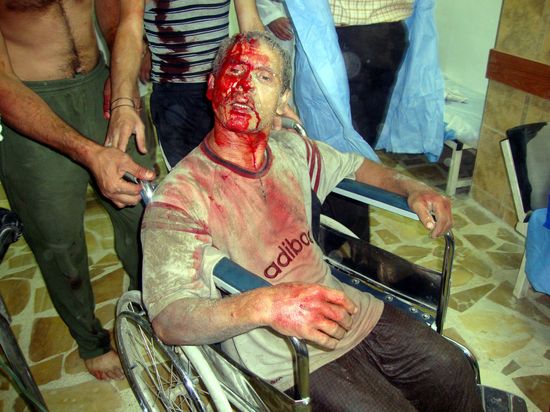
  AWAKENINGATTACKKhalilAlMurshidi:AFP:Getty

Surprise!

Although there are no firm figures, security and political officials say hundreds of the well-disciplined [Awakening] fighters — many of whom have gained extensive knowledge about the American military — appear to have rejoined Al Qaeda in Mesopotamia. Beyond that, officials say that even many of the fighters still on the Iraqi government payroll, possibly thousands of them, covertly aid the insurgency. The defections have been driven in part by frustration with the Shiite-led government, which Awakening members say is intent on destroying them, as well as by pressure from Al Qaeda….

During the past four months, the atmosphere has become particularly charged as the Awakening members find themselves squeezed between Iraqi security forces, who have arrested hundreds of current and former members accused of acts of recent terrorism, and Al Qaeda’s brutal recruitment techniques.

From my Sunday Times column two weeks ago (now paywalled):

If I were a Sunni who had risked his life to fight al Qaeda in Anbar at the behest of the Americans, I would be asking myself at this point: for what? For the triumphant victory of one of the more virulently anti-Sunni forces around – the Sadrites? …

There is still a chance that Maliki will try to coax some Sunnis into government. But to form an easy majority, all he needs now are the Kurdish parties to form a government with no effective Sunni representation at all. If that were to happen, the chances of Sunni alienation – with the revival of al Qaeda in Anbar – are very high.

Which means that a resumption of the civil war is a perfectly plausible outcome, even though Iraq remains exhausted with sectarian warfare. The Shia could use oil revenues to finance an army to crush their ancient enemies for good. With Sunni-Shia tensions rising throughout the region over the prospect of Iran's nuclear capacity, the temptation for neighboring powers to intervene may also become overwhelming. Saudi Arabia and Jordan and not likely to be happy to see a nuclear Iran essentially coopt a pliant Shiite Iraq and become by far the largest influence in the Middle East. This war, in others words, may not be over. In fact, one may wonder if what we have seen so far is but an overture for the main – and much wider – event.

(Photo: An Injured Iraqi man is wheeled into a local hospital in the capital Baghdad on July 18, 2010, following a suicide bomber who targeted anti-Qaeda militiamen known as the Sahwa (Awakening) militia as they collected their wages in the predominantly Sunni Arab district of Radwaniyah, a former insurgent hotspot 25 kilometres (16 miles) from the Iraqi capital, defence and interior ministry officials said. By Khalil Al Murshidi/AFP/Getty.)

What Small Government Republicans?

In a column complaining about Carl Paladino and Christine O'Donnell, Tunku Varadarajan comments on the midterm elections generally:

My first instinct as a libertarian is, of course, for Republican victories everywhere, particularly for candidates running specifically on a small-government platform. The big-government Bush Republicans have already been punished; now it's time to get rid of the big-government Democrats—i.e., all of them.

All Democrats are "big government"? Please. And funny, but I don't remember Tunku alongside some of us arguing against Rove's big government agenda in 2001 onwards. I also don't recall him backing the Dems in 2006.

And he backed McCain in 2008, so one wonders where he gets the gall to posture in this way without some personal accounting. (Oh, I forgot, he's a conservative pundit.) He's also in total denial, as Radley Balko points out:

The label “big-government Bush Republicans” implies that there’s an alternative sort of Republican. Time and again, they’ve proven there isn’t.

The Republican Party was and is filled with big-government Republicans, before, during, and after the eight years that Bush was president. There are some genuinely limited government Republicans, just as there are some Democrats who give a damn and are willing to fight for civil liberties. But they aren’t in the leadership, and they won’t be calling the shots in a new GOP-led Congress. Even now, in the minority, with public sentiment pretty solidly against Obama, all but assured of big gains this November, the GOP figureheads still don’t have the guts to name specific federal programs they’d target for spending cuts.

Demolishing D’Souza

Andrew Ferguson writes, "On the evidence of his new book, we can’t be sure if Dinesh D’Souza is a hysteric or a cynic." That's just one line from a satisfyingly brutal review in, yes, The Weekly Standard. The piece works best when it situates D'Souza's hallucinogenic hate-fest in the larger pathologies of current American politics:

How did the left-wing, coke-snorting Manchurian candidate become the fondly remembered Democrat-you-could-do-business-with—“good old Bill,” in Sean Hannity’s phrase? 

Barack Obama is what happened. The partisan mind—left-wing or right-wing, Republican or Democrat—is incapable of maintaining more than one oversized object of irrational contempt at a time. When Obama took his place in the Republican imagination, his titanic awfulness crowded out the horrors of Bad Old Bill; Clinton’s five days in Moscow were replaced by Obama’s three years in that mysterious Indonesian “madrassa.”

We should probably be grateful for this psychological limitation. Without it the negativity of our politics would be relentless. Like Ronald Reagan before him, George W. Bush was reviled for eight years by Democrats driven mad by a sputtering rage—the “most right-wing president in history”!—but it’s only a matter of time until they rediscover him as a mild-mannered figure, the signer of campaign finance reform, funder of African AIDS relief, would-be grantor of amnesty to illegal aliens; an able if sometimes misguided man whose public service stands in stark contrast to whatever revolting Republicans have come after him. The Dubya renaissance will begin the moment President Christie takes his hand off the Bible and begins his Inaugural Address.

It’s in this light that the anti-Obama hysteria of recent months should be seen. Among professionals, political loyalties and hates are as changeable as the weather, bearing no relation to the plain evidence that normal people try to rely on. Taking the long view means never taking them seriously. Lucky for us, the hysterics make it so easy not to take them seriously.

I may one day find it possible to pity Bush. But Cheney? Not until he is in jail. But what a relief to find such a brutal review of a right-wing apparatchik in the neocon press. Ferguson is no fool.

Remixing 101

Lawrence Lessig thinks remix techniques should be taught in school:

Kids learn how to write "creative writing" essays, quoting from a range of sources to make their point. They should learn how to make remixed videos, quoting and integrating the work of others to make their point. As with good writing, good remixing is hard. As with writing, there are important rules and norms the creator must learn. But as with writing, this is a form of expression that should be spread broadly in our culture — especially because most kids spend so much of their time watching rather than reading.

From Paris Hilton To Brett Favre

Daniel Kaplan questions the future of privacy in the age of the internet:

Protecting their privacy has value for individuals. Yet this value is weighed against others: increasing and maintaining social networks, improving one’s reputation, sharing passions, saving time and gaining access to services. When protection conflicts with projection, protection doesn’t always win.

Yet most privacy laws focus exclusively on protection.

What could I accomplish if I had at my disposal all the data – in some truly useful form – pertaining to the journeys and communications I have made and had in recent years? As well as my past bank card transactions, search engine queries, or detailed lists of all my local supermarket purchases? Not just to control what others do with this information, but to actually use it myself, to my own ends?