Barry Diller's building, by Frank Gehry, trips the light fantastic:
Amazing Building Mapping – Vimeo Festival from Dan Ilic on Vimeo.
Barry Diller's building, by Frank Gehry, trips the light fantastic:
Amazing Building Mapping – Vimeo Festival from Dan Ilic on Vimeo.
Bering plumbs the science behind suicide, after the recent press reports of teen gay ones:
[T]he suicidal organism is not consciously weighing the costs of its own survival against inclusive fitness gains. Redback spiders and bumblebees aren’t mindfully crunching the numbers, engaging in self-sacrificial acts of heroic altruism, or waxing philosophically on their own mortality. Instead, they are just puppets on the invisible string of evolved behavioral algorithms, with neural systems responding to specific triggers. And, says evolutionary neurobiologist Denys deCatanzaro, so are suicidal human beings whose emotions sometimes get the better of them. …
People are most likely to commit suicide when their direct reproductive prospects are discouraging and, simultaneously, their continued existence is perceived, whether correctly or incorrectly, as reducing inclusive fitness by interfering with their genetic kin’s reproduction. Importantly, deCatanzaro, as well as other independent researchers, have presented data that support this adaptive model.
Elsewhere Tom Rees follows a study on suicidal feelings among college students and the role that religion plays:
[The survey] found a third factor that was even more important than religion and social support. That factor was "Existential Well-Being", which relates to things such as feeling fulfilled and satisfied with life, and finding meaning and purpose in life.
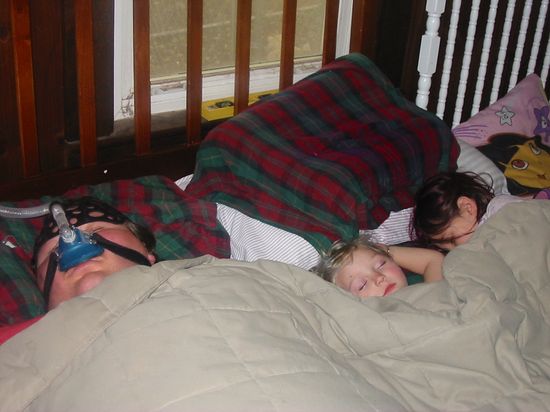
A reader writes:
I started with the mouth piece your reader described. I don't know what it's called, but I got it from this guy. (I lost it, and just recently found it five years later.) Anyway, now I use a new thing called ProVent, which I love. They are basically valves you stick over your nose. You can breathe in fine, but breathing out is slower. This increases the air pressure in the windpipe even if you breathe through your mouth.
I guess they are fairly new. My doc said he was reluctant about trying them, but he kept hearing about good results with them. He tried them with me because CPAP filled my stomach with air. My lab results using them were good. Downside is that if you make a mistake putting them on you have to put on another pair (they are disposable, one-time-use), and sometimes they come off. Otherwise they work great.
Another:
I discovered I had apnea when I met my current partner and he refused to let me move in until I got tested and CPAP'd. I felt like I woke up out of hazy dream afterwards. Try this headgear. It does not touch your face except your nostrils.
Another:
My wife noticed the apnea.
I went and had the sleep test/super-tentacle thing done and sure enough: moderate sleep apnea. Got the CPAP, tried the nasal pillows, the face mask, the full (hockey mask) face mask … no dice. For some reason I start to yawn as I fall asleep and the pressure of the CPAP makes it hard to yawn and wakes me up because I feel like I am choking.
So back to the pulmonary doc. He suggests talking to an E/N/T. Talked to the E/N/T and he said surgery was a possible option, but maybe I should try an occlusal mouth guard. Gives me a prescription for one. I go to my dentist, they make the mouthcast, and a week later I have my mouthguard … I LOVE IT! It's uncomfortable for the first few weeks, but I don't snore anymore and my wife says I'm not having the episodes of 'choking' while I'm sleeping.
Here's the mouthguard info. I don't know anything about brands or who's better or worse or anything like that. This is just what they got me, and what I'm happy with.
Another:
After failed experiments with CPAP and a not particularly successful bout of surgery, an oral surgeon recommended this mouth-guard type device. I got quoted $2000 for a fitting that, having been laid off and now having lousy health insurance, has been a real mental battle as to whether it's worth that much for another gamble at a normal life. There are apparently a couple of different firms offering devices like this.
Another:
Like you and one of your readers, I had the wired-up study and was found to be having 80 apneas an hour. I had been tired since high school (I was 43) and thrilled to finally have an explanation. Like another reader, I had trouble using the mask. I usually fell asleep, but wearing the mask sucked the peaceful joy I feel laying my exhausted head on a pillow. The seal problem was huge because the pressure I need is very low and a busted seal renders the thing useless (so does a loose set screw, or a few kitty-claw punctures). I could only bring myself to use it 3-4 nights a week. My life improved a lot but tiredness remained.
Sleep apnea accessories must be real moneymakers because they are continually improving. My first mask looked just like the one you are wearing. I am now on the third generation and the current mask (Swift LT) works enormously better – I can even sleep on my stomach with it. There is a single nasal pillow with two outlets and the seal is really good once you get the nasal angle right. My Giant Schnauzer has discovered the nasal pillows are delicious to eat and when that happens I have to go back to an older model. There is no comparison; it's awful compared to the LT.
For the past 6 months I have made a special effort to use it religiously every single night. After 10 years of using a CPAP I'm still getting improvements in my energy level and alertness. I bet the technology will improve to the point that we will just be able to get implants.
Another:
Andrew, the dental device your reader mentioned is generally called a mandibular advancement device. My understanding is that the most state-of-the-art brand of these devices is called the SomnoMed. Since you're in DC, I can tell you that by all accounts, the number one doctor in the area for this is Dr. Sylvan Mintz in Bethesda. (I have no affiliation; I'm just a sleep apnea sufferer who just started trying this device myself.)
By the way, thank you for all your accounts of sleep apnea. It has been very inspiring for me to read about such productive and well-known people as yourself who have worked through this problem successfully. The frustration of sleep apnea is nearly unbearable otherwise.
(Photo by Flickrite mia3mom. The caption reads: "Love is sleeping after your daughters crawl into bed. Love is wearing your CPAP every night.")
It's comprehensive and rings true, but is only worth perusing if you've got a couple minutes to follow the lines from beginning to end.
James Parker recites an impassioned love letter (that I could have written myself) to the 47 year-old Doctor Who franchise and this season's latest incarnation:
I find I must lapse into nostalgia. When I was a short-trousered schoolboy in the 1970s, my own Doctor was Tom Baker, and Doctor Who was more or less an out-of-body experience. Wedged into BBC1’s Saturday-evening schedule at fish-sticks-and-ketchup time, it gave off dizzy wafts of the uncanny. Before it, The Basil Brush Show, starring a glove-puppet fox in a cravat. After it, The Generation Game, hosted by Bruce Forsyth, an extraordinary old whippet of a song-and-dance man whose catchphrase was “Nice to see you, to see you … nice!” In between, the thrumming, tunneling synth-beams of the Grainer/Derbyshire music, and the zappings, the disintegrations, the alien pomp … It was English, so English. It reeked of old Albion. No wonder it faded away.
But then, in 2005, comes the Great Reboot, a mighty regenerative act by which Doctor Who is heaved into line with American standards. No more sets made out of cereal boxes and aluminum foil, no more waffling monologues and congealed fancies. Now it’s CGI, backchat, irony, long narrative arcs, and tighter-than-tight writing: a post–Buffy the Vampire Slayer world.

"For My Dog, Who Listens to All My Poems" by Cathy Smith Bowers appeared in The Atlantic in July/ August of 2002:
How entranced, each time, she sits there,
her eyes, I swear,
filling with tears
at her master'sinimitable brilliance. It's
clear to me what's
bounding through her
head: The greatest,yet, of all the generations!
My husband says
she's just waiting
for her rations.
I've been arguing with Andrew Sullivan online since "online" existed. Andrew has invented and defined so many of the Internet's creative possibilities: for politics, for journalism, and for personal reflection. The rest of us admire or criticize or both, but ultimately … we emulate. In a decade that started with a second 1941 and ended with a second 1929, Andrew has been a voice that future historians will quote endlessly and tirelessly as a representatives of the thoughts and emotions – passions and regrets – brilliant insights and terrible mistakes of this generation of Americans.
Read David at FrumForum.
Monica Potts makes the case for Louis C.K. as the liberals' comedian:
Unlike most other shows on television, in almost every episode Louie deals with a deep moral quandary — whether it's ever OK to use the word faggot, for instance — which is addressed from a fundamentally liberal point of view. In the first episode, Louis responds to a bus malfunction on a school field trip he is chaperoning by sending every kid home in a limousine. In the stand-up section that follows, he says, "There are people who are starving in the world, and I'm driving an Infiniti." In the third episode, a fellow comedian complains that white people don't stand a chance in the age of Obama, and Louis asks, "What is 10,000 years of unchecked prosperity? That's not enough for you?"
This is new. For the most part, people of color are the ones who initiate serious discussions about race and privilege in the public sphere — and in the world of comedy.
But Louis CK is so much more than liberal. He's just so fucking real. I worship him a little for that.
Jeff Jarvis rails against NPR's dictum that employees not attend the Stewart/ Colbert rallies:
In its effort to be hyperjournalistic NPR is being unjournalistic. Journalists, properly empowered, are curious. They want to know things. NPR is telling them not to ask questions. … Citizens are involved in their communities, part of their communities, so they can understand and serve those communities. Journalists tried to separate themselves from their communities (and opinions) and that is much of the reason why journalists lost touch with how to serve them. It is time to get off the fucking pedestal and return to the streets.
The Dish team will be there.

Fascinating piece in the NYT today about how popular Hitler was in middle-class Germany in the 1930s, revealed in a new exhibition in Berlin. It akes the Goldhagen thesis and extends it to knitting circles. Money quote:
“This is what we call self-mobilization of society,” said Hans-Ulrich Thamer, one of three curators to assemble the exhibit at the German Historical Museum. “As a person, Hitler was a very ordinary man. He was nothing without the people.”
Understanding this – and constantly exposing it – helps us protect ourselves against it happening again. And yet there's always pressure to brush similar tendencies under the rug if they reappear. Yes, Godwin's Law applies – until it doesn't. In a post looking back at a similar refusal to look away, Letters Of Note blog recalls Rod Serling, of Twilight Zone fame, writing to Playboy to and commending them on running Alex Haley's 1966 interview with George Lincoln Rockwell, founder of the American Nazi Party in Virginia:
There is a breed of layman social scientist who will forever cling to a concept of "defeating by ignoring". Hence, when out of the muck of their own neurosis rise these self-proclaimed fuehrers, there is this well-meaning body who tell us that if we turn both eyes and cheeks the nutsies will disappear simply by lack of exposure.
My guess is that in this case exposure is tantamount to education and education, here, is a most salutary instruction into the mentalities, the motives and the modus operandi of an animal pack who are discounted by the one aged maxim that "it can't happen here." …
[W]e have learned to realize that even the most sophisticated society can still fall prey to an invasion of monsters. It is not public exposure that helps these perverters of human dignity. Rather, it is apathy.
(Photo: Children's tin soldiers of the Nazi criminal Adolf Hitler regime are pictured during a press preview of 'Hitler and the Germans Nation and Crime' (Hitler und die Deutschen Volksgemeinschaft und Verbrechen) at Deutsches Historisches Museum (German Historical Museum) on October 13, 2010 in Berlin, Germany. The exhibition will be open to the public from October 15 until February 6, 2011. (By Andreas Rentz/Getty Images)
 The Dish