Reich For Sale

Robert Reich is back flogging his book on the road. He stopped to reconsider what a future of e-books and specialization will mean for the author:

The Internet has "disintermediated" books, to use biz-speak. Just as it's done elsewhere in the economy, the Internet is wiping away layers of retailers, wholesalers, and distributors … [In the future] I'll [still] need to attract customers, and without any intermediaries between my potential customers and me, I'll be on my own. That means I'll have to sell myself like mad — not my ideas but me. Figuratively speaking, I'll need to put myself into a national shopwindow with a big sign pointing in my direction: Robert Reich, Inc.

Get it? Disintermediation isn't the end of humiliation. It's just the beginning.

Shut up and get a blog. Then you'll know humiliation.

New Media Mogul?

Ben McGrath profiles Gawker owner Nick Denton. John Cassidy follows up:

Denton has moved beyond the stage of running a cottage business, but suggestions that he has joined, or is about to join, the ranks of moguldom, where revenues are measured in the hundreds of millions, or billions, are absurd. Denton is aware of this disjuncture—up to a point. A few weeks ago, I met him at a party, and he told me that New York magazine, which recently profiled him as one of the people who run the city, had pitched the story to him as “the new Rupert Murdoch.” In telling me this, Denton said he thought New Yorks editors had been “a bit premature.” When I suggested that they might have been about forty years premature he didn’t smile.

The web is not about moguls, methinks. It's too bottom-up. It cannot be controlled the way old media was. Or not for the foreseeable future.

What Should They Be Called? Ctd

Rinku Sen's argument against the term "illegal immigrant":

At the center of this debate are human beings. Not illegal beings, but human beings. Discourse reflects the way that people think about themselves and the country thinks about us. 

The word homosexual, for example, is clinically correct but experienced as dehumanizing by gay and lesbian people, and so they pushed for journalists to drop it. As the discourse changes, so does the culture and policy affecting gay people—not nearly fast enough, but significantly nonetheless. Some may say, “But being gay isn’t a choice.” Well, neither is escaping poverty, drought or war. That millions of people wind up in the country without permission comes about for many reasons, only a very few of which have to do with the choices individuals made. 

I actually have no problem with the word "homosexual" and use it as a neutral term all the time. Again, the noun-adjective issue is more important to me. To call someone "a gay" is different than calling someone "gay." And not ever being able to say something lame is gay is so gay.

But this is a complex issue.  There's the difference between saying something and writing it. There's the place and the time and the speaker/writer. Language is infinitely complex, context matters, agency matters. For me to use the word homosexual is different that a straight person using it. When Eric Cartman calls someone a "faggot", it's different than Ann Coulter whipping up a CPAC crowd. And gays, like other minorities also have more lee-way to say things others don't, like the ironic use of "a gay", or my conversational references to "the AIDS" or, occasionally the adjective "AIDSy", because it is self-evident that we are not trying to be homophobic any more than is necessary, but that we are being self-mocking and funny.

As I've said, I don't like the term "illegal" as a noun because it dehumanizes, especially in speech. But "illegal immigrant" seems totally neutral to me, in speech and writing. But before I disappear up my own ironic homosexual posterior, back to Serwer, suddenly in a spasm of liberal guilt:

Reading Sen's piece made me feel a bit like that serial killer on Family Guy who stabs himself and says, "My G-d, is that what I've been doing to people?" I cringed. I don't know that I've been entirely persuaded to stop using the term, but I'm certainly going to think about it. 
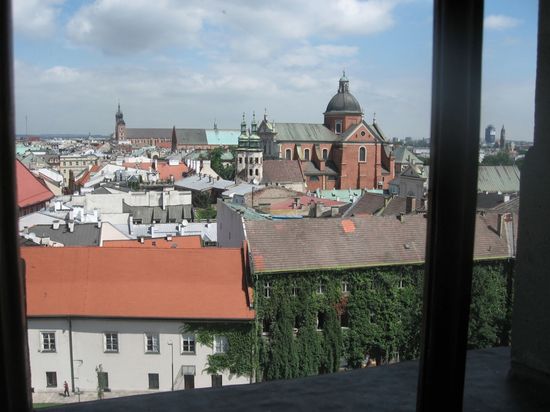
The View From Your Window Contest

Vfyw-contest_10-16

You have until noon on Tuesday to guess it. City and/or state first, then country. Please put the location in the subject heading, along with any description within the email. If no one guesses the exact location, proximity counts.  Be sure to email entries to VFYWcontest@theatlantic.com. Winner gets a free The View From Your Window book, courtesy of Blurb. Have at it.

“Murder By Numbers”

The average social cost of a single murder is more than $17.2 million, according to a new study (PDF). Christina Hernandez interviewed study author Matt DeLisi on the goal of the research:

There is a large and vibrant prevention world that tries to identify at-risk youth and at-risk families and provide some modestly-costing social services that will try to push kids out of risky or at-risk environments into more normative or pro-social environments.

I’m hoping these monetization studies show the end result of what happens if we allow crime to go over to a lengthy criminal career. My hope is that this information — because no one wants to pay for these costs, let alone endure all the victimization — provides an incentive to continue to invest in prevention.

(Hat tip: Maureen O'Connor)

The Odd Lies Of Sarah Palin XCVII: The Motor Home Drive From Alaska To Los Angeles

She mentions it again – that motor home she got in and drove all the way down from Alaska to Los Angeles to see Bristol perform on Dancing With The Stars. Except now, it's Todd who did it – not her. Check out the video here. Money quote:

He drove our motor home all the way back from Alaska … he came down he could see Bristol on "Dancing With The Stars." … That's what Todd did, he did load up the motor home.

Here's the first version:

"I tell Bristol, I am texting her and say 'Bristol'…and I wasn't kidding, I thought that this was a practical thing to do … 'How about if Todd and I we load up all the kids in our motorhome and drive down, park on Rodeo Drive and we come to see you.' And I honestly didn't think that it was an unusual thing to suggest, that's what you do, a road trip. (…) But anyway, that's what we did, though, we parked a little bit further away from Rodeo Drive, and we got to watch Bristol."

She just made that first thing up.

Where’s The Blackberry?

Joanne McNeil notices something about contemporary novels:

The average fictional character is either so thoroughly disinterested [sic] in email, social media, and text messages he never thinks of it, or else hastily mentions electronic communications in the past tense. Sure, characters in fiction may own smart phones, but few have the urge to compulsively play with the device while waiting to meet a friend or catch a flight. This ever-present anachronism has made it so that almost all literary fiction is science fiction, a thought experiment as to what life might be like if we weren't so absorbed in our iPhones but instead watched and listened to the world around us at a moment's rest…

The ADHD, multitasking, always-distracted world of today runs counter to the linear, leisurely-paced storytelling that makes a literary novel. To present email and text messages as they often feel would create an experimental novel, as if descending from Brion Gysin and William S. Burroughs cut-ups. Communicating with technology might be just a little too difficult for even the most skilled novelists among us to describe yet. In the meantime, the distraction-free world of contemporary fiction is an idyllic respite for the rest of us overwhelmed with it.

Perhaps all the novelists with an accurate understanding of what it's like to constantly check email, Facebook and Twitter never finished their books.

Night And Day

Dave Munger explains studies connecting the sleep cycles of humans and other animals. For instance, reindeer might “be immune to jet lag because its circadian cycles are remarkably adaptable”:

[For reindeer circadian cycles] are almost completely absent for much of the year, when the polar animals live in 24-hour daylight (or darkness, in the winter) — since there’s no difference between day and night, a daily clock is not necessary. …

Whether we’re adapting to jet lag or working the night shift, many humans might feel that circadian rhythms are more of a bother than they are worth. But think of it this way: If humans all slept and woke at random times, then it might be even more difficult for us all to get along. Without the dominant day-night cycle guiding our daily lives, how would we ever agree on times for meetings, meals, and other social activities? On the other hand, maybe that would be preferable to that annual ritual most of us share: The struggle of adapting to Daylight Saving Time.