
Sapporo, Japan, 4.54 pm
Sapporo, Japan, 4.54 pm
Is he doing this for free? So wondered the crass capitalist in me when I started soaking up Andrew’s daily musings, genre-benders, analyses, hiccups, tours de force. Then: When does he eat? Then: When do his dogs eat? And occasionally: Are they ghostwriting for him? Much of the time I read in awe of his output. But most of the time it’s simple admiration for his pit-bull persistence, his moral compass, and his catholic range of interests. We don’t always agree—for example, I believe Trig Palin is animatronic—but isn’t that the point? I don’t tune in to have my opinions reinforced. I visit the Dish for the same reasons everyone else does: to be challenged, to laugh, to learn, to nod, and to get my back up. And, of course, to reinforce my embarrassment over not being able to grow a real beard. Here’s to the past ten years of showing the rest of us how to blog, Andrew.
Read Grant at Commonweal.
Pete Wehner takes on Bill O’Reilly’s inflammatory generalizations about the Park51 project. When asked why he opposed building Park51 on The View, O’Reilly spluttered the above quote. Wehner:
O’Reilly’s claim is unfair – and O’Reilly should understand why. Here’s an illustration that might help clarify things. Assume that Sam Harris went on The O’Reilly Factor and, based on the child-abuse scandals that tarnished the reputation of the Catholic Church, made the sweeping claim that “Catholics are child molesters.” My guess is that O’Reilly would (rightly) respond, “No. Some priests molested children, and it was a horrific thing. But you can’t indict an entire faith based on the sins of a relatively few number of priests.”
Wehner nonetheless exonerates O’Reilly from bigotry. But if indicting all Muslims, including American Muslims, with al Qaeda is not bigotry, what would be? Wouldn’t Pete’s analogy hypothetically make Sam Harris an anti-Catholic bigot? Even allowing for the heat of the moment, O’Reilly hasn’t backed down since, and indeed dug in. But I would like to endorse Pete’s rather beautiful sentiments here:
To be an American means, at least in part, to avoid creating unnecessary divisions over matters of faith. This view was central to America’s founding. Comity, tolerance, and respect for people who hold views different from your own is a sign of civility, not weakness.
In his letter to the Hebrew Congregation of Newport, Rhode Island, President Washington wrote these beautiful words:
“May the Children of the Stock of Abraham, who dwell in this land, continue to merit and enjoy the good will of the other inhabitants, while every one shall sit in safety under his own vine and fig tree, and there shall be none to make him afraid.”
Amen.
Noah Millman uses gay equality to make a larger point:
It gets worse before it gets better – indeed, it gets worse even as it’s getting better. That’s the way the politics of these sorts of issues goes, issues that appear to present very fundamental challenges to an entire worldview. At the outset, the worldview has a variety of sources of support: longstanding traditions and patterns of behavior; a larger societal consensus on the rightness of a position; the support of scientific authorities; etc. But as these supports fall away, as patterns of behavior change, as the question becomes contested rather than settled, as the scientific consensus dissolves or even switches to the other side, the defender of the traditional understanding is left with only one actual argument: if I give this up, I will have surrendered everything. And so I will never give up.
This isn’t even a specifically religious phenomenon, something I think Andrew is reluctant to recognize.
The pieds noirs grew more radical even as their political position grew untenable as they were abandoned by Paris. Ditto for Rhodesia. Ditto for defenses of segregation in the American South. The challenge of homosexuality is distinct in that gay people appear everywhere, in all kinds of families – the solution of separatism is not a viable one. But otherwise, it’s a pretty familiar dynamic. And we’ve probably got a decent idea of how that dynamic will play out:
It’ll get worse before it gets better. Indeed, it’ll get worse even as it gets better, even because it gets better.
I think that's exactly right about the dynamics of certain aspects of change. And, yes, it's not just religious, as Noah notes – although religious fundamentalism does become more psychologically helpful in periods of social change and personal bewilderment. I think this also helps explain the intensity of the cultural reaction to Obama. There is a rational argument against some of his policies, of course (health insurance reform primary among them). But the passion of opposition stems, I think, in part from a sense that the way the world once was is disappearing, that this is inevitable, and a repressed acknowledgment of the inevitability actually intensifies a resistance to it.
The America of the future will not be the America of the 1950s, the teenage years of many of those in the Tea Party movement.
It will be majority-minority, it will be one where gay people are not only visible but equal, it will blur racial identity and more and more people will have very complicated and mixed-up selves. The Tea Partiers want "their country back" in an almost poignant way – because their country will never come back, because change is now here for ever. That's also why there is an irrational resistance to any kind of acceptance that 12 million largely Latino illegal immigrants simply need to be integrated somehow, because mass deportation is impossible and a total control of the border very very hard (though still worth attempting). But the babies are already here! And American! So we have the panicked bizarre proposals to tear up birthright citizenship, the settled way of things for a very long time, because emotion – fear – is flooding the frontal cortex.
Obama, for many of the afraid, almost sums up in one person this entire, blurring, mocha, non-Rockwellian vision of the future, which is why so many under 40 felt drawn to him culturally and psychologically – and also why we under-estimated the inevitable cultural reaction among many of the over-40s once he actually had power and exercised it.
He is not, after all, the first black president. He is the first miscegenated president. He is a blurring of boundaries, a Hawaiian-Chicago-Black-Ivy-League-Child-Of-A-Single-Mother kind of blurring. The very complexity of his identity can threaten those whose experience simply hasn't been the same. (One thinks of Palin, for example, and her idealization of an America that requires a wild frontier of a Rockwellian Alaska to stay faintly credible as part of modernity).
Add that to the sense that Obama represents a kind of collectivism, intensified by necessarily collective responses to a major crisis like this recession, and I can certainly understand where the Tea Party is coming from psychologically.
This is not the same as calling it racist. Tea partiers rightly recoil from that personally because it isn't true for most and is far too crude to explain why they feel the way they do. And I think it's the cultural feeling that really dominates their psyche – and our politics – right now, not a political argument. They feel besieged by change. And that is, of course, a conservative feeling.
But the lashing out is not conservative; it is reactionary and populist and dangerous. And the goal of the Burkean conservative is to try and bridge the feelings of loss and panic with a calmer assessment of actual reality and its practical challenges, not to double down and intensify the fear and panic. In that, I remain of the view that Obama truly is the conservative in this – or is trying to be – and that until a calmer, saner, more open-minded Republican emerges, he's the best option as president that we've got.
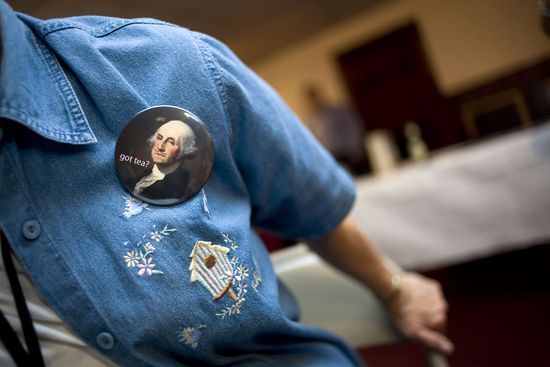
(Photo: Tea Party activist Dot Michael of Dresher, PA., wears her favorite Tea Party button to a 'Get Out The Vote' rally for Pat Toomey at SmokeEaters Pub in Philadelphia on October 12, 2010. Philadelphia Tea Party Patriots, along with FreedomWorks PAC hosted a grassroots activists rally in support of Pat Toomey's campaign. By Jessica Kourkounis/Getty Images.)
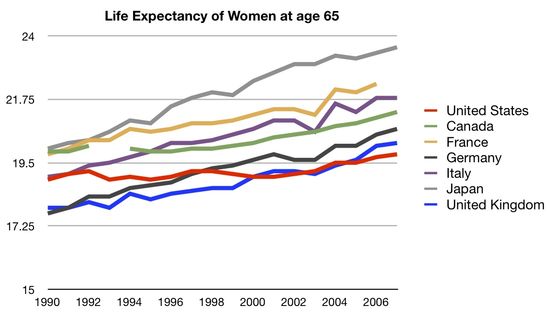
Austin Frakt provides one answer:
[T]here is evidence that Medicare improves health outcomes (no surprise there), but also that previously uninsured individuals who become beneficiaries of that program require a lot more care (not such a shock either). They’re less healthy than they would have been had they had insurance before turning 65.
Thus, another way to interpret poor post-65 U.S. mortality relative to peer nations is that we do a worse job of providing access to coverage and the care it facilitates before individuals become Medicare eligible. In short, even mortality for Medicare beneficiaries could be related to the health insurance system. This is not really surprising since many causes of death are related to life choices made and health care received over many years. It is not inconceivable that better care at an early age can prolong life even for those who make it to 65.
If you haven't read the transcript of Peter Baker's interview with the president, you really should. Money quote:
Something that I have learned over the last couple of years is that I have to make decisions based on the long view. And I have to suppress my own desire for a short-term fix if I’m going to be able to lead the country effectively over the long term… I will keep on making that case, and I think that to point — to quote my vice president — I believe that voters are going to stop comparing me to the Almighty and compare me to the alternative.
We're lucky to have him.
"What this massive new air assault suggests to me – and I'm just speculating here – is that this is an attempt to generate as much leverage over the Taliban to secure as face-saving a political formula for withdrawal next year," – the Daily Dish, October 13, reacting to a piece by Noah Shachtman.
"Airstrikes on Taliban insurgents have risen sharply here over the past four months, the latest piece in what appears to be a coordinated effort by American commanders to bleed the insurgency and pressure its leaders to negotiate an end to the war," – Dexter Filkins, NYT, October 14, in a piece titled, "U.S. Uses Attacks to Nudge Taliban Toward a Deal".
That's the subject of a disagreement between Jonathan Chait, who says they will if they retake the House, and Jonah Goldberg, who disagrees so strongly that he wants to bet $500 on the matter. Chait wants different stakes:
If Obama wins a second term, and a GOP-controlled House has not impeached him by 2017, I will let Goldberg write an item on my blog explaining why I was wrong. I'd hope he'll let me do the same on his blog if I'm right. Oh, I also predict that said impeachment will be endorsed by Goldberg.
Hold your gold. It's on now.
Thanks to a robotic exoskeleton developed by a Berkeley, California company. The nation as a whole is going to spend even more money on healthcare in the future – and some of that spending will be worth it.
Jamelle Bouie questions my choice of words. Why are so many on the left incapable of acknowledging that many people who are rich – but, of course by no means all of them – earned it the hard way? Until more liberals internalize this, they will fail to persuade America of the occasional need for government because people will rightly suspect that what they are really about is penalizing or diminishing hard work. By the way, I favor an inheritance tax. But I also favor allowing those who work hard to keep as much of their own money as possible.
 The Dish