Will Losing The House Hurt Obama?

John Sides digs through research on divided government and gridlock. His bottom line:

Under divided government, [Obama will] have less power but no less accountability. Of course, if the economy turns around, a Speaker Boehner won't matter one way or the other. But if the economy continues to stagnate, blaming a Republican-controlled House or even Congress won't help Obama.

The Attack Ads Of 1800

Nicely done:

Peter Wehner mulls other parallels:

Abraham Lincoln is a unique figure in American history, and there is a danger in measuring the quality of our arguments by the quality of his. But there is a lot to be said for holding him up as the ideal. And if you read the words of Lincoln, you will find him constantly making his case in a compelling and philosophically serious way. That is what is most notable about his debates with Stephen Douglas.

The burden was on Lincoln to show why Douglas’s advocacy for “popular sovereignty” was incompatible with self-government and the moral meaning of the Declaration of Independence — which is precisely what Lincoln did. If you read the transcripts of the debates, there was plenty of “negative” campaigning going on. But it is long forgotten, because the quality of the debate was so good and the stakes so high. The lesson for us is to aim high, not low, when it comes to the caliber of arguments we make to the public.

Liberal Genes?

Jim Manzi debunks a misleading study:

Jonah, Goldberg and John Derbyshire are having an interesting exchange at The Corner on whether researchers have a found a gene that, under certain environmental conditions, predisposes individuals to liberal politics.

I wrote a long piece (gated) for National Review in 2008 that described why we should be very skeptical of assertions of causality that are derived from gene association studies. The basic reason is that, while these kinds of studies have remarkable rhetorical force because their purported  subject is biology, if you look under the skin at the bones of the analysis, the core method is traditional social science. The article under consideration is an almost perfect illustration of this.

The Elite’s Career Accelerator

Here's a recent Ivy League grad describing why she applied to work at McKinsey despite being committed to a career in public health:

It is increasingly difficult to get into Gates or Clinton foundation without experience in management consulting. I saw a number of jobs advertised at these places that required at least 2 years of consulting experience. That’s what made me apply to McKinsey. During the application process, I discovered a number of my friends from med school, who also do international health, were already part of McKinsey. One of them described it as a “career accelerator” in which 1 year at McK was equivalent to about 4 years working in government or an NGO. People come, do their 2 years at McK and leave to take management positions at NGOs or foundations, leap-frogging the whole toil-for-10-years process that you would have to do to rise through the ranks.

The account got Conor wondering whether this leap-frogging process – so common in professional fields – is making meritocratic elites inadequately familiar with the organizations that they wind up running.

Face Of The Day

HorseMouthMatt CardyGetty

Exmoor ponies graze close to where it has been reported that the 'Emperor of Exmoor' was last seen after being shot dead by an unnamed but licensed hunter, on October 29, 2010 in Rackenford, England. Although it has been claimed that the red deer, thought to be one of Britain's largest wild animals – at 300lb and almost 9ft tall – was shot by trophy hunters for his antlers valued up to 10,000 GBP, no body has been seen, prompting rumours that he may not be dead after all. By Matt Cardy/Getty Images.

On Gay Stuff And Honesty, Ctd

A reader writes:

Your reader‘s comment that he wishes he could “come out” as a heterosexual reminded me of a recent Louis C.K. interview on NPR’s Fresh Air. Here’s an excerpt:

And it’s funny because, you know, gay men have to – they’re put sort of a crucible. And I’m speak – you know, it’s not – I’m just taking liberty in saying this. Gay men have to go through something to own their – who they are. They get beat up. They get ostracized. Whatever they go through, if they survive it, they come out very confident people.

They come out having been tested and having to really figure out who they are to get through it, because I think that’s how you get through any kind of a test is by really finding your strengths and believing in yourself. So a lot of gay people who are still standing and still strong, that’s who they are.

Heterosexual men have never been put through that test. We don’t get – nobody goes, oh, my God, you like women? And you don’t have to defend it for your whole life. So we’re not so sure about our sexuality. I think that’s one reason why heterosexual men attack gay people or are afraid of them because they’re now confident and they’ve gone through this, but we don’t know who we are sexually. We’re a mess. So I think that that’s why the two sides of the sexual barrier is such an interesting – it’s such an interesting conflict.

I’m not so sure that straight men don’t know who they are sexually, but I absolutely agree that we don’t go through a crucible, and that many of my gay friends clearly have. They are more honest with themselves and others about who they are regarding other, non-sexual aspects of life.

I wonder if perhaps this is one of the reasons that gay characters appeal to writers, particularly for film and television where confident, sassy gay characters were in vogue long before of depictions of those who are still running the gauntlet of self-discovery and self-defense. There’s an element of admiration involved, even if it sometimes crosses the line into the repetitive stereotypes that South Park mocked as “I’m super, thanks for asking!”

Obama, Marriage And The Gay American Future, Ctd

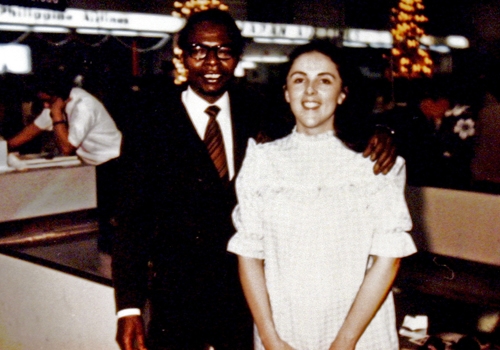
Obama-parents

A reader vents to the president:

You're the product of a relationship that would have been illegal in parts of the country only a generation ago, you're a liberal activist who grew up in the '70s and '80s, and you're a goddamned Constitutional scholar.  Fifteen years ago you supported our civil rights, so what's changed?  Oh right – you became a national political figure.  Now you say you're going to fight for our rights with one face, while standing idle or even actively opposing us with the other. 

Oh well, I'm sure you'll finish your evolution (or is that devolution?) after you're out of office, like every Democrat before you who could only muster political "courage" once there were no repercussions to fear.  And we'll hear grand moving speeches where you'll proclaim:

I think, what made me change my mind, I looked up and said look at all of this stuff you’re for. I realized that I was over 60 years old, I grew up at a different time, and I was hung up about the word. I had all these gay friends, I had all these gay couple friends, and I was hung up about it. And I decided I was wrong.

Oh wait, that was Bill Clinton – a decade after his presidency and a year after his wife's candidacy ended.

Another writes:

How can you applaud Obama for his pragmatism against Republicans but lambaste him for his strategy on DADT and DOMA?  And I think it is a pragmatic strategy – another example of his long game.  Even now, with congressional Democrats in the majority, he doesn't have the votes to repeal DADT or DOMA.  From that quote, and other things he's said, I believe he wants to do both, but knows he loses Blue Dog Democrats if he tries now or even admits that he wants to. In a better economy, he might be able to twist those arms, but Democrats are too vulnerable right now. 

I think Obama's priorities are:  fix the economy (or at least keep Republican from sending it further into the tank), get re-elected, and fight for the hot-button issues (DADT, DOMA, immigration) when the environment is better for Democrats and he's not trying to ensure another term.  Is it what I, or any of us, would like him to do?  Of course not.  But I don't see how he can play it any other way.

The Cost Of Doing Business

Watching the above video makes E.D. Kain clamor for a local tea party:

Chuck should not fall into the trap that so many other Tea Partiers have fallen into: national politics. This isn’t to say that Chuck shouldn’t be at all interested in national politics – plenty of the decisions made in Washington will effect his ability to start and grow a business. However, as this video illustrates, many of the real day-to-day problems facing Americans stem from local political shenanigans and from local regulations put in place by local special interest groups. Miami’s ludicrous business-licensing is a homegrown problem. You can’t blame Barack Obama or George W. Bush for the labyrinthine process of getting a business off the ground.  It’s time that the Tea Parties began to focus on that instead of always looking to Washington to place their blame – or their hope.

Sane Conservative Ideas Watch II

Megan runs through all the reasons for scrapping the corporate income tax. Kevin Drum reacts:

The corporate tax code is by far the most popular way for politicians to reward favored interests without making those rewards too obvious. As long as it exists, even if the tax rate is low, it's a way to funnel money to one sector over another or one company over another. Just get rid of it.

The big question, though, is what to replace it with.

Higher capital gains and dividend taxes are an obvious possibility. Higher top marginal income tax rates. A carbon tax. A financial transaction tax. There are lots of alternatives.

Of course, the business community would never support this. For starters, they like all the tax goodies they get, and they like the potential of getting more. And of course, businesses are run by rich people, and rich people would frankly prefer that taxes be high on their corporations than high on themselves. On a more substantive level, it would seriously raise the incentives for income shifting scams, so we'd have to amp up tax audits to catch that. So it'll never happen. But it's a nice idea.