Face Of The Day

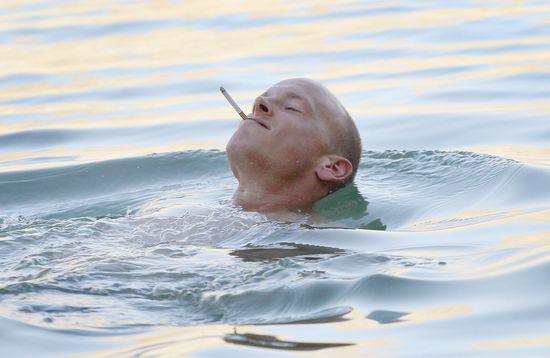
SoldierSmokingScottOlsonGetty

Marine Cpl. Marcus Ferry of Hamburg, Iowa, attached to India Battery, 3rd Battalion, 12th Marine Regiment, goes for a swim in the reservoir above the Kajaki Dam during a break in action at Forward Operating Base (FOB) Zeebrugge on October 12, 2010 in Kajaki, Afghanistan. Ferry's unit is responsible for securing the area near the dam on the Helmand River. By Scott Olson/Getty Images.

Keeping Your Fear-Mongering Straight, Ctd

A reader writes:

Am I the only gay person who's on the side of not taking kids to gay pride?  Let's be honest here – it's not the most family-friendly environment.  Most gay pride events involve a hyper-sexualized parade and a hyper-commercialized fair.  Maybe I'm just a prudish American, but it's a party for adults, not children.  It's not Folsom Street, but it's not Sesame Street either. 

Want your kids to be exposed to homosexuality as a normal thing?  Spend time with gay people you know and bring your kids along.  Our friends' young children spend a lot of time around us.  They were the ring bearers at our wedding.  They absolutely adore us (and we them!) and completely understand the concept of what we are.

I think there's a high level of defensiveness that arises any time someone says they wouldn't want their children around gay people. Granted, Paladino's statement came in a more deplorable context of general homophobia, but I think it's possible to simultaneously be supportive of homosexuality and be opposed to taking kids to gay pride.

I tend to agree. Gay pride events are far, far tamer than they once were (and not the caricature that Paladino presents). I favor freedom for everyone to express themselves at such events, even in bad taste. There are, moreover, many other public gay events that are totally family-friendly, like last year's Equality March. But there's a part of gay pride history that really is a kind of Mardi Gras, with all the adult sexuality that implies, and many wouldn't take kids to that either.

In the end, this is for parents to decide for themselves, not me. But I sure wouldn't criticize a parent who decided to keep it an adult affair. And I sure don't think it's inherently homophobic.

The Dish At Ten: Juan Cole


The sign of an honest thinker is the ability to re-examine deeply-held beliefs and premises and, where necessary, to reverse himself or herself.  The sign of a smart writer is the ability to get to the bottom of the story and make it clear to the public.  Put them together and you get that most rare and precious of commodities, intellectual dynamism.  Andrew Sullivan and the Daily Dish have it. Few others do.

Read Juan at Informed Comment.

The Starbucks Slowdown

The company is telling its baristas to take their time making coffee so that the product is more consistent in quality. Megan explains the significance by analogy:

Consider Burger King and McDonalds differentiated themselves a few decades ago: McDonalds maximized throughput with batch cooking, while Burger King relied on a sort of mechanized burger assembly line.  That meant that Burger King's product was more consistent, and could be more easily customized, since they arrived in a continuous stream rather than all at once; that's why they emphasized that you could "have it your way".  Among other things, this made labor quality less important, because the machine, not the worker, cooked the burgers.  

But while the "burger stream" arguably delivered a better hamburger, it also meant throughput was bottlenecked; you got one burger every few seconds, no matter what.  So Burger King tended to deliver a better burger during slow times, but McDonalds could handle the highest volume periods.  In burgers, it turned out that volume mattered more than the ability to have exactly the burger you wanted.

In this case, Starbucks seems to be choosing quality–or at least, standardization of quality–over speed.  As with Burger King, this is going to have some unwanted side effects.

Obama’s Big Big Spending On Defense

Suderman goes after the president:

You might think that in a time of near-universal worry about the growing deficit, a Democratic president might take the opportunity to trim the defense budget by a few bombs. But holding military spending at its current levels—much less trimming it by the trillion-or-so dollars that experts say could be cut—apparently isn’t on the table. Obama wouldn’t even include military spending in his proposed spending freeze. As an influential critic of military spending once said about the country's ongoing indulgence in defense pork, "Twenty years after the Cold War ended, this is simply not acceptable. It's irresponsible. Our troops and our taxpayers deserve better." That's true, and could be pretty good guidance for a willing politician. And all it would take for the president to follow it would be for him to listen to his own advice.

The caution is still there. And can you imagine the next GOP Congress taking on defense spending? There are some hopeful signs among some of the saner fiscal conservatives. But there needs to be a civil war within the GOP first. Meanwhile, the dollars keep coming.

Against Absentee Voting

Tim Lee has tweeted that "voting by mail is a huge privacy and security risk, and states should be discouraging it a lot more." He elaborates on his blog:

Imagine if an employer, who everyone knew to be a Republican, required his employees to request absentee ballots and show them to him before they were submitted. Think of an abusive husband who insists that he and his wife fill out their ballots together. Or imagine a political operative going around a low-income neighborhood paying people $50 if they let him fill out their ballots for them. This kind of corruption is very hard for voting officials to detect. And more insidious, voters themselves may not even realize that it’s unethical.

Now, there are some circumstances, such as soldiers stationed overseas, where absentee voting is unavoidable. But traditionally, to get an absentee ballot you had to give a specific reason that you would be unable to make it to your regular polling place on election day. But in the last couple of decades a growing number of states are dropping these restrictions, allowing anyone to vote by mail without giving a reason. And the states of Washington and Oregon are moving towards mail-in voting as the default option. Although this is moderately more convenient for voters (and election officials!), the effective abandonment of the secret ballot is too high a price to pay.

I worry about this too. There's also the issue of losing a collective decision at the same time on the same day. Things change, events occur, the world moves. It makes sense to me that an electoral decision is more coherent when it is made simultaneously over a single day, than stretched out over weeks or even more than a month.

Formerly Known As Pamphlets

And coming soon to a bookstore near everyone:

Amazon is rolling out a separate section of its Kindle store meant for shorter content—meatier than long-form journalism, but shorter than a typical book. Called "Kindle Singles," the content will be distributed like other Kindle books but will likely fall between 10,000 and 30,000 words, or the equivalent of a few chapters from a novel.

The company believes that some of the best ideas don't need to be stretched to more than 50,000 words in order to get in front of readers, nor do they need to be chopped down to the length of a magazine article.

A novelette idea; or the classic pamphlet, a form begging to be renewed. Yglesias perks up:

[Particulary] in the kind of political/policy space I work in, I think we see a ton of good magazine articles that outline ideas worth expanding on that get turned into books that are really quite a bit longer than they need to be. But conventions about content-length—the column, the magazine article, the book—are driven by the economics of printing and distributing bundles of ink-covered paper rather than considerations about the content itself.

Democrats Defend The Drug War, Ctd

Meth

A reader writes:

While locking up nonviolent drug offenders in other states may seem silly, it's not in Kentucky, or other parts of Appalachia. For the vast majority of America, "nonviolent drug offender" means "weed dealer/user." In Kentucky, it's crystal meth and Oxycontin, two drugs with massive social deterioration effects – basically hillbilly heroin. The fiends who peddle that stuff are ruining their communities, and need to be stopped. And this is coming from someone who fully, completely, and totally supports Prop 19, and hopes to see full federal legalization in his lifetime.

Another writes:

As a native of Kentucky, a little context is called for in this case.

The state has an outrageous and growing meth problem that is arguably destroying much of the rural parts of that state. Note these statistics, including: "The recent increase of locally produced methamphetamine may have eclipsed the amount of Mexico-produced methamphetamine transported into the state." This is not an issue involving a low risk drug like marijuana.

Also, Rand Paul's objection to the drug war is usually in the context of very large and expensive American actions in foreign countries like Mexico and Columbia. Kentucky's drug problem is actually much more local in nature, and slamming Paul for his position in the context of local Kentucky problems is totally fair game. You're not going to find many Kentuckians who would argue that the meth problem is not tearing their state apart – unless they happen to be tweakers.

Another:

I live in Lexington. The issue with Rand Paul isn't that he's against the war on drugs; it's that he's totally unaware of the meth and oxycontin epidemics in Eastern Kentucky.  That's what he's been taking heat here from the Democrats.  Bill Clinton excoriated him on Monday, at a Conway event, for being simply ignorant about Kentucky – and that was just the headliner of many ways in which Paul's clueless about this state.  Conway didn't get up and say, "And by God we need to put more of those people in jail."  He got up and said, "Why does Rand Paul want to cut assistance to clinics and rehabilitation programs?"  It's classic Dem politics, not triangulating at all.