The Greatest Ever Sports Beard

  WGGRACE

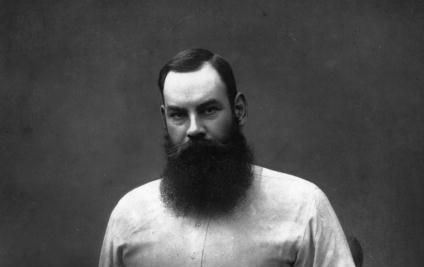
Alex Massie emails to remind me that the Sports Illustrated review of the Best Beards In Sports History was understandably American-ocentric. The greatest cricketer in history, W.G. Grace, also undoubtedly had the greatest beard. David Frith on the legend:

In a cricket environment that few moderns would comprehend, having played his first first-class match in 1865, when just short of 17, and failed to score, WG began totting GRACESTATUEMikeHewitt:Getty up first-class centuries the following year with a huge 224 not out for an England XI against Surrey at The Oval. By the time of his final first-class appearance, just over 40 years later, he had laid down statistics that seemed likely to be forever unmatchable. And in one sense they have been just that. While he was not to be the only batsman ever to reach 100 centuries, in his day a run truly was a run.

It was one of cricket's all-time sensations when he registered 10 centuries in 1871. Few pitches in the 1870s and 1880s were batsman-friendly, and WG drew gasps of amazement and admiration as he clamped down on fast shooters on imperfect pitches – even at Lord's – and whipped the ball to the boundary. His performances amazed and enchanted all who saw him play and read about him in the newspapers, especially in 1874, when he became the first to pass not only a thousand runs but a hundred wickets. Two years later he set yet another breathtaking mark, with the 1000-200 double.

Although he was no lofty intellectual, from his rural boyhood he had devised a technique that took batting from its middle ages of development into something that moderns will instantly recognise. In the only brief film clip of WG Grace batting, in which he makes a few hits in the nets for the newly invented movie camera, what catches the eye is that large waistline and grizzled beard as he plays with a slightly angled bat, showing disdain for the ball. But here was the man who, when young, worked out a way of responding to all the bowling that came his way, pioneering the combination of forward play and back, cleverly using his feet, and venting that extraordinary confidence first perceived by his mother as she played with her little lad in the Gloucestershire apple orchard.

It was said that his beard was so big he batted through it.

(Photo: Rain falls on the statue of W.G Grace during day four of the first power Ashes Test match between England and Australia at Lord's on July 24, 2005 in London. By Mike Hewitt/Getty Images)


The Hegemon’s Bubble

Matt Yglesias concludes a trip to Israel with this insight:

…if you go to Hebron and then to Tel Aviv it’s impossible not to find yourself baffled by the apparent blindness of many Israelis to what’s being done in their name. What’s harder is to recognize that the shoe fits America, too. I wouldn’t analogize the situation in Palestine to anything else, but Americans very much live in an emotional bubble isolated from the practical realities of the acts of violence committed in our names over the years.

It is hard to see what's in front of one's nose… and even harder when the national media has a de facto policy of regularly censoring graphic material that reflects poorly on US foreign policy.

Taking The “Conserve” Out Of Conservatism

Conserve

Bill McKibben confronts the lockstep denialism of GOP senators over climate change:

The odd and troubling thing about this stance is not just that it prevents action. It’s also profoundly unconservative… Conservatism has always stressed stability and continuity; since Burke, the watchwords have been tradition, authority, heritage.

The globally averaged temperature of the planet has been 57 degrees, give or take, for most of human history; we know that works, that it allows the world we have enjoyed. Now, the finest minds, using the finest equipment, tell us that it’s headed toward 61 or 62 or 63 degrees unless we rapidly leave fossil fuel behind, and that, in the words of NASA scientists, this new world won’t be “similar to that on which civilization developed and to which life on earth is adapted.” Conservatives should be leading the desperate fight to preserve the earth we were born on.

Manzi dissents, calling it "comfort food for liberals":

This is the crux of the problem with McKibben’s argument: According to the IPCC, the expected economic costs of global warming are about 3 percent of GDP more than 100 years from now. This is pretty far from the rhetoric of global devastation that McKibben, and so many others, use.

But since when did conservatives only care about "economic costs"? I respect Manzi's cost-benefit argument, and his policy pragmatism. But there is a moral dimension to real conservatism, even a spiritual one, that does not treat the planet as something to be used, but as something to be a sensible steward of. And, as Jim also acknowledges, we do not know for sure whether the temperature rise will be stable, or whether there could be a sudden feedback loop that changes things far more radically. When you do not know such things or sure, it seems to me that a conservative veers on the side of caution, which, in this case, means taking this problem seriously, doing all we can to mitigate it (using the market and government to innovate and research clean energy urgently, for example), as well as thinking deeply about what it means for humankind to suddenly alter the environment in which we have always lived since we emerged as a distinct species on this earth.

This cannot be reduced to percentage points of GDP. And a conservative disposition, it seems to me, regards the loss of habitat, of species, of the settled way of things as sources of grief, not indifference. Let alone denial. As I wrote a few years back:

The earth is something none of us can own or control. It is something far older than our limited minds can even imagine. Our task is therefore a modest one: of stewardship, the quintessential conservative occupation.

Conservatives do not seek to remake the world anew. We do not hope to impose upon it some abstract ideological “truth” or bring about some new age for humanity. We seek as conservatives merely to live up to our generational responsibility and to care for the inheritance we have in turn been given. This ecological vision is a Burkean one, which is why Toryism’s natural colour is as much green as blue.

“Awesome”

WNYMedia.net has posted NSFW pornographic e-mails that New York gubernatorial candidate Carl Paladino allegedly sent to friends. Note the irony of Paladino writing "awesome" in response to girl on girl porn. Serwer connects the e-mails to Paladino's earlier anti-gay remarks:

I suppose Paladino's argument might be that while gay pride parades make your kids gay, manly straight porn just shows how manly you are. I'll just repeat what I wrote when Paladino originally won the primary–as a wealthy, hypocritical homophobe who wants to legislate "family values" while having a kid out of wedlock, talks up fiscal prudence while getting millions in government subsidies, and chuckles at racist jokes with his friends, he's what liberals would come up with if they were trying to paint a nasty, reductive caricature of what conservatives are really like.

Meanwhile Paladino's former allies are abandoning him for apologizing to the gays.

Should We Return To Clinton Era Tax Rates? Ctd

Il_fullxfull.17658262

A reader writes:

I don’t think that people understand the magnitude of the budget deficit.  Here is one way to look at it:  The total budget deficit is $1.3 trillion this year, and there are around 110 million full-time American workers.  Do the math and you find that the U.S. government is borrowing around $12,000 per worker this year.  It is impossible to eliminate this massive deficit without raising taxes unless you absolutely gut Social Security, Medicare, and the defense budget.  A fellow like Ron Paul is intellectually honest about these things, but most conservatives are not.

Another writes:

"And have unicorns over for tea."  The image of you drinking tea with unicorns made me spit coffee all over my keyboard.  It also prompted a Google image search that led to this photo.

Another:

To get real for a moment: who on this planet is going to stop working or work less because the tax rate on their income over $250K has gone up by 4%? 

I get the abstract argument about incentives and yes, at some point, if you raise taxes too much people will have no incentive to work.  The reality though is that people making that much will either not notice the hit because they make so much money or, if they do, will actually have an incentive to work more to make up the short fall.  Nobody is going to stop working or work less.  John Galt isn't going to lead them to some kind of libertarian paradise where there is no government.  They'll simply pay their taxes as they did in the '90s, and our fiscal outlook will be better for it.

Another:

Certainly the “high achiever” types – the successful professionals, entrepeneurs and small business owners – are motivated and driven by the desire to “succeed”.  This is only in part about money; it’s also about pride, self-esteem, the desire to achieve stature in the eyes of one’s family and community and sheer competitiveness.  People like that aren’t going to turn away because the tax rate is slightly higher.  More likely, they will bitch and moan, and then work even harder to build wealth.

Another:

You wrote, "And there's no one's income left to tax but the successful's – and a gas tax or VAT (the better options) seem totally unacceptable to most Americans."

What about the 50% of Americans who pay no federal income tax or worse, get a refundable credit?  And don't say, "Well, they pay FICA", because most now get all of their Social Security back and then some.  The Republicans are just as easy to blame as Democrats for implementing things as ridiculous as the refundable child tax credit on top of the child tax deduction!

I agree with you on the $2/$1 formula for eliminating the deficit and then paying off the debt which is killing us in interest. Let's hope the vaunted "debt commission" is serious and looks at entitlement reform. Items one and two should be public employee pensions and the abuse of the SSI/disability components of Social Security. 

As far as a VAT, I would LOVE for us to move to a consumption tax.  HOWEVER, only in conjunction with a drastic cutting or elimination of the income tax. As a former resident of Pennsylvania and Massachusetts, states with both an income tax and sales tax, I've seen that the temptation to gradually increase either or both is too great.  Reagan was right about starving the beast. Just look at all the states and local governments who had a party with new programs during the real estate boom and now are stuck with little will to cut.

We also should look at regionally-set personal deductions for living expenses on both income taxes and property taxes. This would be challenging, but the cost of living should be taken into account before the goverment takes its share.

Another:

While I agree with your comments on spending cuts vs. tax hikes, you comment that “If we don't do something serious soon, the US will default” is false, and it drives me crazy when I see similar comments in the press (as well as the equivalent, “China will stop buying our debt” or “the bond vigilantes are coming”). The US federal government is the sovereign issuer of its currency, and CANNOT default on its debt.

State and local governments need to finance their spending and can default because they can’t issue more of their own currency (similar to Greece, which doesn’t control Euro issuance). Countries with their own currencies (US, Japan, UK) can fund their deficits indefinitely because any debt that is owed can be “repaid” by transferring funds from Treasuries held at the Fed to reserve accounts at the Fed. As an example, if China runs a trade surplus, they have dollars that are credited to their reserve account at the Fed (similar to putting money in checking account). If they buy Treasuries, that money is transferred from their reserve account to a Treasury account at the Fed (similar to a savings account). When that debt is due, the money is just transferred back to their reserve account (some people would call this money printing, but basically money is being transferred back and forth at the Fed and one account is counted as “national debt” while the other isn’t).

The main concern isn’t default, but that deficits will create a hyperinflationary environment.

However, as Japan (and our current low rate of inflation) has shown us, that may not necessarily happen, despite high levels of debt. The reason this is important is that we are currently in a balance sheet recession (too much debt held at the private level, creating a lack of demand), but instead of addressing this issue, we are keeping banks solvent and interest rates low in the hope that our over-levered population will take out more loans. While this monetary policy is misguided, the constant fear mongering about our debt levels and calls for more fiscal austerity are further dampening demand.

Our main fiscal response, the Stimulus, was not focused enough on productive uses and was largely used to offset local budget cuts (thus creating no new demand). We need to focus on investments in productive assets that will increase demand (i.e. New Jersey’s recently cancelled MTA line), and talk about debt default is counterproductive because it prevents investment and further dampens demand, all while misunderstanding how the US actually funds its debt.

Ah, the deep well of Dishness.

The Best Analysis Of Obama’s Dilemma

OBAMAROSESJimWatson:Getty

It comes from Obama himself:

Given how much stuff was coming at us, we probably spent much more time trying to get the policy right than trying to get the politics right… I think anybody who's occupied this office has to remember that success is determined by an intersection in policy and politics and that you can't be neglecting of marketing and PR and public opinion.

David Corn complains that this is the kind of self-criticism that does not help before an election, and that in arguing that his biggest error was under-estimating Republican obstructionism, the president cannot also argue that he can work with the GOP, if necessary, in the next two years.

I don't agree. This kind of quote is why I still believe, despite my frustrations in some areas, that Obama is the best option we've got and we're lucky to have him. I want a president who can acknowledge error, is not cocooned, can speak publicly about this, and is unafraid of self-criticism. Isn't that why so many of us supported him in the first place?

And, look, another reason we supported him is that after eight years of Rove, we actually wanted a president who got the policy right. I think his success in this is quite remarkable, in fact.

Preventing a second Great Depression, which was a real possibility (and not just the jobless recovery we're in, but a full-scale collapse), rescuing the banks without nationalizing them, saving the auto-companies with precision and technocratic skill (I didn't think it would work at all, and it did), re-setting relations with the rest of the world, bringing a new sanity and balance to Middle East policy, taking out 400 al Qaeda operatives, using the myth of the surge to get the hell out of Iraq (for the most part), upping the ante to get a deal with the Taliban and enacting a centrist, moderate law that for the first time in history ensures that anyone can get health insurance in this country … really, in perspective, pretty damn  remarkable.

Politically, he had to deal with a GOP gone insane, and a propaganda machine of such virulence and relentlessness that you can see he is where he is. But although he is right that he lost the connection to us, his supporters, I don't think he could have kept up the hope and change inspiration indefinitely.

He would rightly have been ridiculed for not being serious at governing, of being all words and no action, of all hat and no battle.

And where he is politically is really not that bad anyway – doing better than Clinton or Carter at this point, and better than Reagan, whose polling trajectory he still follows the most closely of recent presidents. The man's favorables are still 47 percent in a recession – way ahead of his competitors on the right; his approval rate is not far behind with unemployment at record highs; if and when the GOP take back the Congress, their talk radio schtick will have to face the reality of governing's hard choices. And in that battle for the center, I'd bet on Obama's reason and calm over Gingrich's flame wars, Palin's delusions and Boehner's corporate tan.

If I were buying stock right now, I'd say the president is under-priced.

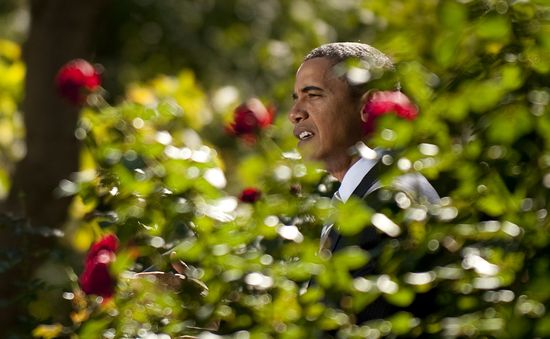
(Photo: US President Barack Obama makes a statement with college students and their families in the Rose Garden at the White House in Washington, DC, October 13, 2010, on the impact of the American Opportunity Tax Credit (AOTC). By Jim Watson/AFP/Getty Images.)

Obama’s Lost Narrative, Ctd

John Cole dissents:

The Chamber of Commerce is spending 100 million dollars this election, who knows how much of it from foreign funding because they refuse to say, all of it to attack Democrats. And in Sully’s world, it is the Democrats to blame for pointing this out. “Ignore those attacks, Obama! Be above it all!”

No. My point is that this shouldn't be a major focus of their message, sounds like whining, and because they have a stronger story to tell. But, as far as the Dish can tell, the Chamber of Commerce's foreign funding –which Think Progress is still yelling about – is no different than the foreign funding of other groups. Here's Jacob Sullum spelling it out:

Obama was referring to a ThinkProgress blog post reporting that the Chamber of Commerce receives revenue from affiliates in other countries. But as The New York Times noted, so do many other American organizations that are active in domestic political debates, "from liberal ones like the A.F.L.-C.I.O. and the Sierra Club to conservative groups like the National Rifle Association."

All these groups are legally required to keep such funds segregated from money they use to pay for political advocacy. The White House admitted it had no evidence that the Chamber of Commerce, which says "foreign money" represents 0.05 percent of its $200 million budget, has broken this rule.

"The president was not suggesting any illegality," insisted White House Counsel Bob Bauer. In other words, when Obama said "one of the largest groups paying for these ads regularly takes in money from foreign sources," he was not implying any connection between the ads and the money. He was just stringing sounds together randomly.

Sullum thinks the Democratic attack on the Chamber Of Commerce is xenophobic. Greenwald wants more funding transparency but nevertheless believes that the Democrats are being hypocritical. John Cole is upset that, in his words, the "Democrats are just supposed to sit around and get beat on, and if they fight back, they are out of bounds." But –setting the hypocrisy and xenophobia charges aside for a second – it's not at all clear that this line of attack is even effective. Here's one of Ben Smith's readers:

I'm not quite sure what the Democrats hope to gain by demonizing these folks, the money is not going to stop and the Democrats' attacks make for pretty bad optics, unless one is simply very anti-business. I guess they will lock up the G20 protesters' votes.

Sargent differs:

I don't have any idea whether the overall White House and Dem attack is working or not. But it seems questionable for folks to conclude already that it's a failure, especially since there isn't any empirical evidence to support that claim.

“Gallivanting Spatula”

Via Goldblog, a pretty hilarious review of words that Jews use that no one else does. When I saw the headline, I was a little worried at first it might be about my obsession with Sarah Palin's pregnancy stories. Still, I have to say I occasionally use the word "gallivanting." The English love it. But "appetizing" as a noun? I concede the point.

The GOP’s War With Climate Science, Ctd

Douthat notices an important wrinkle:

What’s interesting … is that if you look at public opinion on climate change, the U.S. isn’t actually that much of an outlier among the wealthier Western nations. … Europe’s political class, left and right alike, has worked to marginalize a position that it considers intellectually disreputable, even as the American G.O.P. has exploited that same position to win votes.

The debate over climate change isn’t unusual in this regard. On issues ranging from the death penalty to (at least until recently) immigration, America’s major political parties generally tend to be more responsive to public opinion, and less constrained by elite sentiment, than their counterparts in Europe. Overall, I much prefer the American approach, populist excesses and all. (It helps in this case, of course, that I’m deeply skeptical about the efficacy of climate change legislation anyway.) But there’s no denying that it's left the G.O.P. on the wrong side — and increasingly so — of a pretty sturdy scientific consensus.

 Ezra Klein largely agrees. Me too. We sure can argue about the best way to tackle the issue, if we can at all. But to deny flatly that it exists is not resisting elitist opinion, it is denying scientific fact. That's not the same dynamic as the death penalty. It's like assuming, oh, I don't know, that the planet was created 6,000 years ago and having your major leaders unable to point out in public that this isn't true. But, hey, it's Ross's party, not mine.