Here I am on Parker Spitzer, which may air sometime later this week. The episode was pre-empted by live coverage of the Chilean miners rescue. On DADT, I don't cut the president much slack:
My disappointment with the president after the jump:
Here I am on Parker Spitzer, which may air sometime later this week. The episode was pre-empted by live coverage of the Chilean miners rescue. On DADT, I don't cut the president much slack:
My disappointment with the president after the jump:
NASCAR?:
[David Okert Daniel Okrent] says it emerged in the South after Prohibition ended, when all the former runners of liquor needed new uses for their driving skills and fast cars now that they could no longer make a profit smuggling booze.
Dale Carpenter explains it:
Whether it takes the form of saying that some recruits will refuse to enlist, or that some personnel will not re-enlist, or that some will get heebee jeebees in the showers, or that some will not obey orders from gay commanders or share tasks and objectives with their gay comrades, it comes to the same thing. Gays are to be excluded, not because of their own merits, but because we fear that some people around them might not be able to handle the truth. It is not a judgment about gays at all, but about heterosexuals.
This dreary picture of heterosexuals is falsifiable. The available evidence, including ample experience in our own and other militaries, strongly suggests it is built on myths about heterosexual frailty and irrationality.
Or so suggests a new study:
Robert Pape, a University of Chicago political science professor and former Air Force lecturer, will present findings on Capitol Hill on Tuesday that argue that the majority of suicide terrorism around the world since 1980 has had a common cause: military occupation.
Pape and his team of researchers draw on data produced by a six-year study of suicide terrorist attacks around the world that was partially funded by the Defense Department's Defense Threat Reduction Agency. They have compiled the terrorism statistics in a publicly available database comprising some 10,000 records on some 2,200 suicide terrorism attacks, dating back to the first suicide terrorism attack of modern times — the 1983 truck bombing of the U.S. Marine barracks in Beirut, Lebanon, which killed 241 U.S. Marines.
"We have lots of evidence now that when you put the foreign military presence in, it triggers suicide terrorism campaigns, … and that when the foreign forces leave, it takes away almost 100 percent of the terrorist campaign," Pape said in an interview last week on his findings.
A reader writes:
The idea that this recession is over is a myth. A little more than two years ago, I left a pretty well-paying corporate job behind because it was making me miserable. I enrolled at the University of Wales, earned a Masters Degree, and returned home. Since then, I've held two jobs. The first, which I started a year ago, was a temp job doing pretty much what I'd been doing before I left, albeit for less money – but I took it because I needed money to start paying down my college loans. That job dried up in April.
After five months of being jobless (and unqualified for unemployment, since I hadn't held a permanent position), I recently started as an instructor at a junior college about fifty miles from where I live. It's a part-time job, and it doesn't pay much, but at least it's work. My financial situation is still in the toilet, but at least now I can see the top of the bowl. Thankfully, my parents have allowed me to stay at their house during this time, which has alleviated much of my financial burden. Unfortunately, that may not remain an option for very long.
My dad, who immigrated here from Ireland in the mid-'70s, is a butcher by trade, but, with my mom's help, he has run his own sausage-making business since I was born. A few years ago, he finally had enough clients to give up butchering and stake out his own claim as a wholesaler. He has about four or five times as many customers now as he did then, but their week-to-week orders are down, meaning he's having trouble making ends meet.
This morning, my dad, who will turn 63 next May and has problems walking thanks to some asshole who plowed into his car five years ago, told me that he's been applying for jobs as a courier or delivery man – the only things outside of butchering for which he's really qualified, since his only educational background is in some GED courses he took in the '70s. Meanwhile, to try to make ends meet, my mom, who turns 55 next week, has been desperately seeking her own second job. Because, aside from my dad's business, she hasn't held a full-time job since I was a baby, she is understandably filled with an immense amount of self-doubt. Three times this week, I've heard her quietly sobbing in front of the computer as she scours different websites, growing ever-more frustrated with the hoops through which many companies make candidates jump.
After the accident I mentioned, my dad's insurance company dropped them as clients. They have a different insurer now, but the premiums are astronomical – through no fault of their own, only through the fault of the afore-mentioned asshole. My little brother, who's finishing up his last year in college, has a crazy amount of food allergies, so they are completely paranoid about losing the health insurance for his sake. Had I the money, I'd help them out myself; but I barely have enough to meet my loan payments. Then this, which my mom just told me a few hours ago: For the first time in their lives, my folks are worried they're going to miss a mortgage payment because they simply don't have the money in the bank to pay it.
My parents aren't like those irresponsible people at which pseudo-libertarians point – the type who got in over their heads and now expect society's or the government's support. My dad worked for twenty years to build his business to a point at which it could be his last job; his hope was to sell the business in a few years in order to retire. But he's not even close to that; in fact, it seems like he's further away than ever. My parents have never been late on any bills. They work hard, pay their taxes, and are active members in the community. They've done everything that they were supposed to do. Similarly, I've done what I was supposed to do: gone to school, worked hard, gotten a good education, and decided to give back by teaching at a JC attended heavily by minorities. And yet, we're still drowning.
The recession isn't over; it's killing us. What's worse is that it appears to me that the American Dream isn't just, as punk rocker Ben Weasel put it, "an ugly fucking lie." The American Dream is nonexistent. When I see those who contribute nothing to society getting further and further ahead while my parents, whom I have seen work their asses off my whole life, drift further and further behind, I find that belief in the American Dream is like a belief in Santa Claus – a story told to kids to keep them in line.
Scott Morgan counters CBS:
If Prop 19 passes, the closest the federal government can come to interfering with it is to make their own arrests and carry out prosecutions in federal court. This works fine for making an example out of someone they don't like, but it hardly lessens the impact of a major change in state law. Marijuana would remain legal in the eyes of California police, and that's what counts. Just look at the medical marijuana situation, where the feds made some busts, but still failed to prevent a massive industry from forming, because the feds can't realistically take over the role of local law enforcement.
Today on the Dish, Andrew shook his head at the evolution of Goldberg on Israel. Paladino apologized but Andrew was unimpressed. We relived Paladino saying that gay marriage is like Hitler, while Valerie Jarret just blamed teenage suicides on a "lifestyle choice." Jonathan Chait and Matthew Yglesias toasted the Dish and Andrew treated himself to a a classic Trig relapse.
Andrew sighed over lazy legislatures and the culture that reelects them, whereas Matt Continetti and Matt Welch duked it out over tax cuts. The war raged in the air over Afghanistan, and Andrew condemned the right's inablitity to wake up to the realities of tax rate hikes. Andrew jumped in on Dana McCourt's disdain for the term illegal immigrant and we rounded up opinions on insider trading by congressional staffers.
Serwer bemoaned the left's drug attacks on Rand Paul, McCain didn't think he was pandering, and politics pimped itself out for paid speeches. Josh Green profiled Ron Paul in the new issue and Andrew believed his integrity, at least. Huckabee may be the biggest contender for 2012 according to Obama's folks, and Sarah was looking ever more stoppable.
Yglesias examined the Dutch marijuana model, and a child psychiatrist responded to readers about teenage pot use. Self-driving cars could speed up the electric car revolution, Aaron Sorkin somewhat clarified the female computer nerd conundrum, and for former bullies, It Gets Worse. An anniversary/ apnea recap of the view from your CPAP here, map of the day here, VFYW here, MHB here, quote for the day here, Google time sink here, creepy ad watch here, FOTD here, and beards in sports here.
–Z.P.
A reader writes:
You need to post this. It’s a very powerful speech last night from Ft. Worth City Councilman, Joel Burns.
Insider trading laws don't apply to Congress. The WSJ has done an analysis showing that some staffers seem well aware of that fact. Felix Salmon yawns:
The WSJ story is shot through with the implication that there's a big scandal here, but I don't see it. Instead, I see a lot of subtle rhetorical tricks, like the way in which the paper leads with a single profitable trade by a single staffer.
Daniel Indiviglio isn't so quick to dismiss the story:
Let's say a staffer were to have learned of an amendment to the health care reform bill that would adversely affect pharmaceuticals. Should she be allowed to sell short shares in Pfizer before the public learns about this amendment? Of course not. So there should be a law against it.
Staffers profiting from their insider knowledge may not have been a common occurrence in the past, but it could be in the future. Now that the government is more intimately involved in business than it has been in decades, there's more opportunity than ever for staffers to use such information for profit. Moreover, the Internet has made stock trading simple for even the most amateur of stock traders. It's frankly pretty bizarre that there would be any resistance in Congress to such a prohibition. As a method to prevent such behavior, it seems like a no-brainer.
Bainbridge says that these staffers may be breaking existing laws:
The Congressional staffers whose trading activity was discovered by the Journal … are potentially liable for their trading activity, assuming the other elements of the crime can be made out. The key point is that the staffers have no blanket immunity from those laws in the way that members of Congress do. The problem is that the gutless SEC has been even less willing to go after staffers than it was to go after, say, Madoff for all those years.
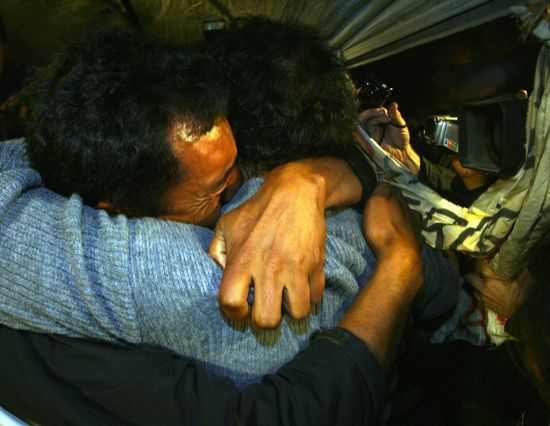
Alfonso Avalos (R), father of Chilean miner Florencio Avalos, and Wilson Avalos, brother of Florencio, embrace each other after Florencio was brought to the surface on October 13, 2010 following a 10-week ordeal in the collapsed San Jose mine, near Copiapo, 800 km north of Santiago, Chile. Avalos was the first of 33 to be lifted to the surface. By Hector Retamal/AFP/Getty Images.
 The Dish