Against The Burka Ban

Ilya Somin revisits the subject after its constitutionality was upheld by a French court:

European Muslims are, on average, less well integrated into the economies and societies of their countries than American ones are. Nonetheless, it is difficult to believe that European Muslim women’s full participation in society is somehow precluded by wearing veils. The French Constitutional Council offers no evidence whatsoever to the contrary.

I can understand the idea that covering one’s face poses a danger to public safety in some instances (e.g. — where security personnel need to carefully screen anyone who enters a particularly sensitive area). But a blanket ban on all wearing of veils in public seems manifestly disproportionate to any such legitimate security concerns. Here, too, the Council doesn’t give any evidence or analysis to justify the conclusion that a blanket ban on public veiling really is necessary.

Finally, while I agree that radical Islamism is a serious danger, banning veils is a poor way to combat it. Forbidding the wearing of veils in public won’t persuade any Muslims to reject radical Islamist ideas. What you wear on top of your head doesn’t determine what you believe inside it. The ban might, on the other hand, increase the attraction of radical Islamism to at least some wavering Muslims who are likely to be embittered as a result.

I agree. But I'm a fierce defender of religious liberty. The French Republic: not so much. It's also worth recalling that just as the Park51 controversy had a Catholic antecedent, so does the issue about public veiling. In Karen Armstrong's words:

In Victorian Britain, nuns believed that until they could appear in public fully veiled, Catholics would never be accepted in this country. But Britain got over its visceral dread of popery. In the late 1960s, shortly before I left my order, we decided to give up the full habit. This decision expressed, among other things, our new confidence, but had it been forced upon us, our deeply ingrained fears of persecution would have revived.

And backfired.

Democrats Defend The Drug War

Rand Paul is getting attacked from the right by the left:

Serwer is embarrassed by his party:

Kentucky has had one of the fastest growing prison populations in the country, having grown 45 percent since 2000, from 3,723 inmates to about 20,200 today. Corrections spending has gone up 54% in the intervening years, to a total of $553 million in 2009. It's gotten so bad that the Democratic governor of Kentucky, Steve Beshear pledged to reduce recidivism in order to lower incarceration costs just a month ago. It's hard to see how going after Paul for suggesting nonviolent drug offenders shouldn't be locked up serves that goal, but I guess know that a "libertarian" is running for Senate, Democrats are back to being drug warriors. 

Tax-Cut And Spend Rises From The Dead

Matt Continetti defends Rovism:

Republicans must be careful as they trim expenses. Otherwise they'll fall into the austerity trap.

In the austerity trap, Republican congressmen get so outraged over earmarks to fund studies of the mating patterns of red-bellied newts, they neglect legislation that would foster long-term growth. Deficit anxiety causes conservative lawmakers to rule out sensible policies like a payroll tax cut. A myopic focus on government spending causes Republican leaders to short-change the defense budget and renege on America's global responsibilities. The entitlement nightmare frightens GOP candidates into framing their economic agenda in strictly negative terms.

Matt Welch cries foul:

What should Republican lawmakers do instead? Roll back "nondefense discretionary spending to pre-TARP levels" (thereby locking in George W. Bush's 60 percent hike). Maybe plug in "a simple formula to contain spending" (so advanced–it's simple!). Add in a vague "tackling the entitlement problem," spiced with a promising if politically inconceivable "tossing Obamacare onto the scrap-heap and replacing it with policies that emphasize portability, choice, and competition," and voila! You can move on to the serious and more detailed business of cutting taxes.

The Evolution Of Goldblog

I note – in this critical period in which Netanyahu faces the crucial test of whether to extend a moratorium on new settlement construction, and in which the Obama administration is offering goodies to Netanyahu and Netanyahu is offering goodies to Avigdor Lieberman – that Goldblog's latest position on an issue which he once saw as crucial to Israel's survival is:

The reason I don't blog more about questions related to the peace process is that I don't think it will work, not in the foreseeable future, so I'm not sure why I spend any time at all parsing what is, after all, a theoretical question within the theoretical peace process.

His previous position was pretty much the same:

It won't work. Israel wants the settlements to be a subject of negotiation with the Palestinians, along with everything else — and not the subject of a preemptive concession –  and it seems that it is during negotiations (as President Clinton showed during Camp David) that the U.S. could best make the case against settlements, just as it is during negotiations that the U.S. could move the Palestinians away from their position on the so-called right-of-return.

But what on earth do the phrases "it doesn't work" and "it seems" mean? What they mean, as the paragraph above makes clear, is that the governing forces in Israel, and Israel alone, don't want it to work, and just don't want to concede anything on the illegal settlements before full negotiations. And if Israel doesn't want it to work, America has no business bringing any pressure to bear, or even incentives to coax, and if it all falls apart because of this, it will be Obama's fault, not Netanyahu's. You can see this coming a mile away. The hard core neocons will actually blame Obama; Jeffrey will merely throw up his hands and walk away. What almost no one in what Peter Beinart has called the American Jewish Establishment will do is actually back this president in pressuring Israel to take this last chance for a two-state solution. They could. And they would make a difference if they would. But so far, so meh.

There is, of course, no conceivable security threat to Israel from extending a moratorium on settlement construction for two more months, or any length of time for that matter, and the administration is offering lots of goodies to get this pathetically small concession from Jerusalem. And yet it is with this set of facts that Goldblog cites Aaron Miller:

The idea that the United States can pummel a close ally into accepting a deal that undermines its security or political interests is flat-out wrong.

"Pummel"?

What conceivable "pummeling" is going on here right now? Where is any credible threat to cease aid if Israel ends the moratorium? Or withdraw the UN veto? Or any actual credible acts of real pressure? It's all carrot and no stick so far, and there never can be a credible stick because AIPAC and its journalistic supporters are so brilliant at what they do – all of which is completely legitimate but, in my view, deeply mishuided and paranoid, and has distorted US foreign policy in exactly the same way the Cuba lobby has in a different context. America suffers and Israel inches ever forward to either an apartheid state or implosion.

But the Ur-post is so painfully conflicted, you have to read it yourself to see if you can figure out what Goldblog's position actually is, depending on which day of the week it is and which mood he is in (his words, not mine). His readers are as bewildered as I am. Yes, he is in a tough position as a liberal Zionist. But that's why it's so disappointing to see him revert to the classic position of the unsustainable, indeed fast deteriorating, status quo.

My best summary of the Goldblog evolution is: I am not against pressuring Israel, but we should never pressure Israel, well, it might be a good idea, but it won't work, because pressuring Israel means it won't work. Then, as if he senses this argument is, to put it mildly, unpersuasive, we get a weird throw-away line that 

I'm also suggesting that the entire peace process won't amount to much until the Palestinians resolve their civil war. 

So it's the Palestinians' fault now again! Thanks for clearing all that up.

The Pimping Of Politics

Ben Smith wonders how paid speaking gigs change politics:

Buried in its profile of Ann Coulter, the Times reports that she makes 90% of her income on paid speeches, and recently charged $25,000 to speak at the Wake County Republican Women’s Club in Raleigh.

Those hefty figures are a glimpse at what is, in some ways, the real economy of politics. Most of the people you see talking on television or quoted in stories — who aren't in elected office — make substantial parts of their livings giving speeches to private groups. Paid speaking, cleaner than lobbying, easier than the practice of law, cleaner than hitting up pension funds, well, safer than graft, has become the primary source of income for a broad range of political figures, beginning with Bill Clinton, who reported $7.5 million from paid speech in 2009.

Twenty years ago, Jake Weisberg outed the journalists who were following the corporate money on the speaking circuit as "buck-rakers." Now the journalists are upped by performance artists like Coulter. Cable news is where they pimp themselves. The actual whoring takes place elsewhere. Follow up here.

Paladino Says Sorry II

Judge for yourself. But what this incident really indicates to me is the total conflation of religion and politics. The speech Paladino gave was written in consultation with Orthodox Jewish rabbis:

Gay advocates were particularly incensed by a reference to homosexuality as “dysfunctional” in a draft of Mr. Paladino’s speech made public on Sunday. Mr. Paladino never delivered that remark, and in his letter, he explained that he had redacted the reference before the speech because he considered it “unacceptable.”

He has said it was included at the suggestion of Orthodox Jewish rabbis. On Tuesday, at a news conference in Albany, Mr. Caputo took responsibility for the appearance of the remark, saying he had cooperated with the Orthodox community in writing the statement. “The speech mistake is on me,” he said.

So a Republican candidate doesn't exactly pander to religious fundamentalists; he just asks them directly what they want him to say; and they effectively co-write the speech. This isn't pandering; it's fusion. That this occurs with Jewish fundamentalists rather than Christian fundamentalists is simply a matter of geography and demographics. What matters is that the GOP is increasingly not a secular political party, but a fundamentalist religious organization seeking political power.

Whatever It Takes

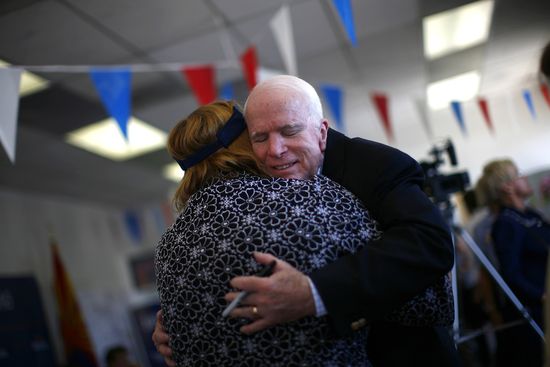
MCCAINEricThayer:Getty

"Neither party should be defined by pandering to the outer reaches of American politics and the agents of intolerance," – John McCain, February 2000.

McCain, this weekend:

Speaking at the 2nd annual Tucson Tea Party rally Saturday, McCain was greeted with a warm reception. And he proceeded to compliment the right-wing base for “changing America.” McCain also proudly celebrated the Republican accomplishments of obstructionism, borrowing a line from his former running mate Sarah Palin. “You know the President says that, quote, we’re the party of no,” McCain told the tea partiers. “No, we’re not the ‘party of no.’ We’re the ‘party of hell no.’” In his opening remarks, McCain also thanked Fox News for its strong support of Republican causes, endorsing Fox as “the best place to get your news.”

(Photo: U.S. Sen. John McCain hugs supporter Kathi Korth during a visit to a campaign office one day before Arizona's primary election on August 23, 2010 in Tucson, Arizona. By Eric Thayer/Getty.)

The Dish At Ten: Jonathan Chait

E-mails and posts are still coming in, so we are going to continue posting cheers and jeers semi-regularly throughout this anniversary week. To say I've been touched by them would be an understatement. Blogging is isolating in many ways, and when most of your interactions are debate-style, you can forget that many of your fellow-jousters actually even like you. In the classic House of Commons, there was a bar for the pols to patch things up after some brutal public fights – or the tea-room, or even the john. This week feels a bit like that – a friendly social truce in an ongoing intellectual argument. Here's Chait's addition:

[Andrew] cares deeply about politics, but politics, appropriately, isn't everything to him. That's a sensibility I've admired and sought to emulate. You can't go through life being angry at people for being wrong.

There's a line from the Godfather Part 2, in which Hyman Roth explains how we swallowed his anger at the murder of his friend Moe Green: "This is the business we've chosen." Opinion journalism isn't la cosa nostra, but it is a contentious business, and especially so opinion journalism blogging. I've always admired Andrew's ability to maintain, alongside his fierce, crusading opinion-mongering, a constant good cheer and capacity to keep his ideological crusades in their proper place. This is the business we've chosen.

I can't say Andrew wielded much of an ideological influence over me. But he influenced something that is more important than ideology.