"Ultimately, the blame on ‘process’ coverage lies with the elected officials. It’s amazing to me how little substance most elected officials will engage in. I think the unsatisfied partisan media critics would be wise to spend more time engaging policymakers than those charged with covering them,” – Chuck Todd.
Month: October 2010
A Jackass Halloween
Enjoy:
Standing Athwart The GOP Yelling Ugh I
Daniel Larison, someone more conservative than 99 percent of commentators you'll read, explains why he isn't excited about the prospect of a Republican surge during the midterms:
I find it hard to get enthusiastic about Republican gains this year because they are wholly undeserved, and because they seem more than likely to result in the re-empowerment of all the same people who supported and enabled Bush’s agenda as if nothing had happened… I assume that the activists who really are on the right track are going to be sidelined or marginalized at the first opportunity by a party leadership that is perfectly content to exploit their energy and then cast them aside.
The “Pledge to America” has already told us that this is what will happen. On the policy front, I am concerned that some things, such as the arms control treaty, will be scrapped in the wake of the election, and that wouldn’t be possible if it weren’t for the broad, near-universal hysteria about Obama’s foreign policy coming from movement conservative think tanks, pundits, and activists. Far from correcting for the foreign policy errors that helped drive them from power, the most influential movement conservatives have become even more misguided.
No Matter What, They Get More Power
After the FBI arrested a man for plotting to attack the Washington DC Metro – he signed on to an imaginary plot concoted by federal law enforcement – local transit police decided they may start searching passenger bags. Will Wilkinson reacts:
How does this make sense? The feds didn't unveil an unsuccessful terrorist plot. They unveiled a man's willingness to join a fabricated plot. But let us suppose that Mr Ahmed had signed on to an honest-to-goodness mass-murder conspiracy, and that this intrigue is now exposed and its principals rounded up. The chances of an attack are now higher or lower? There is now more or less reason for police to nose through the personal belongings of law-abiding citizens? I say: lower, less.
Here's the reasoning at work:
If we learn about a terrorist plot, it's evidence that police need more power so that they can keep us safer. A lack of intelligence about terrorist plots is evidence that police need more power to find out how safe we really are. A successful terrorist attack is evidence that police don't have enough power to fight terrorists. Whereas the successful arrest of a terrorist is either evidence that police haven't yet been given enough power to eliminate terrorism, or that the power we've given police is working and we should give them more power so we're even safer.
Regardless or facts, events, or reality, the right answer is always that we're to give up a bit more liberty, because, you know, terrorists.
NRO On Marijuana
I missed this blast of sanity from Conrad Black yesterday. Not everyone has forgotten WFB.
The View From Your Window (At My Window)
We pray that posting this doesn't cause a tear in the Dish time-space continuum:
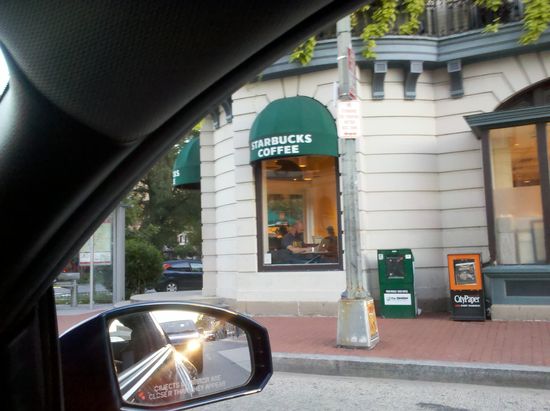
Washington, DC, 6.30 pm
The GOP’s Fiscal Fraudulence, Ctd
What Bombing Iran Would Actually Mean
Stratfor’s George Friedman is a realist on what it would really mean:
Destroying Iran’s nuclear capability does not involve a one-day raid, nor is Iran without the ability to retaliate. Its nuclear facilities are in a number of places and Iran has had years to harden those facilities. Destroying the facilities might take an extended air campaign and might even require the use of special operations units to verify battle damage and complete the mission. In addition, military action against Iran’s naval forces would be needed to protect the oil routes through the Persian Gulf from small boat swarms and mines, anti-ship missile launchers would have to be attacked and Iranian air force and air defenses taken out.
This would not solve the problem of the rest of Iran’s conventional forces, which would represent a threat to the region, so these forces would have to be attacked and reduced as well. An attack on Iran would not be an invasion, nor would it be a short war. Like Yugoslavia in 1999, it would be an extended air war lasting an unknown number of months.
There would be American POWs from aircraft that were shot down or suffered mechanical failure over Iranian territory.
There would be many civilian casualties, which the international media would focus on. It would not be an antiseptic campaign, but it would likely (though it is important to reiterate not certainly) destroy Iran’s nuclear capability and profoundly weaken its conventional forces. It would be a war based on American strengths in aerial warfare and technology, not on American weaknesses in counterinsurgency. It would strengthen the Iranian regime (as aerial bombing usually does) by rallying the Iranian public to its side against the aggression. If the campaign were successful, the Iranian regime would be stronger politically, at least for a while, but eviscerated militarily.
This doesn’t even account for the impact of another Western attack on a Muslim nation and what that would do for Jihadist recruitment or wider terrorism. For all the differences between Shia and Sunni, and the very complicated shadings of Islamist and Jihadist coalitions and factions, a US attack would surely serve to unite and corral the enemy at home and abroad.
Friedman posits nonetheless that a successful campaign could help Obama politically. I don’t believe the president is that cynical or that reckless. To entertain what would amount to a second term Bay of Pigs combined with a Cuban Missile Crisis is not exactly good political judgment. As in the economy, Obama may well be remembered for what he managed to prevent rather than what he accomplished. But prudent restraint and structural change are often much deeper achievements than, say, the reckless, deeply damaging agenda of the Bush-Cheney years.
It’s the difference between morally responsible statesmanship and reckless, fear-driven politicking.
Defending Christine O’Donnell
Gawker has an anonymous, and vile, kiss and tell, which has not a smidgen of journalistic justification and is merely a cowardly, brutal and misogynist invasion of privacy (hence no link). It was also apparently paid for:
(Gawker's editor told a Yahoo reporter that the site paid in the "low four figures" for the O'Donnell story).
Ashley Herzog explains:
So Christine O’Donnell once dressed up in a cute, non-revealing ladybug costume, and Gawker got some asshole to claim she slept in his bed but didn’t let things progress beyond kissing. Even if this story is 100% true (and I have my doubts)…so what? As Amanda said, the only thing this story proves is that O’Donnell is capable of having some good, clean fun.
And maintaining her principles, and demonstrating her non-hypocrisy. Seriously, it's a disgusting piece of page-view whoredom. Weigel is on the same page:
I'm aware that Christine O'Donnell's public commentary career started with her going on TV to talk about how kids shouldn't have sex or masturbate before marriage. But not only has she never called for that behavior to be punished legally, I'm unaware of her ever coming out against the actions mentioned here — which, let's remember are drinking, fooling around, and not having sex. There is no hypocrisy being exposed here. This is anonymous creep shaming a woman who wouldn't sleep with him, and doing so because she's a celebrity now.
Marriage Equality Would Lead To “Kids Raised In Warehouses”
Yep, that's the latest anti-gay bile coming from congressman Steve King. Chait takes the Sparta reference and runs with it.
 The Dish