Dutch Tea Party

Ferry Biedermann reports on the rise of Dutch politician Geert Wilders, "the brash, provocative, and peroxide-blond political wunderkind MP, and his right-wing Party for Freedom":

To give an idea of the tone of his discourse in the Netherlands, he has called for a "head rag tax" on women wearing headscarves. He favors banning the Quran, wants to close Muslim schools but not equivalent Christian or Jewish ones, wants to force immigrants to sign "assimilation contracts," and wants to include the "Judeo-Christian character" of the state in the constitution.

But some Dutch analysts warn that it is a mistake to "blacken" Wilders's name too much or lump him with fascism or Nazism. "For one, he's not anti-Semitic," says Alfred Pijpers of the Clingendael Institute of International Relations in The Hague. Israeli officials have indeed privately commended him as "a friend of Israel." Pijpers says that Wilders has more in common with the Tea Party activists in the United States than with any old-style European right-wing party, because he can't really be classified as either right-wing or left-wing.

Life Is Too Sweet

Carolyn Kellogg excerpts a letter Jack Kerouac wrotes in 1961 which was auctioned off last Monday at Bonhams and Butterfield:

I can just see the shabby literary man carrying a "bulging briefcase" rushing from one campus to another, one lecture club to another, nodding confirmation with his hosts that he is right, hurrying to the next town … a whole gray career of proving himself to others, to as many as can hear him, that he was right … till finally people say: "Here comes the self-prover again, O dear … bring out the papers and the canapes."

This my friend is what I will become if I accept all lecture offers, TV appearances, radio interviews and start arranging with reviewers and critics who want information and my books through me, a great long lifetime in a briefcase proving my work and my work itself stopped dead at the level where I took to proving myself. So, I say, life is too sweet to waste on self propaganda, I quit self promotion, I enter my page.

The longer I live, the more I feel this way too.

The Voice Of Poetry In The Conversation Of Mankind

Stuart Kauffman believes "science is born of metaphor" and needs poetry just as much as poetry needs science:

On the dominant view of the mind, the mind is a Turing machine. A Turing machine is utterly definite.  … Our minds are algorithmic.  Artificial Intelligence is the offspring of this view. On it, science itself is an algorithmic activity needing no metaphor, the signal case of the fully definite, the  mind is nude of rich non-computable allusions, notwithstanding the very interesting connectionist strand in AI.

But is the mind algorithmic?  I think not, and think we need poetry to unite the Two Cultures [with science] and rediscover our deeper humanity.

Revolutionizing The Republic Of Letters

Library

Robert Darnton wants the U.S. to follow in the steps of the Netherlands, France, and Japan by building its own National Digital Library:

The ambition behind this project goes back to the founding of this country. Thomas Jefferson formulated it succinctly: “Knowledge is the common property of mankind.” He was right—in principle. But in practice, most of humanity has been cut off from the accumulated wisdom of the ages. In Jefferson’s day, only a tiny elite had access to the world of learning. Today, thanks to the Internet, we can open up that world to all of our fellow citizens. We have the technical means to make Jefferson’s dream come true, but do we have the will?

(Image from the portable libraries that were once supplied to Michigan's lighthouse keepers)

“A Reality We Can All Agree On”

Tim Challies asks what Wikipedia and the wiki model mean for the concept of truth, for Christians:

Wikipedia says that knowledge flows horizontally from human-to-human and that truth is the sum of this knowledge; the Bible tells us that knowledge and truth find their source in God and that all truth flow vertically from him to us. At the heart of the wiki model is a new conception of truth—truth is what we agree upon.

Religious truth, it seems to me, is both. It is revealed from above and yet must be communicated and discussed and reasoned through by human beings who are definitionally incapable of understanding it fully. Any attempt to prefer one method over another will fail. But the current Pope would disagree. He alone knows and our job is to obey. The Second Vatican Council – and Cardinal Newman – had a different vision, and, in my view, the right on.

Humans As Objects

Kathryn Crim tries to understand life in the San Quentin prison, while teaching there:

Teaching often facilitates a relationship with one’s own ignorance: only by confronting the limits of my knowledge can I begin to ask questions, begin to imagine how questions will be asked of me. This is a confrontation I have learned to accept readily, as a useful practice, a gentle intellectual and spiritual stretching in the safe and narrowed context of a classroom. But outside the door of the San Quentin classroom is a prison yard, and beyond that, stairways that lead to cellblocks and dorms where thousands of men live literally stacked against each other.

 I do not understand how to live out there. I don’t have to. But more significantly, I don’t know how to think about what a life there means. For some hours after teaching—sometimes days—I can’t reconcile the scale of my daily existence with the scale of a world which has brought about this other place.

Religion And The Beating Of Homosexuals

6a00d83451c45669e20120a5e9b5b8970b-500wi

Cody J. Sanders argues anti-gay bullying is a theological issue:

If this were a hostage situation, we would have dispatched the SWAT team by now. And in many ways, it is. Our children and teenagers are being held hostage by a religious and political rhetoric that strives to maintain the status quo of anti-gay heterosexist normativity. The messages of Focus on the Family and other organizations actively strive to leave the most vulnerable among us exposed to continuous attack. The good news is that we don't need a SWAT team. We just need quality education on sexuality and gender identity in our schools and more faithful and courageous preaching and teaching in our churches.

I don't think the teaching can always be so easily equated with violence itself, but I do think indirect rhetorical responsibility is real. The following, for example, was written in 1986 by a man who is currently the Pope:

The proper reaction to crimes committed against homosexual persons should not be to claim that the homosexual condition is not disordered. When such a claim is made and when homosexual activity is consequently condoned, or when civil legislation is introduced to protect behavior to which no one has any conceivable right, neither the Church nor society at large should be surprised when other distorted notions and practices gain ground, and irrational and violent reactions increase.

My italics. Here, in his 1986 "Letter On The Pastoral Care Of Homosexual Persons," the current Pope is clearly saying that the gay rights movement is responsible for violence against homosexuals and that if gay rights advance, we should not be surprised when "irrational and violent reactions increase". This shifts the moral responsibility for violence from the thug to the victim. And when that message is sent from the very top of the church, those far less scrupulous can find moral justification for torture, beating and murder.

Gladly, Ratzinger is not the only voice in the church on anti-gay violence. Catholic theologian M. Shawn Copeland  via Cody Sanders:

“If my sister or brother is not at the table, we are not the flesh of Christ. If my sister’s mark of sexuality must be obscured, if my brother’s mark of race must be disguised, if my sister’s mark of culture must be repressed, then we are not the flesh of Christ. For, it is through and in Christ’s own flesh that the ‘other’ is my sister, is my brother; indeed, the ‘other’ is me…”

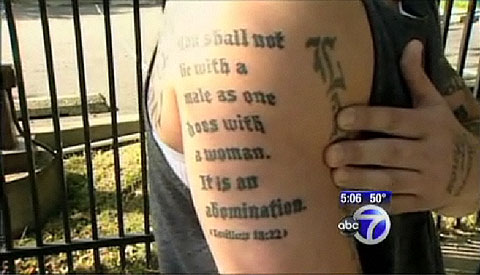
More context on the image above here and here. The tattoo was worn by a friend of a man who beat a homosexual to the point of a fractured jaw, rib fractures and a lacerated spleen. The beating was captured on tape.

“Subtle Glimpses Of Magic”

DARK SIDE OF THE LENS from Astray Films on Vimeo.

Choire Sicha hates your beautiful, digitally enhanced pictures and video effects. But he likes the video above because it's actually about something:

These are romantic and really somewhat infantile image techniques. They're childish and nostalgic. They're about sunny days and buzzing bees and reading books on a porch, and about road trips and romanticizing urban grime and being oh so gently alienated.

And really, it's gross. …

Online at web resolution, though, can you tell the difference between film effects and digital effects? Sometimes, yes, you can! That's because the actual analog film effects aren't as "interesting" as the quicky digital ones. They aren't as thrilling to the eye. They're not as cheaply emotionally evocative. They're just pictures.

Arcs Of Time

Alva Noë explains why habits are a curse:

How do you count time in a marriage? In a career? In a research project? What is the measure of time during an illness? Not seconds, minutes, hours, days.

So now we come to the crux: time goes faster as you get older, but this is because, as a general rule, by the time we are older, we have settled in on the story lines and narrative arcs by which we structure our lives. …

Want to live forever? Break your habits. Do things you don’t know how to do and foreswear the routine.