A fall film preview as seen through a conservative's eyes. Can you name this one?
A mountain climber rescues himself, without government assistance.
A fall film preview as seen through a conservative's eyes. Can you name this one?
A mountain climber rescues himself, without government assistance.
The Urbanophile reacts to the video, posted above, about New York City improvements to transit and public space:
What I’d like to highlight is how with all these initiatives, the sustainability angle is actually downplayed. If you listen to Mayor Bloomberg and Jannette Sadik-Khan talk, you hear them talking about making tangible, near term improvements in quality of life, safety, and bettering business conditions in the city. In short, it’s not about doing something to save the world or because it’s the right thing to do. It’s about doing them because they make sense for the city and New Yorkers.
Obviously New York is a unique place and these ideas can’t be lifted and dropped just anywhere. Other cities will continue to require a more prominent role for the automobile, for example. But the attitude of asking what we can do right now, today to create a safer, more livable city that is a better place to do business is one any city can take to heart. I hope America’s other metropolises are listening.
Brian X. Chen sorts out the mass of studies claiming our interactions with the internet are damaging our brains:
[Neuropsychologist Vaughan] Bell points out that multitasking is hardly a problem of the digital age -– we’ve been doing it all along. We can dribble a basketball while running, jot down notes while listening to a lecture, and jog through the park while listening to music.
“If you think Twitter is an attention magnet, try living with an infant,” Bell said. “Kids are the most distracting thing there is, and when you have three or even four in the house it is both impossible to focus on one thing — and stressful, because the consequences of not keeping an eye on your kids can be frightening even to think about.”
(Kids are indeed distracting: A British study found that for drivers, the distraction of squabbling kids can slow down brak-reaction times by 13 percent — as much as alcohol.)

"Fast Foods: A Rap Rondeau" by W. D. Snodgrass first appeared in The Atlantic in April, 2003:
With fast foods you've got to feast since you can't fast—
In next to no time you feel famished, though
You're looking paunchy, fat-haunched and flab-assed
And by now the force-fed figure you've amassed
Hamstrings your frame. Getting enough comes slow
With fast foods.Like fast fucking. Simone Weil warned: we know
Appetites from addictions by an acrid contrast
In their satisfactions: that is, by how long they last.
You can get too much bread; there is no
Such thing as enough cocaine. Hungers turn vast
As lunar landscapes where you range, aghast
At your own emptiness. With time, those faux
Fixes that should fill lust's vacuums cast
-rate you: both flesh and flesh's cravings grow
With fast foods.
(Image from mechanically separated meat found in many mass-produced chicken nuggets, but no longer used in McDonald's McNuggets.)
Mike Albo reviews the new reality TV show featuring gay men in New York City:
I suppose in some way "The A-List" is groundbreaking. The series shows that no matter what sexuality you are, you have been infected by the media-soaked bizarro world of American life in the early millennium. Like the "Real Housewives," "The Bachelor" and any other show that features hot tubs, spray tanning and mansions with curved driveways, "The A-List" takes outdated markers of glitzy life in the '00s before the financial crash and repackages them as an aspirational consumerist lifestyle we can watch from our Ikea-decorated living rooms. This time it's gay men, living in fabulous, increasingly unreal gay ghetto bubbles.
I only watch this kind of stuff on The Soup. It made me retch. The idea that this represents gay life in any conceivable fashion is preposterous; the idea that some might mistake it as such, in these times, dangerous.
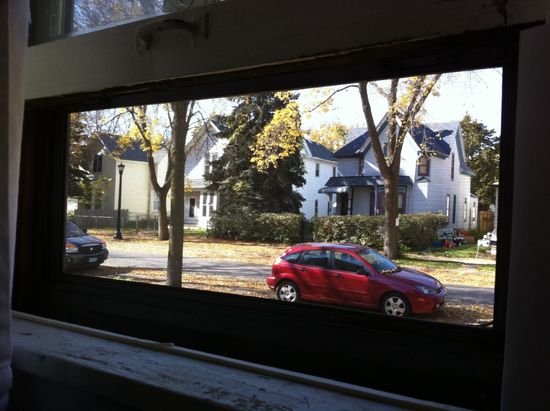
Minneapolis, Minnesota, 12 pm
Eileen Reynolds interviews the great Alex Ross about his new book, Listen To This, on trying to find something new to say about Mozart. Over at 3QD, Colin Eatock outlines one of many warning signs of troubling times for classical music today:
The use of classical music in public places is increasingly common: in shopping malls, parking lots, and other places where crowds and loitering can be problems. The TTC is by no means the only transit service to use the technique: in 2005, after classical music was introduced into London’s Underground, there was a significant decrease in robberies, assaults and vandalism. Similar results have been noted from Finland to New Zealand. …
As a classical music lover, I’d like to believe that my favourite music has some kind of magical effect on people – that it soothes the savage breast in some unique way. I’d like to think that classical music somehow inspires nobler aspirations in the mind of the purse-snatcher, causing him to abandon his line of work for something more upstanding and socially beneficial.
But I know better. The hard, cold truth is that classical music in public places is often deliberately intended to make certain kinds of people feel unwelcome. Its use has been described as “musical bug spray,” and as the “weaponization” of classical music.
A night at the fair:
State Fair – Twixtor Test from Robert on Vimeo.
A GOP Ohio candidate belonged to a club that enjoyed wearing Nazi uniforms and celebrating the Third Reich's military prowess. I kid you not. Josh has pictures of the dude in full Waffen SS drag. And, yes, he's a Tea Party favorite.
David L. Ulin interviews Phillip Roth about old guys writing about cataclysm, his new book Nemesis, and how he taught himself to entertain on the page:
So for me, writing is a performance. "Portnoy's Complaint" was a performance. When you’re an actor who gives a performance, you have a false wig and a false mustache and a crooked back, and when you go backstage you take off those things and then you go out into the street and be yourself. But the problem for a writer is that he can’t take off those things, so when he goes out into the street it looks like that’s the same guy.
Except if you're a blogger.
 The Dish