The Hubris Of Neuroscience

James Garvey interviews Wittgensteinian philosopher Peter Hacker on how infatuated our culture has become with neuroscience:

We are prone to think that if there’s a serious problem, science will find the answer. If science cannot find the answer, then it cannot be a serious problem at all.

That seems to me altogether wrong. …[I]n the current neuroscientist’s view, it’s the brain that thinks and reasons and calculates and believes and fears and hopes. In fact, it’s human beings who do all these things, not their brains and not their minds.

Is Islam Incompatible With Democracy?

Was Christianity, not so long ago? Jan-Werner Müller draws a historical parallel:

There is little evidence … that the Vatican consistently steered the development of Christian Democracy, or that the ultimate accommodation of Christian Democratic parties to democratic politics was driven by the Vatican’s decisions. These parties developed in ways that were not intended by the Vatican, their leaderships could not be controlled from above, and their programs often veered more to the left than the Church desired, especially under Pius XII.

Christian Democracy, particularly after 1945, was the creation of political entrepreneurs such as Don Sturzo and savvy strategists such as West Germany’s first postwar Chancellor, Konrad Adenauer. To the extent that churchmen were directly involved, they were members of the lower clergy or of what in Italy was often called the proletariato di chiesa (“proletariat of the church”) .

The Vatican would eventually endorse democracy unequivocally, but only after decades of Christian Democratic practice and only after renouncing its transparent sympathies for authoritarian Catholic leaders such as António Salazar in Portugal and Francisco Franco in Spain.

A Poem For Sunday

LeavesMattCardyGettyImages

"Not My Leg" by David Rothman first ran in The Atlantic in June of 1997:

Not my leg
Not my leg,
My lean, strong leg.
Choose any other part,
But please don't start
With my lovely leg.
I'd look bad with a peg.

Not my hand,
My articulate hand.
Please don't let it
Get torn or shredded.
Writing this book
Would be hard with a hook —
You must understand
I need my hand.

Not my eyes,
Dear God, not my eyes.
Don't poke them out
So I grope about
Like Homer, Milton, Joyce.
If you have to be blind
To have such a voice,
I find
I want my eyes.

Not the urethra, not the anus,
The avenues that meekly drain us.
At least if they block, or get infected,
Please let it be quickly detected,
So a minimum of me gets cut.
Leave them alone,
My necessary thrones
Of pleasure and smut.

Not my body, my only body.
I know that the construction's shoddy,
Not built to last —
Someday it will lie in the past —
Still, I cannot restrain myself
From praying for my own good health,
Which some denying part of me
Believes should last eternally,
Although that only could hold true
For something out of nature's view,
And not my body, not my body.

(Photo by Matt Cardy/Getty Images) 

The Spiritual Center

AGNOSTIC

Reza Aslan praises Michael Krasny’s new book, Spiritual Envy:

Pity the poor agnostic these days, caught in the middle of an ever-widening gap between an increasingly assertive religious fundamentalism on one side, and on the other a new brand of atheism whose dogmatic certitude and zealous proselytizing make it appear more fundamentalist by the day. Where in the conflict between these two competing claims of absolute certainty—religious and scientific—is there room for the person willing to throw his hands in the air and say simply, “I don’t know?” …

Krasny’s new book, Spiritual Envy, is essentially an agnostic manifesto: an eloquent and deeply personal journey to find some kind of spiritual center in what has become an increasingly polarized debate about the role and function of religion in America.

A Big Week

With a record 304 separate posts, the Dish racked up 1.3 million visits/sessions in a week. Last month, saw us break 1.2 million unique visitors, and 4.5 million visits/sessions.  By adding the read-on feature, we've cut down on our page views a lot, but believed it would easily be a net plus, as our regular readers would find more to read, and more easily. Thanks for showing up every day. And thanks for the countless links, tips, suggestions and emails.

Worshipping Humanity

Mary Midgley uses the philosophy of Auguste Comte, among others, to refute Hitchens' claim that "religion poisons everything":

Many people, no doubt, agree with Hitchens. But Auguste Comte, the founding father of modern humanism, would not have been one of them. For him, "humanism" was a word parallel to "theism". It just altered the object worshipped, substituting humanity for God. … He thought – and many others have agreed with him – that the trouble with religion was simply its having an unreal supernatural object, God. Apart from this, the attitudes and institutions characteristic of religion itself seemed to him valuable, indeed essential. …

These precepts, however, did not work out easily. Comte's new Christian-like institutions withered like alien vines once they were applied to their new objects, even though he carefully policed them and trained his priesthood in the newly-discovered skills of Sociology.

I once saw the still extant Comtian temple in Paris, a tidy little Victorian church with round (not Gothic) arches, its walls lined with statues of the Saints of Humanity – Plato, Newton, Shakespeare, Beethoven. I asked its gloomy concierge whether she thought anybody ever worshipped there but she replied, "Nobody. I think, never."

Why would anyone worship Plato when they could read him?

The City From Above

12-LA-DAY

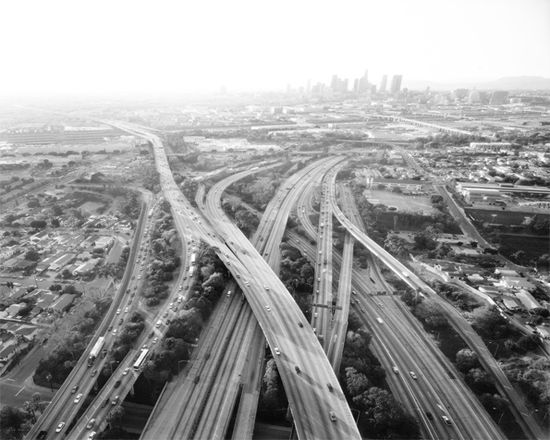
Lawrence Weschler interviews photographer Michael Light on his new book LA Day/LA Night, shot from the air:

ML: One of the things I learned after doing the night work was that whatever one might think about L.A., it is actually something else. It’s far more than one’s cheap and hackneyed preconceptions. It shifts constantly. Color work on an overcast day; the difference in seasons; puffy Hudson River School clouds in between spring rainstorms versus late-fall harshness—it’s startling. …

LW: It reminds me of an L.A. cinematographer who once said to me, watching the sun setting and all the changes in the light, “God, the effects that guy gets with just one unit.”

Hallmark Christianity

Scott Nehring rails against the saccharine state of "Christian films" today:

The term Christian film has become synonymous with substandard production values, stilted dialogue and childish plots. Why is Christian film no more than a side note to modern culture? Why are Christians left behind?…

Rather than developing organically, the average Christian film is more pushy and sanctimonious than the global-warming agenda movies. Violence is almost non-existent, salty language never happens, unmarried people never struggle with lust and evil is never very bad, because showing various forms of sin is not allowed. By movie’s end, everyone is converted with no residual issues. Life is reduced to an after-school special with prayer thrown in for good measure. For me, this is where the dry heaving begins. …

It is a tough argument to think modern Christians cannot handle a simple kiss or rough language when God allowed Joshua to slaughter thousands behind the walls of Jericho. .. Christian artists cater to us, give us what we want, what we prefer, and Christians’ expectations have tended to not stress biblical truth, moral clarity or technical achievement, but a watered-down, unrealistic view of the world.

When faith is a kind of neurosis to protect us from modern reality – which a lot of fundamentalism is – its cultural artefacts have to create an alternative reality as well. So we get Hallmark Christianity – that'll make you richer and happier! Nehring understands what the problem is:

the first step toward establishing the groundwork for a vibrant, relevant cultural movement based on scriptural thought is to stop producing “Christian films” or “Christian music” or “Christian art” and simply have Christ-followers who create great Art.

The Face Of Philosophy

ThePhilosophers

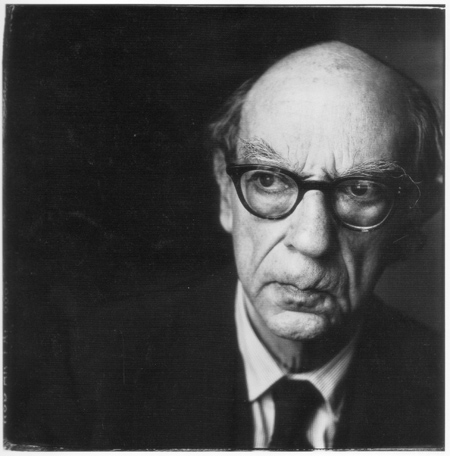
Steve Pyke has photographed more than 200 philosophers over the last 20 years:

Most philosophers have spent their entire lives in intense concentration, developing and defending lines of argument that can withstand the fearsome critical scrutiny of their peers. Perhaps this leaves some mark on their faces; to that I leave others to judge.

His NYT gallery is here. His older personal website galleries are here and here.

(Image of Sir Isaiah Berlin, London, 14 June 1990 )