This one's for Kenny and Gerald. Or how Fox 2.0 will one day deliver the news. A little racy, so below the fold:
This one's for Kenny and Gerald. Or how Fox 2.0 will one day deliver the news. A little racy, so below the fold:
Kay Ryan's poem, "This Life" first appeared in The Atlantic in April, 1993:
It's a pickle, this life.
Even shut down to a trickle
it carries every kind of particle
that causes strife on a grander scale:
to be miniature is to be swallowed
by a miniature whale. Zeno knew
the law that we know: no matter
how carefully diminished, a race
can only be half finished with success;
then comes the endless halving of the rest —
the ribbon's stalled approach, the helpless
red-faced urgings of the coach.
Nige fawns over Ryan, as her poems "say what they have to say, do what they have to do, with such economy of means and simplicity of expression that there is little, if anything, to explain."
In a rather enjoyable rant, Garth Risk Hallberg lets loose on Atlantic reviewer B.R. Myers and his review of Freedom in particular:
In his dyspeptic disregard for what might be amusing, enticing, or appetizing about the world we live in – his inability, that is, to read like a writer, or write like a reader – B.R. Myers has placed contemporary literature in toto beyond his limited powers. He offers us, in place of insight, only indigestion.
Hugh Hart interviews director Chris Morris about the movies extremists love, his early career in satirical radio, and his film Four Lions, which opened Friday. The film's trailer, above, went viral months ago:
“This film understands jihadists as human beings and understands human beings as innately ridiculous,” he said. “Within that context, terrorism is about ideology, but it’s also about imbeciles.”
This is among the best anti-Jihadist propaganda pieces out here. Because the one thing Jihadists desperately need is to be taken too seriously.
Meredith Blake interviews Jill Lepore on her new book, The Whites of Their Eyes: The Tea Party's Revolution and the Battle Over American History:
The only lesson history teaches, in the end, is humility. Everyone who has written about the Tea Party this year will eventually be proven wrong. This is a diffuse and dynamic movement. Yes, its version of American history is quite strikingly narrow. And, yes, founding a politics in that history looks to me decidedly anti-pluralist, although perhaps even to see it that way is to get it backwards: it’s an anti-pluralist politics that has gone in search of a history.
Presumably, after [the election], Tea Partiers will think more about governance. Maybe their style of governance will prove more pluralist than their account of the past. I sure hope so. I would like to be proven wrong sooner rather than later.
Earlier coverage of Lepore's book here. I don't think the spirit of this sprawling movement has anything to do with governance or governing. It is its opposite, which is why it is incarnated most effectively in talk radio hosts, Malkinesque bloggery, and Fox News shows. It is revolutionary in intent and reactionary in aspiration. Or as David Bromwich puts it in the NYRB, a core aspect of the Tea Party's message can be found
in lyrics written and sung with a yell by Martina McBride, which Hannity plays to open every half-hour:
Let the weak be strong, let the right be wrong
Roll the stone away, let the guilty pay, it’s Independence Day.The plot of the song casts a garish light on the words of that refrain. A daughter is telling how her mother heroically murdered an abusive husband by burning down their house, with him in it, on the Fourth of July. The state, in this vision of things, is the abusive father, and its power to hurt the mother and daughter must now be destroyed.
Barack Obama grew up thinking government the most natural thing in the world. These are people who think government unnatural.
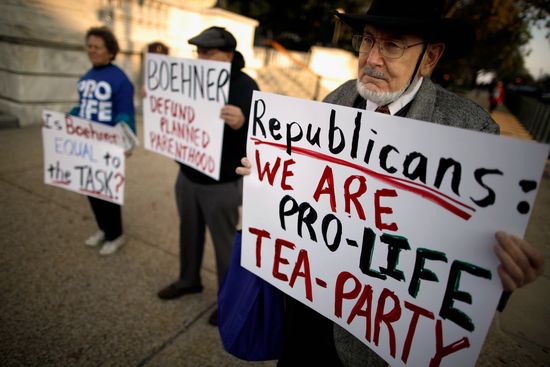
(Image: A handful of anti-abortion demonstrators stands outside the Cannon House Office Building on Capitol Hill on November 5, 2010 in Washington, DC. The demonstrators demanded that House Minority Leader John Boehner (R-OH), the presumed speaker of the House, pass aggressive anti-abortion legislation or they will find candidates to challenge the Republican leaders in the next primary elections. By Chip Somodevilla/Getty Images)
“If you look at the U.S., you look at who we’re electing to Congress, to the Senate—they can’t read. I’ll bet you a bunch of these people don’t have passports. We’re about to start a trade war with China if we’re not careful here, only because nobody knows where China is. Nobody knows what China is," – New York Mayor, Michael Bloomberg.
My kind of peeps. Heather Havrilesky salutes HBO's "Bored To Death" for accurately portraying writers:
One of the most pathetic (and therefore also one of the most accurate) depictions of the writer's life ever to grace the small screen, "Bored to Death" quite appropriately presents writing as the choice of the wilty, self-involved narcissist, the sort of self-pitying loser who encounters impossible deadlines, ambivalent girlfriends, disrespectful editors and oppressive corporate publishing overlords with the same flavor of whiny disbelief. To the random hardworking surgeon or lawyer or business professional on the street, such a character might appear the epitome of ineffectual hipster solipsism. To the writer (or to the aspiring artist, or to the oppressed creative drone, yearning to breathe free), though, such a character seems downright heroic.
A reader writes:
You have argued passionately the case for marijuana legalization (which I agree with), but it made me think of your arguments for the health insurance bill; it's a similar case (individual freedoms vs. collective good) but you argued exactly the opposite case (essentially: the benefits of forcing people to buy health insurance provide enough societal good to outweigh the rights of the individual to not be insured).
I'd be interested in why you view this issue differently than other issues, and where you see the line drawn in which personal freedom should be constrained in the interest of the collective concerns/needs.
First off, we already guarantee emergency room healthcare for those who choose not to be treated or to get insurance. It seems to me that once you have conceded that principle, and are not going to let people die hideous or long deaths alone or in the streets, then the collective costs clearly authorize a collective solution that would be more humane and cheaper.
I suppose someone who smokes pot might, in a haze, drive a car and crash; or fail to show up at work regularly; but Prop 19 made stoned driving and working illegal; I cannot see anything like the collateral costs of lacking all health insurance. Another writes:
Look, I'm with you on pot legalization, but as for how we approach legislating plants, what we do with pot isn't actually all that unusual. I've lived in Georgia for almost two decades, and we have this plant called Kudzu, the Plant That Ate The South. Most people are probably familiar with it, and as I understand it, it is illegal to intentionally grow it or to allow it to grow wild on your property. Because it spreads and devours.
I read an article yesterday about something called the Tonka Bean, apparently all the culinary rage out west, but I hadn't heard of it. It's illegal in the US because it contains a compound that has been shown to cause liver damage in rats. But tasty — like a vanilla caramel mouthgasm! Or so the article suggested. Some distributors have been busted for supplying it to restaurants. Ackee is a Jamaican fruit tree producing this awesome, potato-like fruit (but with some tang to it — it's really quite good). Cultivation is restricted in the US because the unripe fruit is toxic. I can only find it imported, at about $8 a can, but talk about a pleasure-inducing plant.
All I'm saying is, pot's not the only plant we regulate. Not even close. And it's not the only plant we ban. And it's certainly not the only plant we derive pleasure from and which we've created laws against.
I've been unable to find any online sunstantiation that kudzu is actually illegal in some states, rather than an invasive species, with some great medicinal properties. I don't think very toxic plants or beans are an applicable case, or we'd have a war on nutmeg.
"There are multiple people being paid by Fox News to essentially run for office as Republican candidates. If you count not just their hosts but their contributors, you're looking at a significant portion of the entire Republican lineup of potential contenders for 2012. They can do that because there's no rule against that at Fox. Their network is run as a political operation. Ours isn't. Yeah, Keith's a liberal, and so am I. But we're not a political operation — Fox is. We're a news operation. The rules around here are part of how you know that," – Rachel Maddow.

You have until noon on Tuesday to guess it. City and/or state first, then country. Please put the location in the subject heading, along with any description within the email. If no one guesses the exact location, proximity counts. Be sure to email entries to VFYWcontest@theatlantic.com. Winner gets a free The View From Your Window book, courtesy of Blurb. Have at it.
 The Dish