The Agenda Of No

Jonathan Bernstein compartmentalizes the Republican legislative agenda. It's mostly political posturing, as this anti-earmark John Boehner op-ed should make clear. Bernstein's guess on healthcare:

I see two paths on health care that would at least plausibly work for the Republicans.  One is to do a repeal-and-replace vote in the House that involves passing an entirely nonworkable bill designed to include all the goodies in ACA, at least on the surface.  It doesn't matter if there are no works inside; after all, the bill wouldn't stand a chance in the Senate, so it only needs to be designed to deal with attack ads, not the real world.  The other, and better, path, is to just do a bill to eliminate the individual mandate.  Of course, policy analysts will point out that without the individual mandate the ACA won't work — but good government truth squadders would probably not give their seal of approval to attack ads saying that it's a vote against coverage for preexisting conditions.

The Next Ron Paul? Ctd

Doug Mataconis is hopeful:

Johnson doesn’t come with some of the baggage that Ron Paul did in 2008. There are no political polemics with controversial statements, or associations with people who’ve gone on to become advocates of odd conspiracy theories, in Johnson’s past. For another, the Republican Party of 2012 will clearly be far more receptive to the libertarian-ish positions that Johnson espouses than it was in 2008. Despite his fundraising successes and the fact that he was attracting enthusiastic support on college campuses, it was easy for the rest of the GOP to ignore Ron Paul in 2008 and dismiss him in the manner that pundits like Sean Hannity did. Even in a crowded field of candidates, it won’t be so easy to dismiss Gary Johnson.

Alex Massie is realistic:

Gary Johnson's probably alienated 90% of the Republican party before he's even announced his candidacy. But so what? When he was Governor of New Mexico he vetoed no fewer than 750 bills. That's a kind of discipine Washington could benefit from too.

He has a record, he has convictions, he has a refreshing openess and a willingness to tell it as he sees it. Obviously he doesn't stand a chance.

McConnell As The Moderate

Well, the true cynic, anyway:

McConnell is the moderate option here. He's not arguing against making deals with Obama so much as he's arguing that Republicans should avoid taking position that Obama can use against them in 2012. He's trying to make the case that doing so best positions conservatives to ultimately achieve their goals. I think he's right. Pushing bills to slash entitlements and let insurance companies deny coverage to sick people is a pretty bad political idea for the GOP. Much better for them to avoid a positive agenda and keep its own agenda vague rather than unveil highly unpopular specifics. But let's be clear about what's happening: The prospect of two years of fighting Obama on every front while ignoring the country's dire straights is what now passes for mainstream Republican thinking.

I don't think the GOP can get away with McConnell's strategy having fired up the Tea Party base. The cynicism and condescension to the GOP voters would be just too obvious. Even for him.

Lincoln vs Limbaugh, Ctd

A reader writes:

This idea predates Lincoln. I think we can move this discussion back to the man credited with writing the Declaration of Independence:

"The rich alone use imported articles, and on these alone the whole taxes of the General Government are levied… Our revenues liberated by the discharge of the public debt, and its surplus applied to canals, roads, schools, etc., the farmer will see his government supported, his children educated, and the face of his country made a paradise by the contributions of the rich alone, without his being called on to spend a cent from his earnings," – Thomas Jefferson to Thaddeus Kosciusko, 1811.

Another writes:

Thomas Jefferson wrote a letter to James Madison in October of 1785 speaking about the problems of the gap between rich and poor (and the size of the gap that he was seeing at that time in Europe).  Jefferson argued that "the consequences of this enormous inequality producing so much misery to the bulk of mankind, legislators cannot invent too many devices for subdividing property, only taking care that their subdivisions go hand in hand with the natural affections of the human mind”. Jefferson then notes that if subdividing property is not sufficient then “ to tax the higher portions of property in geometric progression as they rise” might help.

Another:

"Taxes should be proportioned to what may be annually spared by the individual," – Thomas Jefferson to James Madison, 1784.

The Other Big Prop In California, Ctd

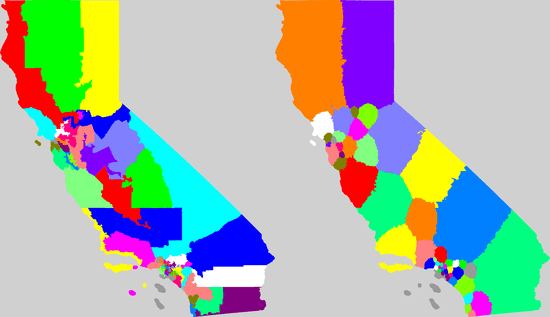
CA_ba

A reader writes:

I disagree with the reader who claims that "there is no way to take the politics out of whatever district boundary decision is made." It becomes possible when you allow a computer to do it automatically without human intervention. Here, for example, is a website that generates new districts from existing schemes. And there are alternatives to having boundaries in the first place, such as multi-member districts and proportional representation (not that I expect any of these to catch on soon in the US!)

Another writes:

I was one of the finalists for the Citizen's Redistricting Commission, and I take issue with your reader's contention that the legislators should be drawing the districts.

That's an inherent conflict of interest; legislators draw districts so as to preserve their own jobs. Oh, they're legislators, so they're accountable? After they've drawn the districts to make voting them out nearly impossible? Please.

I live in the Santa Cruz area of California, where we haven't had a local representative since the last redistricting split up our area. Our current representative lives hundreds of miles away and never even visits the Santa Cruz area. This is representation?

Certainly it's impossible to draw districts to satisfy everyone. There will always be complaints from some group or other that their vote was diluted. But at least the process should be taken out of the hands of people who get a direct financial benefit from how they draw the districts. The people of California seem to agree, as the propositions to expand the power of the redistricting commission won by a huge margin, and the effort to destroy the commission failed by an equal margin.

I think this is an important step towards getting a little more sanity in government, and I hope other states follow suit.

Another:

So while most of the truly ridiculous district shapes are the result of manipulating the demographics of a district, sometimes the reasoning is explicitly political. Case in point: the Pennsylvania 1st, home of Congressman (and City Democratic boss) Bob Brady. The 1st isn't as bizarre as some of the shapes in PA, but one tiny piece, the S-shaped arm just above the "Philadelphia" dot, has a fun story.

As the urban legend goes (and we Philadelphians love our urban legends), that tiny arm of the 1st was added to capture the brownstone mansion of now-incarcerated State Senator Vince Fumo. Apparently, Fumo had toyed with the idea of running for Congress, and his home west of Broad Street would put him up against Rep. Chaka Fattah in the 2nd District. But the powers that be moved the line so Fumo would be in Bob Brady's district to keep him from running.

After all, no one crosses Brady, the Mayor of Capitol Hill.

Another:

As much as I enjoy the Daily Dish, this has been one of the few series of posts in which I am personally vested. I live in CA-24, which is Elton Gallegly's district.  Like the first reader I, too, am pleased by the passage of Prop 20, though I share the latter reader's conclusion that redistricting will be every bit as "political."

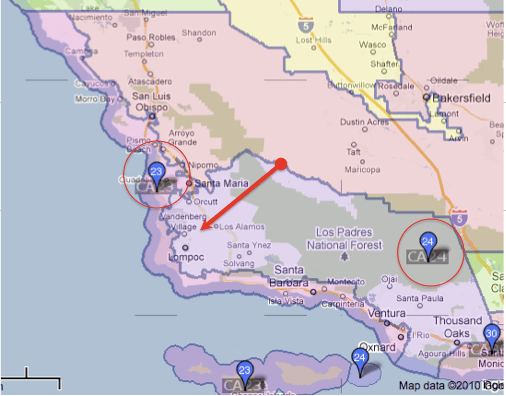
But I take exception to the latter reader's claim that CA-23 (Lois Capps – D) represents a "community of interest."  Your reader is obviously a political scientist, of the "data tells all" variety.  But to borrow your reader's words, "that [claim] is absurd."  The district was transparently gerrymandered to make my district, CA-24, safe for the long-term — and systematically ineffectual — Republican rubber-stamp Elton Gallegly, whose one legislative achievement in 24 years of congressional service was overturned by the Supreme Court. 

CA-23 was drawn to put Oxnard, California (where whites are only 42% of the population and much of the non-white population is rural labor) and Port Hueneme, California (where whites are only 52% of the population) into a district full of upper-middle-class whites: Santa Barbara (75% white), Montecito (94% white), San Luis Obispo (84% white). Conveniently, CA-23 was also drawn to include all of the local 4-year colleges and universities, save one — CA-23 gets UC-Santa Barbara, California State University-Channel Islands, and California Polytechnic, while CA-24 has California Lutheran University.  So the one specifically "Christian" institution of higher learning goes to the safe Republican seat — hardly coincidental, I should think. CA-23 splits the city of Buenaventura (AKA, Ventura) in half, with the "minority" half of the city in CA-23 and the white half in CA-24 (the Republican district).  

Why gerrymander like this?  Isn't it obvious?  The minority/working class vote gets diluted into a district that is heavily white and upper-middle-class, but which is also full of beach community types ("hippies") and college students and faculty (all liberals, of course). That hardly constitutes a "community of interest."

Another reason to gerrymander in this way, of course, would be to avoid foisting on the Republican representative a group of constituents who might have desires or needs that run contrary to Tea Party ideology.

On the other hand, CA-24 was transparently gerrymandered to put all the presumably pro-Republican votes of the military into the safe Republican district, rather than make them "compete" with the more-populous liberal vote of the Santa Barbara coastal communities.

In this area we have four military installations: Vandenberg Air Force Base, Channel Islands Air National Guard Base, and two formerly independent Navy facilitiess, Naval Construction-Battalion Center Port Hueneme and Naval Missile Test Center Point Mugu.  The former is training center of the "Seabees" and the latter is an aerospace testing center which also includes on its ground the Channel Islands Air National Guard base.  Vandenberg AFB is still an independent installation, whereas the other three were all combined into "Naval Base Ventura County" at the last Base Realignment and Closure Commission round.

Like the city of Ventura, Naval Base Ventura County is split between CA-23 and CA-24.  Capps, the Democrat, has in her district the Port Hueneme part of the base, where many of the personnel are trainees at the Naval Construction Training Center  — in other words, transient personnel who will graduate from Seabee training and move on to other assignments.  Personnel who don't vote in California elections.  Personnel in the permanent units assigned to the base, like the Naval Mobile Construction Battalions, live in surrounding parts of the community, the entirety of which is in CA-24, since the city of Port Hueneme itself is only 4 square miles in size.

The Point Mugu/Channel Islands part of the installation, on the other hand, goes to Gallegly, the Republican.  These are "permanent party" military personnel, who live in the community, all of which (again) is in CA-24.  In other words, they are military personnel who do vote in California elections.

Vandenberg Air Force Base, on the other hand, is 102 miles from Port Hueneme, in Lompoc, California, geographically well into the area covered by the Democratic CA-24.   Miraculously, Vandenberg Village is just several hundred yards outside of the easternmost border of the 23rd district, safely in the hands of the Republican:
Screen shot 2010-11-04 at 10.02.38 AM

I don't know if a panel of "civilians" would necessarily ameliorate this situation, but I don't see that it could make it much worse.  CA-23 is proportionally one of the thinnest, smallest congressional districts in the U.S.  Nearly 46% of the registered electorate in this county is Democratic, but we have been "represented" in Congress for two decades by a tenured absentee landlord who speaks only at the Reagan Library and other safe conservative venues, who refuses to debate his opponents, who has for over 20 years waged a Quixotic campaign against "illegal" immigrants, who would lower the bar on death penalty prosecutions nearly to the level of absurdity, and whose most important legislative achievement – banning the sale of sex fetish videos that feature animal cruelty – while well-intentioned was (a) overturned by the Supreme Court and (b) hardly addressed an important issue of the day. Maybe I'm just foolish, but this doesn't feel like "representation" to me.

Thanks for letting me vent.
McGinniss Fights Back On Privacy

Money quote from a lawyer's letter from Joe McGinniss to the Discovery Channel:

It has come to our attention that the first episode (titled “Mamma Grizzly”) of the above referenced television show … contains unauthorized videotaped images of Mr. McGinniss which were obtained without his knowledge or consent… Mr. McGinniss was not asked if any production crew could videotape him as he read a book on the secluded deck of the house he was living in at that time.  He was not aware that any camera crew was in fact videotaping him.  Mr. McGinniss had a reasonable expectation of privacy under those circumstances. 

The mere taking of the video therefore gives rise to an actionable claim for invasion of his privacy.  The publication of the video on your website and in the television show constitutes an additional wrong – the unauthorized use of the likeness of Mr. McGinniss.  Finally, the manner in which Ms. Palin describes Mr. McGinniss in the episode is defamatory: Mr. McGinniss has never invaded the Palins’ privacy, contrary to the many statements made by Ms. Palin and her husband, both prior to this television production, and now repeated in the episode referenced above. 

The Future Of Pot, Ctd

Cowen's response to my last post:

When it comes to marijuana legalization, I believe that the "anti-" forces will muster as many parental votes as they need to, to defeat it when they need to.  The elasticity of supply is nearly infinite at relevant margins.  Legalization may appear "close" for a long time, but in equilibrium it will not spread very far.  The "no" votes will pop up as needed.

McArdle thinks Cowen might have a point:

I'm not saying this happens to every single person who has a kid.  But in my experience, as the kids approach the teenage years, a lot of parents do suddenly realize they aren't that interested in legal marijuana any more, and also, that totally unjust 21-year-old drinking age is probably a very good idea. … Maybe we have reached the high-water mark of this sort of personal liberty.  As the baby boomers age, they will be less interested in directly exercising their right to smoke pot, which means that even if they still support legalization, they will be less motivated on the issue.  Meanwhile, there will be more people in the electorate with young adult children who they worry about–and fewer young adult children. 

Maybe the kids thing explains Josh's discomfort as well. But again, you cannot help but notice the parallels with gay equality. Prop 19 went down because of scared parents; Prop 8 passed because of scared parents. The question is whether the fear is rational. With homosexuality, it's totally irrational. No kid is going to become gay because gay people have civil equality. But more kids will be less hostile to their gay peers and gay kids will have an inking of a better future.
With pot, legalization could mean more teen consumption. But again, the question is: can we control this more with a legal regimen or by allowing the current situation where most teens can easily get pot, but do so from criminals and with no supervision?

The Phone Book And The End Of Privacy

There's a case to be made that it started the trend:

The phone itself was a pretty big deal, of course, helping intimacy transcend proximity. But phone books provided a crucial element to the system: intrusiveness. In the beginning of 1880, Shea writes, there were 30,000 telephone subscribers in the U.S. At the end of the year, that number had grown to 50,000, and because of phone books, each one of them was exposed to the others as never before. While many American cities had been compiling databases of their inhabitants well before the phone was invented, listing names, occupations, and addresses, individuals remained fairly insulated from each other. Contacting someone might require a letter of introduction, a facility for charming butlers or secretaries, a long walk.

Phone books eroded these barriers. They were the first step in our long journey toward the pandemic self-surveillance of Facebook. “Hey strangers!” anyone who appeared in their pages ordained. “Here’s how to reach me whenever you feel like it, even though I have no idea who you are.”