Take a bow, Patrick Ruffini.
Month: November 2010
Why Annie Leibovitz Photos Aren’t That Valuable, Ctd
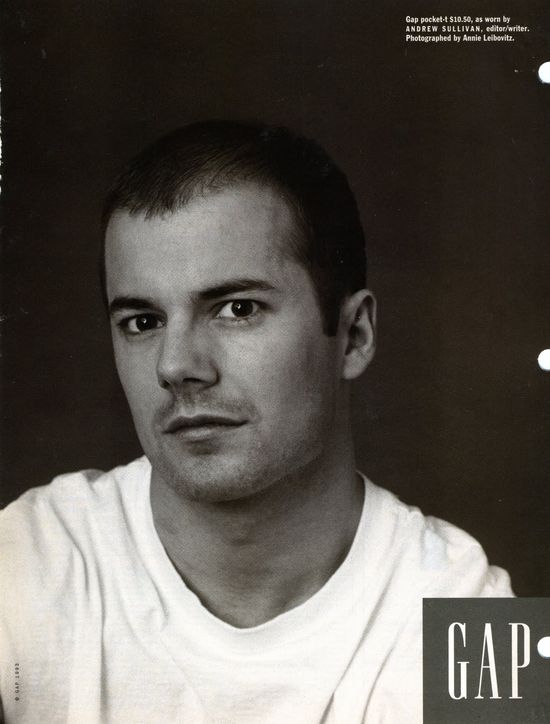
Alas, the Gap photo was scanned by someone, as a reader points out:
Olbermann Suspended From MSNBC
That’s what TPM is hearing, related to this Politico story:
MSNBC host Keith Olbermann made campaign contributions to two Arizona members of Congress and failed Kentucky Senate candidate Jack Conway ahead of Tuesday’s election — a potential violation of NBC ethics policies.
Olbermann, who acknowledged the contributions in a statement to POLITICO, made the maximum legal donations of $2,400 apiece to Conway and to Arizona Reps. Raul Grijalva and Gabrielle Giffords. He donated to the Arizona pair on Oct. 28 — the same day that Grijalva appeared as a guest on Olbermann’s “Countdown” show.
It now seems the suspension is “indefinite.” And official:
“Anyone working for NBC News who takes part in civic or other outside activities may find that these activities jeopardize his or her standing as an impartial journalist because they may create the appearance of a conflict of interest. Such activities may include participation in or contributions to political campaigns or groups that espouse controversial positions. You should report any such potential conflicts in advance to, and obtain prior approval of, the president of NBC News or his designee.”
Olbermann obtained no prior approval.
BP: We’re Sorry
A failing grade for the company in Palin's backyard:
… a new report has declared that BP’s Oil pipeline in Alaska — the Trans-Alaska Pipeline, which leaked large amounts of oil in 2006 and earlier this year — is in many areas more than 80% corroded; in an internal memo it got a “F” grade for maintenance. The report noted 148 pipes in the North Slope of Alaska that are currently under distress and in danger of leaking toxic substances across the pristine Alaskan wilderness.
Why Annie Leibovitz Photos Aren’t That Valuable, Ctd
A reader writes:
I'm surprised you did not mention the marriage equality angle to this story. As I understand it, a significant reason for Leibovitz's financial constraint (and also, perhaps, for her freedom to refrain from playing by the rules of the art world over the last 40 years) was due to her relationship with Susan Sontag. The properties Sontag left to Leibovitz were subject to taxation which caused a cash flow crunch. Had they been able to marry, this would not have been the case.
Another writes:
Andrew, when are you going to post the Leibovitz photos she took of you?
There is just one – the 1992 Gap ad. I haven't had it scanned. I look scarily young and twinky.
Greenwald vs O’Donnell
A TV showdown among Democrats:
Dissents Of The Day
Some remaining thoughts from readers about my back–and–forth with Rick Hertzberg. One writes:
I'm trying hard to make myself radically receptive to your arguments about conservatism, though I myself am instinctively liberal. (Isn't it funny how rarely people admit to the difficulty of dispassionately weighing opposing worldviews?) So help me out by clarifying the following.
Your latest defense of conservatism rests largely on the idea of decentralized social planning, that the messy but iterative wisdom of crowds (effectively harnessed by free markets) is superior to the rationalist but rigid wisdom of the ruling elite. So far I'm with you. Totally. But this where I start to lose the thread:
In general, money = power. The more of their own money people keep the more likely it is that the society will evolve the way its people want it to evolve, and not be coerced by some rationalist in government.
You go on to make some exceptions for coercive market practices ("ensure that the game is not rigged"), but this seems to evade the issue.
We live in a country of increasingly polarized wealth where the top 1%, the top 0.1% and particularly the top 0.01% control staggeringly large amounts of our collective wealth. Notwithstanding the Enrons and CDO scammers of the world, most of this wealth was gained by means both legal and socially sanctioned. Now isn't there a point where the market-based oligarchy achieves a level of control that's functionally indistinguishable from the government stranglehold on GDP? When do "the people" become "persons"? When is the distinction between "rationalists in government" and free-market finance moguls a pedantic distinction?
In so far as those moguls have no more right to enact legislation than you or I do, this extreme wealth does not, it seems to me, directly change other people's lives the way government can. They can spend the money – philanthropy on the Bill Gates model or lots of yachts – but I don't see the extreme success of a few as undermining the argument for conservatism. Even after Citizens United, the Democrats ended up raising and spending as much money as the GOP on the last election cycle. It may be, as I concede, that a conservative would be okay with higher taxes for these folks if social and income inequality seemed to be destabilizing the entire polity. But that's the only reason for a conservative to worry about such conspicuous success; for the most part, a conservative should celebrate it. Another writes:
The more local a vote, the easier it becomes for the majority to hold tyranny over the minority. America is only as free as it is today because, after the civil war, the nation made the restrictions applied to the central government applicable to the states where individual liberty was concerned. Without the incorporation clause of the Fourteenth Amendment, gays would still be imprisoned (or possibly even executed) in the South, and the poor and the non-white would still be denied the right to vote.
Concentrating power in local government is just as dangerous as concentrating it in national government- more so, because in practice abuse of local power is harder, not easier, to correct. How do you vote out a government that violates the rights of a minority when the majority of voters support and endorse those violations?
That's where the judiciary comes in, I think. And my defense of a robust judicial branch pushing back, if necessary, against executive and legislative power is another point where I disagree with today's "conservatism." I want power dispersed; they want the judicial branch's power neutered. Another:
You wrote, "[I]t is … true (and this is where conservatism has gone off the rails in America) that it is the government's task to ensure that the game is not rigged, that private corporations do not gain too much power, that politics is not corrupted in this fashion, and that financial markets are robustly regulated and monopolies vigorously broken up."
This has been a fundamental of American liberalism since FDR. American liberalism is not dogmatic; it is founded on Aristotelian pragmatism. It works outward from reality and empirically seeks what works and what humans actually do. Both socialism and the strange belief of American movement conservatives in market anarchy are Platonic attempts to bend reality and human nature to preconceived ideals.
Socialism, by excising the spark of entrepreneurship from the political economies that have tried it, has always ended in catastrophe. But market anarchy has always failed to achieve full employment, driven down median real income, and blocked the rise of the working class into the middle class. American progressive capitalism, by placing markets under the rule of law, by making prudent public investments in physical and human infrastructure, and by providing a safety net, has created the greatest wealth for the greatest number. American liberalism created the middle class.
American liberals have no affinity for Old Labour. We were always the middle alternative (not the middle ground) between the twin disasters of socialism and market anarchy. Your repeated linkage of American liberalism's success in class mobility to Old Labour's pursuit of class warfare is a mild academic form of McCarthyism.
I'm, not sure you can have "a mild academic form of McCarthyism". But it's certainly true that my Toryism is forged and was forged against much more leftist forces than have prevailed in America. That's why an old Tory like Henry Fairlie so easily turned into a Democrat in the US. And I don't doubt that much of my pragmatic, modern Toryism could easily fit into the current Democratic party, and that it too, certainly in my adulthood, has been largely pragmatic and less ideological than the Republicans (the exception was the under-rated presidency of George HW Bush). I think Obama could easily be a Tory prime minister in many ways (though not of the Thatcherite hue; times change).
My problem is that I don't see a majority among the Democrats truly willing to tackle unaffordable entitlements the way the Tories seem to be in Britain. I don't see any excitement in seeing government pared back to a leaner model. And I don't see any clarity in Democratic goals for government that doesn't easily get overwhelmed by interest group pressure.
We’re Obsessed With American Exceptionalism
Julian Sanchez tries to understand why:
You can think of patriotism as a kind of status socialism—a collectivization of the means of self-esteem production. You don’t have to graduate from an Ivy or make a lot of money to feel proud or special about being an American; you don’t have to do a damn thing but be born here. Cultural valorization of “American-ness” relative to other status markers, then, is a kind of redistribution of psychological capital to those who lack other sources of it.
You can gin up bogus reasons why it might matter from a policy perspective when the president says something that can be construed as “apologizing for America,” or doesn’t engage in a lot of symbolism that’s supposed to signal commitment to “American values”—but none of them have ever made much sense. The conventional take is that it’s really about markers of tribal affinity, but we can go a step further: Maybe it’s more precisely that people want high-status figures to invest in building the brand of their shared identity—a sort of status redistribution as noblese oblige.
Quote For The Day
"You need to drill a little tiny hole there, a peephole, to let me look through and see where he is,"- Todd Sarah Palin, on a reality show about the Palin's life, complaining that Joe McGinnis is invading her privacy.
Sarah Palin also keeps up her meme that somehow moving in next door must mean Joe McGinnis is a pedophile. But it's always others who are wanting "to seek and destroy."
Josh Marshall And The Weed

Josh Marshall confesses that although he despises our drug laws, he probably would have voted against Prop 19:
I just don't know if I think marijuana should be legalized at all. Maybe it's that I'm getting into my 40s. And maybe I'm a hypocrite… But do I think it should be like alcohol? Anyone over 18 or 21 can buy it?
I remember, many years ago, talking to my father about the idea of legalization. And bear in mind, my Dad, God bless him, smoked a decent amount of grass in his day, said he didn't like the idea. One reason is that he was already a bit older by that time. But he had this very contradictory and hard to rationalize position which was that he was fine with people smoking pot but keeping it at least nominally illegal kept public usage in some check. Again, how to rationalize that in traditional civic terms? Not really sure. But frankly, I think I kind of agree.
How to rationalize the irrational? From the post cited, I'd say Reason One is: I'm older. Reason two: er, see Reason one. What Josh seems to be saying is that he wants pot de facto legal but closeted. But like most closets, this one requires a shame that simply isn't there any more – and has not been for decades now. And any illegality is bound to end up hurting the poor and minorities to a disproportionate extent. It's not unenforced. It's enforced brutally upon hundreds of thousands of people. It's okay to sit there mulling how uncomfortable fully legal pot makes you, as long as none of your friends is thrown into jail, or forever barred from employment, or fired for no reason related to work performance. Josh's view reminds me of the argument of those who backed sodomy laws but didn't want them aggressively enforced. They didn't want to throw people in jail, but they wanted the stigma to remain. Yes, stigma. For one kind of pleasure (being stoned) as opposed to another (being drunk).
Of course, Josh is not a libertarian. My view – regardless of the arguments back and forth about the effects of marijuana – is simply that it is absurd for any government to prevent people from growing a naturally-occurring plant that requires no processing to provide humans with pleasure. It's pretty basic, actually. This is a core freedom for human beings and requires an insane apparatus of state control and police power to prevent it from occurring. All you have to do is burn a plant and inhale the smoke. If humans are not free to do this in the natural world in which they were born, what on earth are they free to do? My premise is freedom; Josh's is not.
Should we ban roses because they give us pleasure with their beauty and their scent? Should we ban herbs, like rosemary or thyme, because they give us pleasure and encourage us to eat more? Should we ban lawn-grass because maintaining it consumes too many people's weekend afternoons? Should we cut down trees because the beauty of them can sometimes distract someone from the road? I could go on.
The point is the government has no business regulating how its citizens derive pleasure from a naturally occurring plant. Period. The whole idea is preposterous. And yet it is taken for granted.
(Photo: U.S. Marines from India Battery, 3rd Battalion, 12th Marine Regiment patrol through a marijuana field in a village near Forward Operating Base (FOB) Zeebrugge on October 10, 2010 near Kajaki, Afghanistan. Yes, that soldier appears to be smiling. By Scott Olson/Getty Images)
 The Dish