Lincoln vs Limbaugh, Ctd

Limbaugh asked who on earth came up with the idea of progressive taxation? In America, Lincoln established it. In theory, Adam Smith proposed it, as several readers have noted:

"It is not very unreasonable that the rich should contribute to the public expence, not only in proportion to their revenue, but something more than in proportion."

I'm sympathetic to Limbaugh's general argument – although I believe the debt and alarming inequality should temper one's preferences in this respect in the current circumstances. But it tells you something about today's "conservatism" that it is fiercely opposed to both Abraham Lincoln and Adam Smith on taxation and Friedrich von Hayek on universal health insurance.

The 2012 Race

Two polls find Romney, Huckabee, and Palin in a dead heat. James Joyner sizes up the candidates:

My gut tells me that Romney is the frontrunner and Palin the strongest challenger.  I can’t [imagine] Huckabee beating Palin, although he has a track record of hanging around long after his defeat is inevitable and could serve as a spoiler.  Gingrich has way too much baggage.

My hope is that someone who didn’t run in 2012 — a governor like Gary Johnson, maybe — emerges.   But it’s going to be difficult because this race will get started quickly and the winner will need enough money to choke a horse.

I suppose there’s always Marco Rubio — he’ll be more experienced than Obama was in 2008 and he’s got a huge fan base and boatloads of charisma.   But I suspect he’ll wait a little longer.

The Future Of Pot, Ctd

Contra Drum, Tyler Cowen is pessimistic

I don't see marijuana climbing the legalization hill, if it can't make it through current-day California. We're seeing the high water mark for pot, as aging demographics do not favor the idea. 

That assumes that today's younger anti-prohibition generation will get pro-prohibition as they age. But is that true? Maybe having kids changes things, but my experience of ageing boomers is that they're not anti-pot at all. Here's Ilya Somin on the question:

My tentative conclusion is that it's probably more of a generational effect. This is not just a difference between the very young and the rest. Rather, each successive age group is much more pro-legalization than those older than them. Even 50–64 year olds were 12 points more favorable to Prop 19 than the over-65s. Moreover, much social science data suggests that political attitudes tend to be fairly consistent with age, solidifying for most people when they are in their twenties. Winston Churchill notwithstanding, if you were a socialist at twenty, that implies a high probability you will still be one at forty. In addition, an important recent study suggests that the elderly actually become more socially liberal as they age, not less so.

Lincoln vs Limbaugh

In a monologue on the Bush tax cuts, the talk radio host mused:

Looked at within the prism of liberty and freedom, as our founding documents spell out, the Declaration, the Constitution, in nowhere in any of our founding documents was it ever said that people earning X would be punished for it.  It was never said in our founding documents that people earning X would share a greater burden of funding the government than people who didn't.  Where does all this talk start?

The answer is that it started with Abraham Lincoln, and the Congress that helped him to defeat the Confederacy:

When the Civil War erupted, the Congress passed the Revenue Act of 1861, which restored earlier excises taxes and imposed a tax on personal incomes. The income tax was levied at 3 percent on all incomes higher than $800 a year. This tax on personal income was a new direction for a Federal tax system based mainly on excise taxes and customs duties. Certain inadequacies of the income tax were quickly acknowledged by Congress and thus none was collected until the following year…

On July 1, 1862 the Congress passed new excise taxes on such items as playing cards, gunpowder, feathers, telegrams, iron, leather, pianos, yachts, billiard tables, drugs, patent medicines, and whiskey… The 1862 law also made important reforms to the Federal income tax that presaged important features of the current tax. For example, a two-tiered rate structure was enacted, with taxable incomes up to $10,000 taxed at a 3 percent rate and higher incomes taxed at 5 percent. A standard deduction of $600 was enacted and a variety of deductions were permitted for such things as rental housing, repairs, losses, and other taxes paid. In addition, to assure timely collection, taxes were "withheld at the source" by employers.
Quote For The Day II

"My feeling about Don't Ask, Don't Tell was, in the middle of the height of the Iraq war, not a good time to do it. We're not in the middle of the height of the Iraq war. Afghanistan is a different kind of thing. You could probably accomplish it now. It's eventually going to happen and it seems to me that it gets my party out of this anti-gay, feeling that we're being unfair to people who are gay," – Rudy Giuliani.

We'll have, as I noted, a really great test for what exactly the rebranded GOP now is when it comes to this issue next month. I suspect Rudy is isolated – and the new Congress will be the most socially conservative and anti-gay in modern times. But I'd love to be proven wrong. And Rudy is right, I think, that it would be a very good move for the GOP to embrace this popular decision. Alas, I don't think they can – because of the very base that got them elected.

We’ll Cut Spending After 2012 …

Ari Fleischer doesn't want the conservative wave to crest any time, you know, soon:

"If Republicans push too hard, we may blow our chances to actually reform entitlements and meaningfully roll back the size of government after the 2012 elections."

Until then, expect a meaningless roll-back of the size of government.

The Unstoppable Bristol Palin

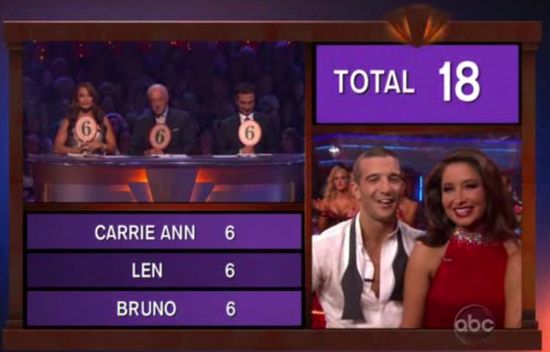
Bristol-palin-scores-a-6-6-6-on-dancing-with-the--13138-1285107177-41

A reader writes:

I'm not a huge fan of Dancing With The Stars, but I've been watching it regularly this season … and have been stunned at the results on a weekly basis. Bristol Palin gives a lot of effort, but she is a terrible dancer. Clearly the worst of the whole lot; it's not even close. I know that in the past, this can work to your advantage for a few weeks. After all, this show is a popularity contest. But week after week, Bristol ends up in the bottom of the judging and nevertheless continues to get tons of votes. Care to guess who's doing the voting? People like my in-laws, who think she's "adorable" and "trying so hard, just like her mother."

This is what scares me.

You may think I am being trite and that this is just a silly TV show, but I truly think it's a microcosm of the 2012 election season. For Bristol, it doesn't really matter that she can't dance. The point is, her fans adore her. They don't care that she's a walking contradiction – an unwed mother who now flaunts her "abstinence" all over the country for $15,000 dollars per speaking engagement. They just know that they "like" her and, more importantly, they love her mother.

These people don't seem to care that they are being fooled by Sarah. They don't seem to care that their heroine doesn't read books, know policy, or practice rational thinking. They don't seem to care that she is little more than a vindictive, petty, hypocritical Queen Bee with a paranoid streak. All they know is that she's "trying so hard" and she's "just like them." Bristol Palin is Sarah Palin.

And each week, far more qualified dancers get voted off the island. Sure, they are technically proficient, terrific athletes, and talented artists. But they can't keep up with Bristol and her two left feet. This show stopped being about dancing a long, long time ago. Now it's about image. It's about power. And it's about who our next president could be.