Common Ground?

Obama has mentioned education policy as potentially fertile ground for bipartisanship. Dana Goldstein gives it some serious thought:

[T]here are plenty of obstacles that could prevent education from becoming a bipartisan issue in 2011. But if there is cooperation, it will likely be around issues of teacher accountability and school choice, with President Obama potentially using private school vouchers as a bargaining chip in order to earn some Republican buy-in on tougher curriculum standards or spending on public charter schools.

Scalia 1, Ginsburg 0, Ctd

A reader writes:

The item you pulled from Volokh's blog was mislabeled. Ginsburg and Scalia were on the same side of the argument – equally skeptical of the censorship of video games. Ginsburg put the puck in front of the net, and Scalia fired a slapshot for the goal. Credit Ginsburg for the assist.

Another writes:

Volokh's post doesn't give any context for the quote, but Dahlia Lithwick's piece does (and this LA Times piece gives a good synopsis of the odd alliances this case has brought out). It's a good zing, but let's be clear: Scalia said the same thing Ginsburg was getting at, but got there faster.

The Other Big Prop In California, Ctd

Screen shot 2010-11-03 at 4.44.13 PM

A reader writes:

Regarding the post of your reader’s comments on Prop 20, I would respectfully say the reader’s logic is flawed. Boiling the argument down, the reader cheers the passage of Prop 20 saying, “hopefully, this will take the politics out of the process, at least somewhat, and I can have an actual representative for the first time in 16 years.” For starters, there is no way to draw district boundaries in a way that “takes the politics out of the process.”  All Prop 20 does is to hand this inherently political process off to a different group of people … a group of people that are not in any way directly accountable for their actions in contrast with legislators (who are).

As for the claim that your readers has not had “an actual representative,” that is absurd.

This person has been represented and their member of Congress has been quite in step with the majority of voters in that district.  The notion that people are disenfranchised or not represented by the members in their gerrymandered districts is simply not true.  Are district boundaries drawn in odd shapes so as to give one party or another an advantage?  Yes.  But it is also true that another one of the key reasons we have so many “deep red” and “deep blue” districts (see Bruce Oppenheimer’s work on this) is that Democrats live near other Democrats and Republicans live near other Republicans for a variety of demographic reasons that are not too hard to figure out.

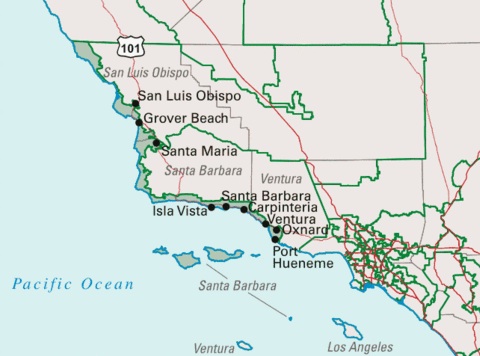
The commenter’s district, the 33rd congressional district, is not even one of the more bizarre shapes.  Take a look at CA-23 (Lois Capps’s district).  It has frequently been referred to as the “ribbon of shame,” a long, skinny coastal district on the Central Coast.  But does this district represent a “community of interest?”  Sure.  You could argue (quite reasonably) that people in southern part of the 23rd district have more in common with people in the northern part of that district (very far away) than they do with people 10 miles to their east.  That’s not a crazy argument to make.

The point is there is no way to take the politics out of whatever district boundary decision is made.  It will always be “political.”  Indeed, the problem with voters in California is they too often try to “take the politics” out of things that are inherently political.  And we just tie ourselves in knots in all sorts of insane ways.  Given that, I’d just as soon have my elected representatives (who are accountable at the ballot box) making these decisions.

Another writes:

Like your reader, I live in CA-33, except I'm in Yoshi's tail. I would guess your reader in Yoshi's head is about an hour away from me. He or she neglected to mention that since we're taken for granted as safe liberals, Diane Watson never had to campaign. I've been in her district for 10 years and never heard from her about anything. Same with Karen Bass. Why waste the effort? As a result, her opponent was the only Republican I voted for yesterday – just in protest.

Another:

Florida had two propositions regarding districting, one for Congressional seats, and one for the state legislature. Both passed. I don't think they were as well thought out as California Prop 20, but hopefully they'll be useful.

Following The Money

Steve Pizer and Austin Frakt don't think the Republicans will repeal healthcare:

When the new Republican House majority starts legislating on health care, they will be more concerned with what the relevant interest groups want. The insurance industry, hospitals, and drug companies want looser regulation and lower taxes. That is, the big players want what they always want–more control over implementation and establishment of favorable regulations–even if it’s at the expense of a more efficient health system for the rest of us. But they also want the mandate, which can’t work without the subsidies and insurance reforms.

Election Wrap

2010map

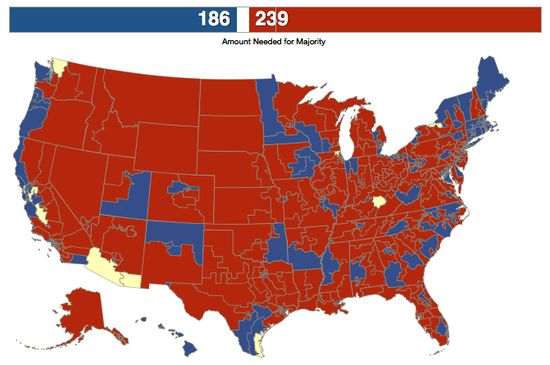
Andrew live-blogged the bloodbath. Rolling coverage of incoming results here, here, here, here, and here. Silver waged war on Rasmussen, and a hefty collection of projections to refudiate are here, here, here, and here. Highlights included O'Donnell's loss and and Alaska humiliating Palin. Yglesias and Karl Smith assessed Palin's 2012 prospects, and Douthat and Andrew joined the chorus for not nominating lunatics. Batty Paladino went down like Al Capone, the base believed Obama doesn't dress "properly," and Packer predicted the next two years won't be pretty.

Some readers dissented over Prop 19 and some defended it, even as it crashed and burnedthanks to the generation gap. We tracked the full reax to its official death, with readers weighing in, and kept an eye on the other state pot initiatives. Jacob Sullum remained positive that Prop 19 helped prove the intellectual bankruptcy of prohibition (elsewhere, San Francisco banned the happy meal).

On the analysis front, Andrew demanded some form of actual GOP proposals on spending cuts, and Tim Rutten wondered if the Republicans would fold on the debt when push comes to shove. Andrew praised Obama's pragmatism, while seniors stood in the way of Medicare cuts. Brendan Nyhan didn't put much weight on the mythical permanent majority, Andrew argued it was actually a great night for gays (just not the Republican ones or the Iowan judges). Working off of Douthat, Chait and Andrew nailed the difference between winning in policy and winning in politics. 

Frum fisked Boehner and McConnell for their second-hand radicalism, Douthat reminded the GOP to at least try to pass some laws, and Wilkinson seconded Brennan's advice on voting well or not voting at all. Ambinder looked to future legislation, Saletan singled out Boehner's lack of agenda, and the rest of Speaker Boehner reax is here. Meanwhile, the GOP geared up for hearings on the "scientific fraud" behind global warming, and Kinsley mocked Americans for wanting their fat-free chocolate cake politics. Judis asked if we're now Japan, while a first former Real World cast member was elected. Steven Taylor wanted to know what would have to happen to prove the Tea Party's influence on the GOP and Boris Shor fingered the moderate Republicans in the wave. Ackerman eyed McCain's newly elected hawks, and the congressional elections impacted the drumming war machine against Iran. McWhorter gushed over Marco Rubio, and Angle turns out to have mobilized the Hispanic vote. A reader reported on the other big prop in California, redistricting updates here, and readers reactions to the election here.

FOTD here, VFYWs here and here, chart of the day here, and MHB here.

— Z.P.

(Map from TPM)
The Difference

Chait captures it:

If Douthat is correct about his political premises, both parties had to choose between politics and policy. Democrats could have minimized their losses at the cost of sacrificing the health reform they wanted. Or Republicans could have minimized the scope of health care reform, at the cost of minimizing their potential wave. Democrats chose the best policy, and Republicans chose the best politics. I'm happy with the choice. Mitch McConnell won his election, and Democrats won health care reform. The latter is going to [be] around a lot longer than the former.

I supported Obama precisely because he was about policy more than politics. And his calm reason today was another reason. In the end, I believe policy achievement matters. And that the GOP's greatest problem right now is that they have lost interest in policy – hence their running on ideological abstractions rather than actual proposals. But if the American people reward this, it will keep on happening. And the Morris-Rove era will never end.

Did Prop 19 Change Anything?

MarijuanaJoeRaedleGettyImages

Jacob Sullum believes it did, in a way:

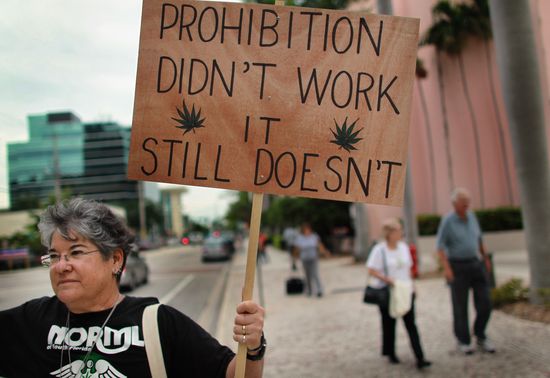
The debate over Prop. 19, which received a great deal of national attention by virtue of California's size and significance, has highlighted the intellectual bankruptcy of the prohibitionist position in a way that nothing in recent memory has. Drug warriors were (or should have been) highly motivated to defeat the initiative because of the precedent it would set for drug policy federalism. Yet their arguments were embarrassingly bad. Really, really, really, really, really bad. This weakness, together with the growing influence of age cohorts in which a history of marijuana use is the norm, is reflected in rising public support for legalization, which a Gallup poll last week put at 46 percent—a new high in that organization's surveys. By contrast, a Gallup poll in 1977, a time that is remembered as relatively pot-tolerant compared to the Just Say No era that followed it, found that only 28 percent of Americans favored legalization.

(Image: Joe Raedle/Getty Images)

The Anti-Gay Backlash In Iowa

Doug Mataconis is unsettled by it:

At some level, it strikes me as inappropriate for a judge to be removed for office based solely on the fact that some segment of the public doesn’t agree with a single decision that they made.  When a court is acting in its role as the protector of minority rights, it’s inevitable that the majority isn’t going to like it. The idea that they would then be able to turn around, oust that Judge, and replace him with someone who would rule the other way does serious damage to the entire notion of individual and minority rights. This is the reason, in the end, that an independent judiciary is a good thing, and it strikes me as a bad thing that we could be entering an era when judges at the state level would be subject to the whims of a vocal political group.

The Slow Exit

GlassesAhmadalRubayeAFPGettyImages

Bernstein notes:

I haven't seen any coverage of this yet, but pending any late news it appears that fewer American troops died in Iraq in … [October] — two — then in any previous month since the war began.  There was a lot of skeptical commentary about the end of combat operations a couple months ago, and casualties spiked up a bit in September, but the trend line is clearly down (sixteen American deaths over the last four months, also a new low, compared with 29 the previous four months or 34 for July – October 2009).  It's a big deal, and I think underreported, that Barack Obama has stayed on course with withdrawal regardless of what's happening at any particular moment.

Civilian casualties, however, are on the rise again. But Obama is going to get out; and my firm suspicion is that he will be as determined in removing troops from Afghanistan in the last year of his first term.

(Image: Blood-stained glasses are seen at the priest's room in the Sayidat al-Nejat Catholic Cathedral, or Syrian Catholic Church, in central Baghdad on November 3, 2010 after US and Iraqi forces stormed on October 31 the cathedral to free dozens of hostages in an attack claimed by Al-Qaeda gunmen and in which 46 worshippers were killed. By Ahmad al-Rubaye /AFP/Getty Images)

Straight Cruising

Contra Stephen Fry, a reader points to the fairly widespread practice of "dogging" among heterosexual Brits:

Puttenham, about an hour’s drive from London, has fewer than 2,500 residents and is famous for its ancient church; its friendly pub, the Good Intent; and its proud inclusion in both the Domesday Book — an 11th-century survey of English lands — and “Brave New World.” Unhappily for many people here, it is also famous for being featured on lists of good places to go “dogging” — that is, to have sex in public, sometimes with partners you have just met online, so that others can watch. So popular is the woodsy field below the ridge as a spot for gay sex (mostly during the day) and heterosexual sex (mostly at night) that the police have designated it a “public sex environment.”

Public sex is a popular — and quasi-legal — activity in Britain, according to the authorities and to the large number of Web sites that promote it. (It is treated as a crime only if someone witnesses it, is offended and is willing to make a formal complaint.) And the police tend to tread lightly in public sex environments, in part because of the bitter legacy of the time when gay sex was illegal and closeted men having anonymous sex in places like public bathrooms were routinely arrested and humiliated.

There are more than 100 dogging spots in Surrey alone. Somehow, I have a feeling it isn't Mykonos.