Silver vs Rasmussen

Ouch:

Rasmussen polls quite consistently turned out to overstate the standing of Republicans tonight. Of the roughly 100 polls released by Rasmussen or its subsidiary Pulse Opinion Research in the final 21 days of the campaign, roughly 70 to 75 percent overestimated the performance of Republican candidates, and on average they were biased against Democrats by 3 to 4 points.

That's why I remove them from any summary of the poll of polls. Rasmussen's response:

"I don't respond to comments from bloggers or others."

Their Palin Problem

Yglesias spells it out:

Palin isn’t the most formidable candidate out there, and in a very close election her flaws could easily deny the GOP the White House. And very close elections do happen—think how important the 2000 presidential election was in retrospect. But most elections aren’t that close, and if the fundamentals are strongly against Obama—which they may be—Palin will beat him.

I think the dirty secret of conservative Palin skeptics is that they think Sarah Palin would be a bad president.

She would also be terrible for down ticket races; Republican congressmen and senators should keep that in mind. Karl Smith expands on Yglesias's thought:

By my reading what has happened is that the conservative movement has outsourced its elitism to the media. Rather than simply say “This woman is unqualified and we will not support her” they say she’s unelectable and that the media will trounce her.

McCain Versus Obama, Round Two

Ackerman looks ahead:

[I]f ever John McCain … wanted to wage a fight against the administration’s plans to start pulling troops out of Afghanistan in July 2011, the new Republicans in the Senate are likely to have his back. (Well, maybe not incoming Kentucky Senator Rand Paul, a war skeptic.) The future course of the war is likely to be the first major defense battleground between Obama and the expanded GOP minority in the Senate. And it’s definitely not going to be the last.

If the battle is between those who want to continue the decade-old war in Afghanistan versus those who want to wrap it up, I think McCain will be over-playing his hand. Especially if, by that time, even Washington cannot keep up its pretense about the success of the surge in Iraq (where, by the way, a wave of sectarian bombings just occurred).

The Cutting Edge Of Brain Research

It's owed in larger part than you'd think to one specimen:

When a surgeon cut into Henry Molaison's skull to treat him for epilepsy, he inadvertently created the most important brain-research subject of our time — a man who could no longer remember, who taught us everything we know about memory. Six decades later, another daring researcher is cutting into Henry's brain. Another revolution in brain science is about to begin.

It's a long read that's worth your while.

Moderates In The Wave?

Before the election, Boris Shor named 14 Republican candidates running in liberal districts. He expected that "these candidates–once they win—to magically accumulate moderate and liberal voting records once they realize the next election is only two years away, in rather dangerous territory":

I’ve already written a bit about Scott Brown. My prediction after his election but before his arrival in Washington was that Brown, based on his voting record in the Massachusetts state legislature, would prove to be one of the most liberal Republicans in the US Senate, for which I was vilified a bit online. Now that we have nearly a year’s worth of votes behind us, I feel pretty good about that prediction. My estimate of Brown’s ideology—using our NPAT common space data–is that he is the third most liberal Republican in the Senate, just behind Olympia Snowe and Susan Collins of Maine.

Of 2010 candidates listed by Shor, seven have won: Charlie Bass, Joe HeckRandy HultgrenLou BarlettaBobby SchillingPat Meehan and Sean Duffy. And two races were too close to call last time we looked: Ruth McClung and Andy Vidak. What's the Republican equivalent of a Blue Dog Democrat?

The Other Big Prop In California

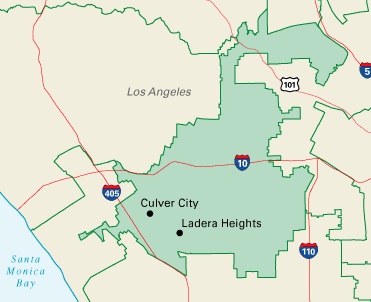
Screen shot 2010-11-03 at 12.04.08 PM

A reader writes:

Lost in the shuffle of Prop 19's failure was the passage, by a 61% majority, of Prop 20, regarding the redistricting of Congressional districts. Like most states, California's legislature has done redistricting every 10 years, and whatever party is in power in Sacramento carves out absurd districts to protect favored members from ever seeing a competitive election. I live in CA-33, the ridiculous map of which you can see above.

I think it sort of looks like the Nintendo character Yoshi. I live up in Yoshi's head up north. The upshot of that is that in a densely populated city, I live over a half hour from my member's office, just so Diane Watson (and now Karen Bass) never had to be in a real race. Before that, we were attached to Howard Berman's district (his office in Panorama City was also over a half hour away), so he could cruise to victory every 2 years.

In any event, the passed initiative constitutional amendment will take the power to redistrict away from the legislators and give it to a redistricting commission which is made up of 5 Dems, 5 Reps and 4 of neither party. Everything has to be approved by at least 3 Dems, 3 Reps, and 3 none-of-the-aboves. I am concerned about the power given to the none-of-the-aboves in that arrangement, but hopefully, this will take the politics out of the process, at least somewhat, and I can have an actual representative for the first time in 16 years. Likely the result will be a few less Dems in the California delegation, but I think that overall, the delegation will become more moderate over time.

In districts like mine, my member is much more likely to see a serious challenge from her left than from the Republicans, so there is no penalty for extreme behavior and rhetoric. The end result is a House of Representatives where members are so out of touch that they actually think that John Boehner and Nancy Pelosi are good spokesmen for their parties.

Maybe other states will follow and we will stop electing the most extreme elements of both parties to the House.

Scalia 1, Ginsburg 0

Via Eugene Volokh, a priceless exchange during oral arguments on the case about regulating violent video games:

JUSTICE GINSBURG: Is there — you’ve been asked questions about the vagueness of this and the problem for the seller to know what’s good and what’s bad. California — does California have any kind of an advisory opinion, an office that will view these videos and say, yes, this belongs in this, what did you call it, deviant violence, and this one is just violent but not deviant? Is there — is there any kind of opinion that the — that the seller can get to know which games can be sold to minors and which ones can’t?

MR. MORAZZINI: Not that I’m aware of, Justice Ginsburg.

JUSTICE SCALIA: You should consider creating such a one. You might call it the California office of censorship. It would judge each of these videos one by one. That would be very nice.

The Base’s Voice, Ctd

A reader writes:

"He doesn't dress properly?" Not positive, but I'm pretty sure she's refering to a canard from just after Obama's inauguration that he doesn't require jackets in the Oval Office (it turned out that most presidents have gone casual).  You covered this, though it's so silly that I forgive you for not wasting brain cells remembering it.